



A version of this story appeared in the daily Threat Status newsletter from The Washington Times. Click here to receive Threat Status delivered directly to your inbox each weekday.
OPINION:
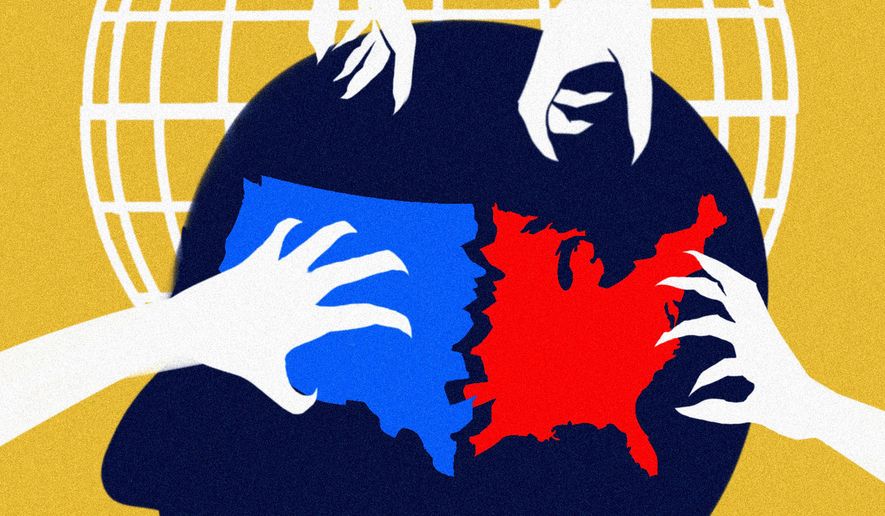
The U.S. is spending billions of dollars to degrade Iran’s military. Iran is spending a fraction of that to degrade America’s society using social media platforms as a force multiplier.
America must defend itself by ensuring proper transparency on the source and authenticity of social media accounts.
Social media promised a marketplace of ideas. In theory, open exchange would produce better discourse and greater transparency, but human psychology intervened. We are wired to respond to repetition, emotionally charged content and messages that affirm our prior beliefs.
Foreign malign actors understand this. They do not need to persuade Americans of a coherent ideology; they simply need to amplify the most divisive voices on all sides, push extremes further outward and erode trust in shared institutions.
Fake foreign-run bots posing as Americans and coordinated paid accounts flood the zone, artificially magnifying inflammatory content. The goal is not debate. It is destabilization.
A Clemson University study published in March documented such an operation in real time. At least 62 Islamic Revolutionary Guard Corps-affiliated accounts posing as Americans in Texas and California flooded social media with a unified false message: that U.S. strikes on Iran were a betrayal of American voters, done at Israel’s behest.
The campaign resulted in nearly 60,000 posts, potentially reaching millions of users, and enabled the accounts to “gain meaningful influence” over time.
That same month, the Office of the Director of National Intelligence warned of “gray-zone tactics” by state actors, including disinformation and other influence campaigns, amid an increasingly complex global security backdrop.
The platforms, whether intentionally or not, reward the strategy. Their revenue depends on engagement: clicks, shares, impressions and time on site. Content that enrages spreads faster than content that informs.
Algorithms do not distinguish between civic contributions and coordinated manipulation by U.S. adversaries. They optimize for attention. The result is a feedback loop that brings fringe narratives into the mainstream and, ultimately, sows national division.
The risks are not just to our national security. They are also commercial.
The issue is not what people are allowed to say; it is whether users and advertisers know who is speaking and how much of the apparent public reaction is real.
A substantial portion of social media revenue comes from advertisers. Advertisers believe they are paying to reach human beings, but those impressions, likes, shares and followers are being materially inflated by automated or foreign-controlled accounts.
Some initial reforms deserve acknowledgment. Efforts to label state-affiliated media accounts and introduce greater transparency around algorithms are steps in the right direction, but they are not nearly sufficient to address the scale of the threat.
The Federal Trade Commission should step in — not to regulate speech but to enforce transparency. This is squarely within the FTC’s Section 5 mandate against deceptive practices. If companies monetize artificial engagement without clear disclosure, then advertisers and consumers are being misled.
Platforms should be required to disclose what percentage of their accounts are verified human users. These platforms should also provide meaningful transparency regarding the geographic origin of political content.
Users should have a clear context when accounts operate from foreign jurisdictions.
Finally, economic incentives must change. As long as algorithms reward raw engagement above all else, outrage will outperform reason and manipulation will outperform authenticity. Platforms should prioritize verified human interaction and de-emphasize automated amplification.
When bots lose their leverage, foreign adversaries lose one of their cheapest and most effective tools.
None of these reforms silences Americans, nor does any of them outlaw extreme views. A solution must begin by reaffirming a core American principle: Freedom of speech is sacrosanct. The answer to manipulation is not censorship. The cure must not be worse than the disease.
However, defending free speech does not require tolerating deception.
• Sander Gerber is the founder and CEO of Hudson Bay Capital and a member of the President’s Intelligence Advisory Board. All views expressed are his own. Shawn Chenoweth is the director of Cognitive Advantage at the National Security Council. All views expressed are his own.

Please read our comment policy before commenting.