



OPINION:
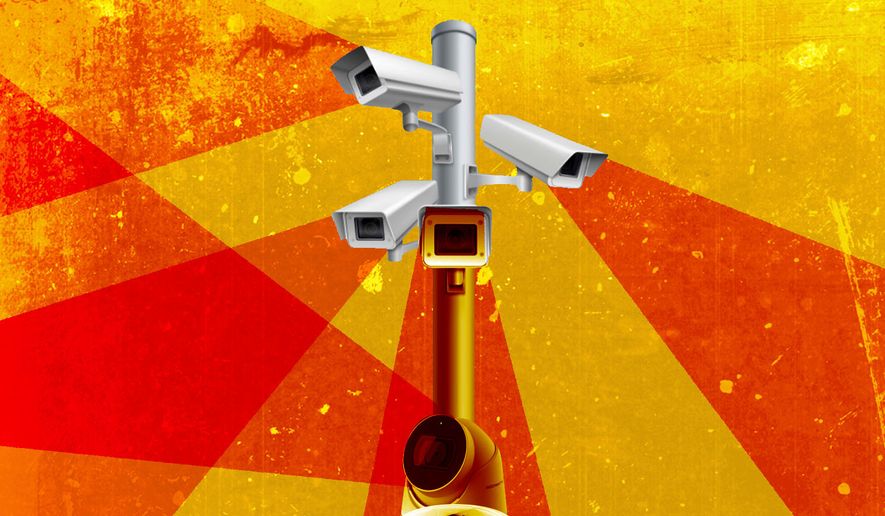
Some recent legal challenges to the Department of Homeland Security’s surveillance of Americans have revealed truly terrifying behavior by the government, in direct defiance of the Fourth Amendment to the Constitution.
We now know that the federal government spies on innocent Americans without suspicion and without warrants.
The spying seems to fall into several categories. The National Security Agency, which is in the Department of Defense, employs about 60,000 domestic spies. These are the folks who want us to believe that they go through the trouble of making applications to the Foreign Intelligence Surveillance Court for warrants to spy on foreigners.
People were interested in these podcasts
Actually, from time to time, they do go to this court, but their travels there — where judges are frisked upon entering and leaving the courthouse by the NSA agents who appear before them — serve as fig leaves for their massive warrantless spying on Americans.
The FISA Court is unconstitutional because it issues warrants based on probable cause to communicate with a foreign person, rather than probable cause of a crime as the Fourth Amendment requires.
The courts have consistently ruled since the 1960s that spying — surveillance, as the feds call it — is a search, and the capture of data from surveillance is a seizure.
The Fourth Amendment protects all persons in America — not just Americans — from warrantless searches and seizures of their “persons, houses, papers, and effects.” There are some well-recognized exceptions to this constitutional baseline, such as evidence that will quickly vanish or be seriously degraded, but those exceptions do not apply here, as the NSA captures in real time all keystrokes on all digital devices and all fiber optic data transmitted into, out of and within the United States.
The judges of the FISA Court surely know that the Department of Justice lawyers and NSA agents who appear before them are going through a charade, and the court has been made a part of it. The charade is the pretense that all spying is conducted pursuant to warrants issued by FISA Court judges. Former NSA agents have revealed publicly that this is hardly the case.
Nevertheless, the lowered standard from probable cause of crime to probable cause of communicating to a foreign person was crafted by Congress — in another of its many moments heedless of the Constitution.
After a few years of this, the FISA Court began to issue warrants for spying on Americans who communicate with foreigners, up to the sixth degree. A sixth-grader can do the math, as this means hundreds of millions of Americans have their communications captured.
A second category of spying is employed by the DHS. The DHS — now a 250,000-person strong federal police department nowhere countenanced by the Constitution — has sophisticated software that can read fingerprints at 15 feet and irises at 15 inches.
So if you wave goodbye or good riddance to an Immigration and Customs Enforcement (ICE) agent and he holds up his mobile phone and you are in the federal system for any benign reason, he has captured your bank, health, legal and commercial records on the spot.
If he talks to you in your car and is within 15 inches of your face, he can capture the same data.
As if all this were not enough, the feds and local police use a device called a Stingray that mimics the signal sent to all mobile devices, as if the device were being used to communicate. But the communication is one-way, as the Stingray will tell the government where the person with the mobile device is at any given moment.
This too is a seizure of private personal information — the contents of the computer chip in your mobile device — which the Fourth Amendment characterizes as an “effect.”
And then there is the FBI, which now uses zero-click software. This permits agents without warrants or their superiors’ approval to engage in computer hacking without tricking the victim into clicking a link. Computer hacking is a felony.
All of this surveillance is unconstitutional, dangerous and commonplace. It consists of the use of surveillance and law enforcement tools without articulable suspicion.
For 600 years, articulable suspicion — the lowest evidentiary standard we have — has been the baseline for all government behavior that targets an individual. Articulable suspicion is the fact-based ability to state why a person — not a group — should be targeted and for what crime. This is the same standard that must be met when police stop someone in public.
Anything less than an articulable suspicion is a fishing expedition; stated differently, a general warrant. General warrants — which were used by British agents against American colonists — permitted agents to stop anyone, search anywhere and seize anything without articulable suspicion. The Fourth Amendment outlawed them.
How did we get from a Constitution that assumes that the individual is sovereign, our rights are natural and inalienable, and the government may only legally do what the governed have affirmatively authorized it to do, to where we are today? The answer is fear.
Fear is the great tool for authoritarians — fear of foreigners, fear of war, fear of crime, fear of drugs, fear of terror. When people are afraid, they will allow the government to take liberty in return for a promise of safety.
Of course, liberty once surrendered is never returned. But liberty is individual, not collective. You can surrender your liberty and your neighbors can surrender theirs, but none of you can surrender mine.
These values are what animated Thomas Jefferson in the Declaration and James Madison in the Bill of Rights. Those animations seem like ancient history today. On the eve of America’s 250th anniversary, the Founders would not recognize this country of no values where everyone is a suspect.
• To learn more about Judge Andrew Napolitano, visit https://JudgeNap.com.
Follow the author

Please read our comment policy before commenting.