



OPINION:
I cast my ballot in the 2016 elections from thousands of miles away.
Though I was a young U.S. Army lieutenant on a deployment to Ukraine, I made a point of voting. I believed then, as I believe now, that an oath to “support and defend the Constitution of the United States” includes taking part in the republic itself.
Unfortunately, fewer service members are doing the same today. More than 300,000 of them were not registered to vote in the 2024 elections.
People were interested in these podcasts
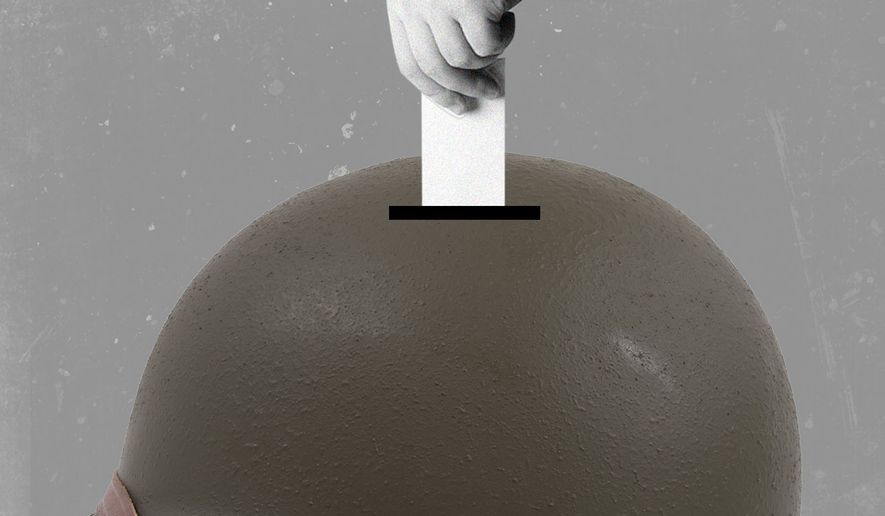
Last month, Defense Secretary Pete Hegseth ordered a one-day “stand-down” across the military so that troops could register to vote and request absentee ballots. Commanders had until Oct. 15 to hold the stand-down, and the order makes it a regular part of every election year going forward.
Mr. Hegseth made what should have been an uncontroversial promise to the force: “We’re not telling you who to vote for, but we will give you every opportunity to do so.”
Apparently, however, encouraging troops to participate as citizens was a bridge too far for some.
In an X post in response, Donna Brazile, former interim chair of the Democratic National Committee, called Mr. Hegseth “incredibly unethical.” The New Republic went even further, describing Mr. Hegseth’s message as a “veiled order” to vote for Republicans. The Daily Beast framed the stand-down as a “desperate plot to save Trump’s skin.”
The only way to read a partisan scheme into the order is to assume that you already know how soldiers will vote, and to prefer that fewer of them do. If we keep the status quo, that is exactly what will happen.
Only 67% of active-duty troops were registered to vote in 2024, 3 percentage points lower than in 2020, and fewer than half of them voted. It is not difficult to imagine why those numbers are so low. With a busy training schedule and competing priorities, service members often do not have time or the opportunity to vote.
That is why setting aside one day in the training schedule each election year for voting makes all the difference.
Of course, the same detractors who bemoan the Pentagon’s voting push had little to say five years ago when Defense Secretary Lloyd Austin ordered a more overtly political stand-down. In an effort to appease the activist class, Mr. Austin ordered the entire force to stand down and root out “extremism in the ranks.”
The Pentagon went on to spend more than 5 million hours trying to prevent “extremist or dissident ideologies,” even though fewer than 100 of the military’s 2.1 million active and reserve members had faced official action for extremist activity.
In other words, Mr. Austin’s stand-down treated our troops as suspects, while Mr. Hegseth’s treats them as citizens.
As we witnessed in the previous administration, many distractions can threaten our military’s readiness. Voting is not one of them. In fact, one of the greatest dangers to readiness is a military that becomes completely detached from the republic it defends.
That is what happens when troops sit out election after election.
A soldier who votes and then serves the winner is living out an older ideal. The Founders worried about a standing army that saw itself as a class apart from the people, and they put their trust in citizen soldiers who would go home and live under the laws they had defended. That ideal has held even in wartime.
During the Civil War, 20 states let Union soldiers vote from the field. During World War II, Congress enacted the Soldier Voting Act so that overseas troops could cast ballots. Several years ago, Pentagon rules put voting assistance officers in every unit and on every installation. Ironically, Mr. Hegseth himself served as his platoon’s voting assistance officer at Guantanamo Bay while in the National Guard.
No one at the Pentagon is calling for active-duty troops to suddenly begin campaigning for partisan candidates or speaking for the armed forces on political questions. The same long-standing military directive that bars that kind of activity also encourages service members to carry out their duties as citizens, with registering and voting at the top of the list of things that troops ought to do.
The midterm elections Tuesday will be a crossroads for our nation. We should not expect our service members to stay on the sidelines.
• Jeremy Hunt, a West Point graduate and former U.S. Army intelligence captain, is a fellow at the Hudson Institute.

Please read our comment policy before commenting.