


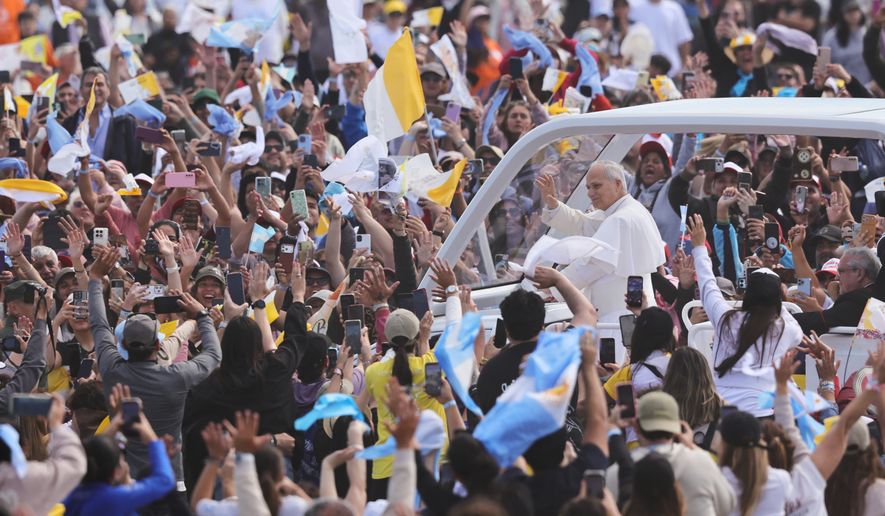

CÓRDOBA, Argentina — Pope Leo XIV urged Argentines on Tuesday to follow the holy example of the country’s best-known saints as he drew an estimated 650,000 people to the central city of Córdoba for Mass, a day after an estimated 2.5 million turned out in the capital.
Faithful from all over Argentina drove hours to be on hand for the Mass, from the farthest north of the country to Patagonia in the south and points in between. After nearly 40 years without a papal visit, Córdoba was chosen to host Leo because of its central location.
Leo told them that Córdoba was a “land of saints,” home to some of Argentina’s best-known missionaries. They include St. José Gabriel del Rosario Brochero, known as the “ Gaucho priest,” and “Mama Antula,” who in 2024 became Argentina’s first female saint. They were both canonized by the Argentine Pope Francis.
People were interested in these podcasts
Leo urged Argentines today to follow their example.
“We are all called to holiness,” he said. “These saints and blesseds have already fulfilled their mission on Earth. Today, it is our turn to follow the radiant example of holiness they have left with us.”
After Mass, Leo surprised the crowds with a brief appearance on the balcony of the archbishop’s residence in downtown Córdoba, the same balcony from which John Paul II greeted Córdoba in 1987. Thousands of people chanting “León, León” packed the street below. “United, we can do anything,” the pope told them.
Erika Viñales, 39, and Elena Llanquenao, 54, religious education teachers from Santa Cruz province in southern Argentina’s Patagonia region, said that they traveled 2,000 kilometers (more than 1,200 miles) to be on hand.
“It was quite a journey,” Viñales said.
A site that recalls the dictatorship
The site for the liturgy was the grounds of the Argentine Aircraft Factory, a plant run by the air force for much of the 20th century that built the attack planes Argentina’s military first used in late 1975 to strike leftist guerrillas.
That counterinsurgency campaign was a prelude to the state terror unleashed under the 1976-1983 military dictatorship, in which human rights groups estimate that around 30,000 people were killed or disappeared.
After Tuesday’s Mass, in a private room behind the altar, Leo was to greet 20 people chosen by Córdoba’s archbishop, Cardinal Ángel Rossi, to represent the city’s poor and marginalized. Included was a woman searching for relatives killed by the dictatorship.
“Giving us the opportunity to meet with him is already a gesture showing that he sees us,” said Alba Camargo, 64, who was detained by security forces in 1976 at age 13 shortly after her father, stepmother, aunt and uncle were all abducted and taken to La Perla, a secret detention center outside Córdoba.
“His greeting will be a gesture of support for what we’re doing, which is searching for the bones of our relatives,” she said.
Two weeks ago, forensic anthropologists found and identified the remains of nine missing people from La Perla, one of the dictatorship’s largest clandestine detention and torture centers.
Camargo said that she hoped Tuesday’s meeting “would bring change” at a time when President Javier Milei’s government has gutted funding for dictatorship memorial sites and organizations searching for the disappeared, and has promoted a revisionist account that casts the military’s crimes as little more than excesses in a war against leftist guerrillas.
“It’s exhausting to have people constantly telling you that what you’ve lived through your entire life isn’t true,” Camargo said.
Leo has made only a passing reference to Argentina’s painful history
Leo has only made a passing reference to the dictatorship while in Argentina. In his first speech delivered Sunday to President Javier Milei and government authorities, he spoke of Argentina’s history that included “reasons for gratitude and painful memories.”
He said then that it was up to each generation to “discern what deserves to be preserved, to confront past injustices and to add to its shared material and spiritual patrimony,” in comments seen as referring to the dictatorship.
Leo’s host in Córdoba is also one of the Argentine church’s most outspoken critics of Milei. Rossi, a Jesuit, trained under Jorge Mario Bergoglio in the 1970s, decades before Bergoglio became Pope Francis and made him a cardinal.
He has advocated for relatives of the disappeared and railed against Milei’s cuts to aid for people with disabilities and retirees, calling it “state and institutional sadism” at a Mass in May.
Local leaders said Leo’s visit offered a bitterly divided country hope of finding common ground. “In times of so much division and individualism, your message of peace, fraternity and hope challenges us,” Córdoba’s governor, Martín Llaryora, wrote on social media.
Another site tied to dictatorship on agenda
On Wednesday, Leo’s last day in Argentina, he will visit another site with a history linked to the dictatorship. The Devoto Prison in Buenos Aires functioned as a clandestine detention and torture center under the jurisdiction of the Army’s Third Corps.
Designated as a Memory Site in 2012 to ensure that the military repression isn’t forgotten, the prison is undergoing its definitive closure and transfer of inmates to a new complex.
Leo is going there to meet with inmates and pray with them, much as Francis used to do when he was archbishop of Buenos Aires.
___
DeBre contributed from Buenos Aires. Martín Silva Rey contributed to this report.
___
Associated Press religion coverage receives support through the AP’s collaboration with The Conversation US, with funding from Lilly Endowment Inc. The AP is solely responsible for this content.

Please read our comment policy before commenting.