



CAIRO — Another tanker was hit near the Strait of Hormuz on Monday, British maritime authorities said, the latest strike in an eight-month-long Persian Gulf war that has American oil and gas producers looking north to the less-chaotic-but-still-risky eastern Mediterranean.
Last week, Israel gave Houston-based Murphy Oil six offshore licenses near the giant Leviathan gas field, making Murphy the second U.S. operator in Israeli waters after Chevron. Murphy takes the block that Italy’s Eni won in 2023 and gave up after the Gaza war began.
Qatar sold about a fifth of the world’s liquefied natural gas before the war. In January, it agreed to send Egypt up to 24 cargoes for the summer. Two months later, Iranian missiles shut Qatar’s plants, and gas loaded on the Gulf Coast of Texas and Louisiana became Egypt’s fallback. Egypt took about 130 tankers of American gas in the first eight months of this year, nearly twice last year’s pace, and it is now paying more than $100 million a cargo.
People were interested in these podcasts
“The involvement of Chevron and ExxonMobil in bringing Cypriot gas to Egypt strengthens Cairo’s strategic weight in Washington,” Hany El-Aasar, a Cairo security analyst, told The Washington Times. “It turns Cairo from a mere importer of American gas into a partner in the regional energy system, and it makes Egypt’s security and political stability an American interest.”
Mr. El-Aasar said the arrangement also gives Washington more say over Egypt’s energy sector and dilutes Israel’s leverage. “The equation of influence will not be limited to Egypt and Israel,” he said.
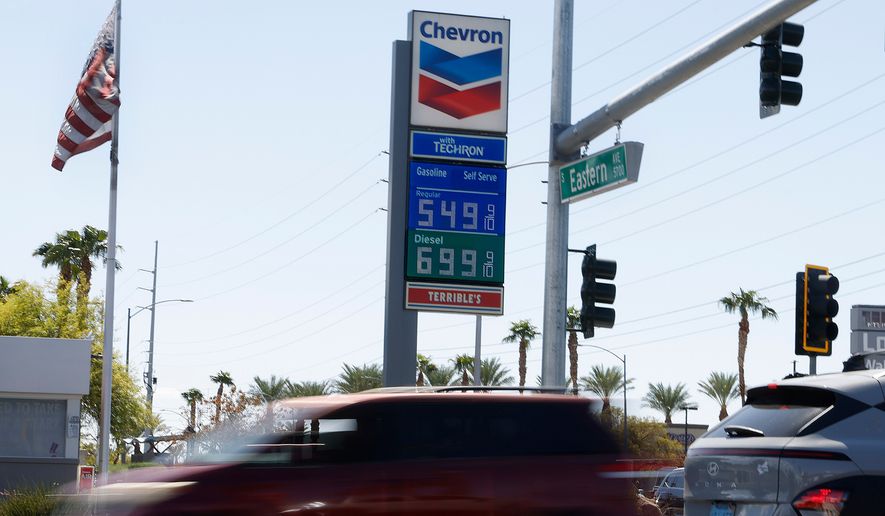
Most of the rest of Egypt’s imported gas comes from a Chevron-run field in Israel. Egypt is a country of more than 100 million people that receives about $1.3 billion a year in U.S. military aid, controls the Suez Canal and borders Gaza, Israel and Libya. Israel shut off its gas exports three times in three years of war.
Egypt also mediates between Israel and Hamas and controls Rafah, Gaza’s only crossing that does not lead into Israel.
Brenda Shaffer, an energy expert at the U.S. Naval Postgraduate School, said the Gulf war has brought Washington back to its old policy of spreading energy supplies beyond the Persian Gulf. “In the Trump administration, it’s back,” she said. “Any major choke point, any narrow waterway, no matter what regime is there, is a danger. So in that way the East Med is good.”
Gina Cohen, an Israeli natural gas analyst, said Washington looks after its own exports first. “I think America prefers to sell American LNG, and not the gas from Chevron in the Eastern Mediterranean,” she told The Times. But she said the company and the White House need each other. “The American administration helps Chevron, and Chevron helps the American administration.”
Mohamed Fouad, an economist and member of Egypt’s House of Representatives, said the companies’ nationality counts for little. “What matters is that people go after their profit, and that’s it,” he told The Times. “I think there is exaggeration in portraying these projects as Egypt’s return to the role of regional gas exporter.”
The attacks in the Gulf have not let up. Tankers have been hit near the Strait of Hormuz every few days this month. On Sunday, a tanker linked to India was attacked off Khasab, Oman, before it reached the strait. Iran’s Revolutionary Guards said Friday that a gas carrier sailing under U.S. escort hit a mine in the strait and exploded. No one else has confirmed it.
Iranian missiles knocked out about a sixth of Qatar’s export capacity in March, and its shipments through Hormuz fell by more than 90%. Its tankers have only begun moving again this fall, at a fraction of the old pace, and Qatar has told buyers in Asia and Europe not to count on contracted deliveries before January.
That has put American gas at the center of the market. U.S. export terminals are running near full, and Qatar itself has signed long-term deals that will make it the largest buyer of U.S. LNG. Record U.S. production has kept prices at home low, even as overseas prices hit their highest level in nearly four years.
The danger now reaches the Red Sea end of the region, too. On Sunday, Yemen’s government forces pulled back from the coast along the Bab el-Mandeb, leaving Iran-backed Houthi rebels in control of the southern gateway to the Suez Canal.
The war has impacted the eastern Mediterranean. When the United States and Israel struck Iran on Feb. 28, Israel shut Leviathan rather than risk a hit on a working rig. Leviathan stayed closed for more than a month.
“It’s not about the price anymore,” said Elai Rettig, an energy analyst at Bar-Ilan University. “It’s about getting gas versus not getting gas.”
“The more important question is how Egypt can keep gas flowing in wartime, even if its biggest suppliers stop at the same time,” Mr. El-Aasar said.
On July 29, a drone hit an American ship at Egypt’s port of Damietta, more than 800 miles from Iran. The Energos Winter turns imported LNG back into gas. Funds managed by New York-based Apollo Global Management own the ship. Apollo’s chief executive, Marc Rowan, serves on President Trump’s Board of Peace for Gaza alongside Egypt’s intelligence chief, Gen. Hassan Rashad. Until then, Egypt had largely escaped attacks tied to the war with Iran.
The fire spread to a Greek-owned tanker moored alongside. No one was hurt, and no one claimed the attack. Iran’s foreign minister denied any role. Analysts at two Washington think tanks assessed that Iran “possibly conducted or directed” the strike.
Mr. Trump said aides had briefed him. “It’s a little more of the same. But it’s going to be straightening out,” he said.
In early March, days after the U.S. and Israeli strikes on Iran, an Iranian-made drone hit the British air base at Akrotiri on Cyprus. It caused limited damage and no casualties, Cypriot and British officials said. Greece sent warships and F-16s to the island within days.
Israel’s navy guards its rigs with warships carrying a naval version of Iron Dome, and last month Israel agreed to sell Cyprus a second patrol boat. Greece now keeps F-16s and a warship in Cyprus for good, Cyprus’ defense minister, Vasilis Palmas, said. Greek media report the three governments are working on a joint rapid-response force of about 2,500 troops to guard gas platforms, pipelines and undersea cables.
The Foundation for Defense of Democracies, a Washington think tank, argued in September that the United States “should add teeth” to that partnership.
Turkey is moving in from the other side. Ankara lent Egypt a floating LNG terminal in 2025. Their navies wrapped up joint drills off Alexandria last week, and Turkey’s navy chief said there that the two countries are looking at building warships together. Turkey’s energy minister, Alparslan Bayraktar, has offered a new pipeline to the Turkish Cypriot north as a route for any East Med gas to reach Turkey and Europe.
Late last month, Turkey’s Defense Ministry said Ankara was ready to sign a sea-border deal that would give Egypt more waters than a deal with Greece would. Greek Foreign Minister Giorgos Gerapetritis objected. Turkey has also complained to the United Nations about Cyprus’ military buildup, including an Israeli air defense system.
Mr. Rettig said Israel now sees Turkey as a rival. “Economics, fine. Energy infrastructure, fine. When you start seeing Turkish Navy ships in Egypt’s docks, that’s a bit too much.”
Ms. Cohen said Egypt should move closer to Israel, Greece, Cyprus and the Gulf and North African states that have made peace with Israel “to make a balance against Turkey and Iran.”
Meanwhile, the bill keeps rising in Cairo. In April, the federal Export-Import Bank insured more than $2 billion in shipments to Egypt through 2027 by Hartree Partners, a U.S. trader, putting “U.S. energy molecules to work in a critical market,” said John Jovanovic, the bank’s chairman.
Egypt’s LNG imports will cost nearly three times as much this month as a year ago, a Petroleum Ministry source told Egyptian media last week, and Cairo has pushed a third of its November cargoes into next year. Egypt is bidding against Europe for those cargoes as the European Union prepares to ban Russian LNG under long-term contracts on Jan. 1.
Last week, the government deepened cuts to gas supplies for fertilizer makers, from a fifth to a third, Misr Fertilizers Production Co. said. Fertilizer is one of Egypt’s biggest exports. It also cut gas to the country’s biggest steelmakers by nearly a third.
Houston-based Halliburton signed on last week with Egypt’s state oil company to study fracking at 50 wells, as Cairo tries to pump more of its own oil and gas. On Sunday, Shell and a Kuwaiti government company started pumping gas from Mina West, a new field off Egypt’s coast. It is a small addition next to what Cairo imports.
“It can certainly compete with American LNG,” Charles Ellinas, a Cypriot energy expert, told The Washington Times of gas from Cronos, Cyprus’ first export field. Italy’s Eni and France’s TotalEnergies will liquefy it in Egypt from 2028, mostly for Europe.
Ms. Shaffer said that at current volumes, Israeli and Cypriot gas is too small to pipe to Europe.
The World Bank stopped lending for oil and gas production after 2019, and the ban still stands. As climate negotiators meet this week at the U.N. conference in Antalya, on Turkey’s Mediterranean coast, Ms. Shaffer said Washington, the bank’s largest shareholder, should push the bank to change course. “They hold the purse strings. They should be forcing the World Bank to go back to at least loans for natural gas,” she said. “This would be very important for Egypt.”
Last year, the partners in Leviathan signed a $35 billion deal to supply Egypt through 2040, the largest export deal in Israel’s history. Leviathan holds enough gas to heat and cook for every American home for more than four years. Israeli gas covers as much as 20% of Egypt’s needs. Cairo plans to buy about a quarter more of it this month, Saudi media reported.
“As I see it, nothing beats Israel on volume and price,” Mr. Fouad said.
In September 2025, Prime Minister Benjamin Netanyahu weighed shelving the Leviathan deal over Egypt’s military buildup in Sinai, on Gaza’s border. Energy Secretary Chris Wright canceled a visit to Israel the next month after Israel’s energy minister, Eli Cohen, refused to sign, citing domestic pricing concerns while signaling he would also use the deal as a diplomatic tool. “We need to cement the peace treaty with Egypt and make sure there are no violations,” he told Israeli radio in December. Mr. Netanyahu approved it later that month, days before meeting Mr. Trump.
Mr. Rettig said U.S. pressure pushed Mr. Netanyahu to sign without winning any political or security concessions from Egypt.
“Israel is not free to do whatever it wants,” he said. “There’s limits to its power, even over its own gas fields.”
Off Gaza itself, a small field called Gaza Marine was close to development before the Hamas attack of Oct. 7, 2023. Most of the gas was to go to Egypt, with some for a new power plant in Gaza, Mr. Rettig said. The war ended the plan.
Mr. Netanyahu has driven Israel’s gas policy for more than a decade. Israel’s next government will set it now. Last week, President Isaac Herzog asked opposition leader Gadi Eisenkot to form a coalition after last month’s election left neither side with a majority. Mr. Eisenkot has until early December.
Egypt once exported gas, some of it to Israel. Its own production began to fall in 2021. In the summer of 2024, gas shortages forced daily power cuts across the country.
“Mubarak fell during a wave of electricity blackouts in Egypt, and then Morsi fell during the next wave of blackouts,” Ms. Shaffer said, referring to former Egyptian President Hosni Mubarak. “So regime stability is highly connected to the ability to provide power to the Egyptian public.”
Egypt’s state gas company has preliminarily agreed to buy all of Aphrodite’s gas, while the field’s partners will build the subsea pipeline to Egypt. Part of the field reaches into Israeli waters, and the two governments let an end-of-October deadline pass without a deal. Chevron’s Israeli partner, NewMed Energy, expects the first gas in 2031.
Mr. Ellinas said Chevron feels little pressure. “If it is delayed, they don’t particularly care very much, because they have many other projects, much more profitable, to invest their money in,” he said.
“The Aphrodite issue with Israel has been going on for years without affecting the partnership, which has, in fact, deepened over the past few years,” Zenonas Tziarras, a lecturer at the University of Cyprus, told The Times.
Gulf money now runs through these waters as well. Qatar’s state energy company owns 40% of ExxonMobil’s gas finds off Cyprus and holds stakes in several blocks off Egypt and Lebanon. Abu Dhabi’s Mubadala owns part of Egypt’s giant Zohr field and of Israel’s Tamar field, whose partners agreed in July to sell gas to an Egyptian buyer from 2031. In Syria, a Qatari-led group with Turkish partners has signed to build gas-fired power plants.
“We import gas at high cost to run our economy, while we rent part of our infrastructure to export our neighbors’ gas for relatively limited fees,” Mr. Fouad said.

Please read our comment policy before commenting.