


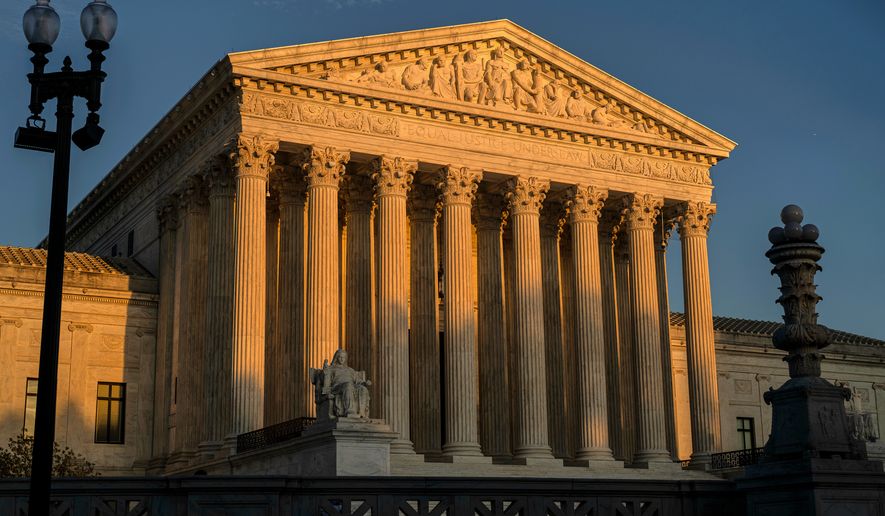

The Supreme Court said Monday it will not take up a case challenging Maryland’s expansive ban on firearms in “sensitive” public places such as anywhere alcohol is sold or any government building.
The court rejected the case in a brief order.
But Justice Clarence Thomas said the court will need to revisit the issue in a future case. He said states such as Maryland have rushed to adopt new laws carving out sensitive locations as a way to limit the high court’s other rulings recognizing an expansive right to bear arms.
People were interested in these podcasts
“I harbor serious doubts that our nation’s historical tradition of firearm regulation supports many of these sweeping restrictions. In an appropriate case, this court should consider whether particular sensitive-place laws are consistent with the right to public carry,” said Justice Thomas, a George H.W. Bush appointee.
Maryland has long been among the more restrictive states in gun policies. That included a more limited ban on guns at schools and on public transit.
The state also had one of the more restrictive policies on issuing concealed-carry permits, but that law fell after the Supreme Court in 2022 issued a ruling striking down a similar law in New York.
Unable to block owners from carrying concealed, the state’s Legislature enacted a broader sensitive places law to put more locations out-of-bounds for those permit holders.
The new law bans carrying guns anywhere in areas “for children and vulnerable individuals,” which includes schools, daycares, clinics and hospitals; state and local government buildings; and so-called special purpose areas, which are places where the public gathers for fun, education of “other collective social pursuits.”
That includes anywhere alcohol or marijuana is sold for on-site consumption.
Maryland residents and gun-rights groups sued, arguing the expansive ban trampled on their Second Amendment rights. They lost in the district court and again at the 4th U.S. Circuit Court of Appeals.
The case is the latest to test the standard the high court laid out in its 2022 ruling in the Bruen case. The justices said for gun restrictions to survive scrutiny, they had to be the sort of policy that would have been recognized by those when the Second Amendment was adopted and applied to the states.
The Maryland residents said the nation’s founders would have been shocked by a law like Maryland’s that broadly bans guns in “crowded” places.
The only exceptions, the residents said, were in instances where the state already provides its own security, such as courthouses.
But Maryland pointed to laws from New Orleans in 1817 and New Mexico in 1853 restricting guns in public ballrooms, and an 1870 Texas law prohibiting armed people from entering churches or school rooms, as examples.
“Maryland’s laws prohibit public carrying of firearms at only those discrete locations where restricting the carrying of firearms is consistent with history and tradition and their underlying principles,” Maryland Attorney General Anthony Brown told the court in urging the justices to take a pass on the case.
Justice Thomas, in his statement Monday, said he agreed with his colleagues not to take the case. He said the specific challenge brought to the law was so broad that it “would complicate” the high court’s review.
Still, he said a narrower case should garner the court’s scrutiny.
Justice Thomas said some states have seized on sensitive location policies to eat away at the Second Amendment. He name-checked New Jersey’s ban on firearms at zoos, libraries, casinos and state beaches, or California’s ban on 29 gun-free locations, including athletic facilities, financial institutions and any “public gathering” permitted by the government.
“These restrictions stand on questionable historical ground,” Justice Thomas wrote.
Even though the court didn’t take this case, it has agreed to hear a challenge to bans on AR-15s and other similar semiautomatic rifles.
Maryland has such a law in place.
The justices last year declined to hear a challenge to Maryland’s law, but agreed this year to hear challenges to similar bans in Connecticut and in Cook County, Illinois.
Contact the author


Please read our comment policy before commenting.