


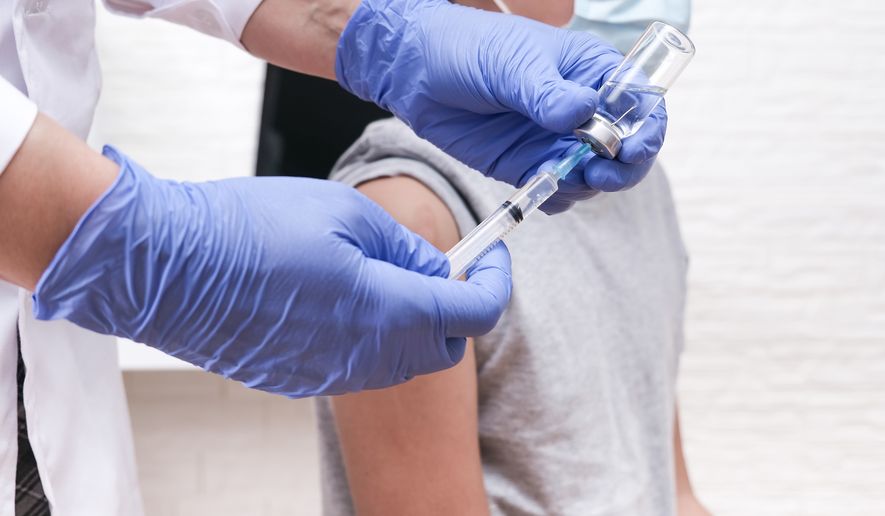

A father in Maine has asked the Supreme Court to order the public schools to let his son attend despite lacking two vaccinations, saying he recently discovered ties between the vaccines and stem cells from aborted fetuses, which he said tramples on his religious beliefs.
James Childs said his son is an honor student and should be in the eighth grade at Tripp Middle School, but officials have blocked him from attending this year as they enforce their vaccine mandate.
The boy, identified in court documents by initials GC, received the shots required up through sixth grade. But his father has refused the two vaccines required beyond that — the meningococcal and tetanus, diphtheria, and pertussis shots — after hearing that stem cells taken from aborted fetuses are used in some vaccine testing.
People were interested in these podcasts
Joining Mr. Childs in the lawsuit is We the Patriots, whose members are also seeking exemptions.
“Childs will not violate his faith, and, because Maine’s vaccination law bars him from public, private, and religious schools, he has nowhere to send his son,” his lawyers said in their petition to the high court.
A lower appeals court had said Mr. Childs could have opted his child out of a lesson based on his religious beliefs, but said vaccines are different than instruction.
The First U.S. Circuit Court of Appeals, in a 2-1 ruling, declined to issue an injunction ordering G.C. be allowed back into school.
Judge Joshua Dunlap, a Trump appointee, dissented. He said Mr. Childs has a strong argument and allowing the boy to be in class while the case proceeds seems like the best option.
He said that was particularly true because Maine already allows several exemptions to its vaccine mandate. Those exemptions include a grade period for parents who do plan to get vaccines, and another involving some religious exemptions grandfathered in before 2021.
That’s when Maine updated its policy to remove the religious exemption.
The lead defendant in the case is Pender Makin, commissioner of the Main Department of Education.
The Washington Times has sought comment from the department.
The Supreme Court turned back a similar request in October 2025 from a parent in California who sought an exemption from a California school system’s vaccine mandate. That case was also brought with We the Patriots.
The legal battleground is over how Maine’s requirement conflicts with Mr. James’s beliefs.
In a Supreme Court case last year, Mahmoud v. Taylor, the justices allowed religious parents to opt out of pro-LGBT lessons in public schools in Montgomery County, Maryland.
Justice Samuel A. Alito Jr., writing for the 6-3 majority, said the county’s lessons contradicted the families’ religious teachings.
U.S. District Judge Stacey D. Neumann, in rebuffing Mr. Childs’ request for an exemption, said Mahmoud only applies to cases where a school is competing directly with the parents over a child’s beliefs.
She said cases that involve physical or mental harm fall outside of the Mahmoud ruling.
In addition to the grace period and grandfather period, Maine also allows a medical exception to its vaccine rules.
In the 2017-2018 school year, 95.3% of students entering kindergarten had the Dtap vaccine and 3.9% had an official exemption.
By 2024-2025, the vaccination rate was 97.3%. Another 1.4% either had a medical exemption or were considered in the 90-day grace period.
Mr. Childs argued that his son presented the same risk to the school that a child in the 90-day grace period presents.
In his original district court complaint, he stated that every vaccine required by Maine used cell lines derived from aborted fetuses for some part of their development.
The district judge accepted Mr. Childs’ belief as sincerely held.
The National Conference of State Legislatures says most states allow religious or personal objections to immunizations.
Only four states — Maine, New York, California and Connecticut — bar non-medical exemptions.
Contact the author

Please read our comment policy before commenting.