



OPINION:
When Outlook stops working, most Americans see an inconvenience. A foreign intelligence service may see an opportunity.
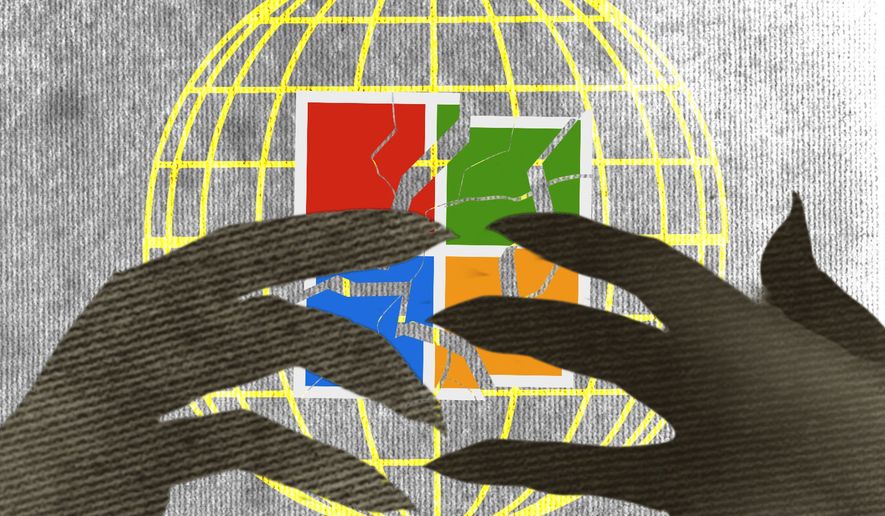
The massive Microsoft outage Thursday disrupted far more than email. Businesses struggled to communicate, and government services and cybersecurity tools were affected.
In Britain, police were unable to accept some online crime reports. Pharmacies warned of possible prescription delays. Government operations in Asia experienced disruptions of their own.
People were interested in these podcasts
All because a company most of us barely think about until something suddenly breaks could not deliver services millions depend on.
Microsoft says that it has found no evidence of malicious activity. Yet this is the troubling part: An enemy need not cause an outage to learn from it.
If I were sitting in an intelligence office in Beijing, Moscow or Tehran, I would want to know which American institutions lost access first. Which services stayed operational? Which backup systems failed? How long did it take organizations to switch to alternatives? What happened when Microsoft tried to bring everything back online?
Much of that information can be pieced together from public reports, customer complaints, official statements and recovery updates. An adversary could compare those accounts, identify patterns in the disruption and follow those patterns with quiet probes against potential targets to see how defenses respond.
Microsoft’s account of its recovery efforts shows why those observations could prove useful. When some servers went offline, traffic shifted onto others and overwhelmed them. Restarting servers was not enough; some became unresponsive again as traffic returned.
Engineers limited connections and redirected traffic as they restored service, giving anyone watching a public account of how the failure spread and what it took to contain it.
The stakes become clearer with China’s Volt Typhoon hacking operations. Federal cybersecurity agencies warned that the group had compromised American critical infrastructure networks, apparently positioning itself to disrupt essential services during a future crisis.
The concern was that an adversary could quietly prepare the battlefield long before anyone recognized that a conflict had begun.
Artificial intelligence could speed up that preparation. A foreign intelligence service could use AI to sift through outage reports, identify recurring failures and compare recovery times across industries. It would not need to invent a sophisticated new weapon to gain an advantage; it could learn from the mistakes and breakdowns happening in plain sight.
An adversary could exploit those weaknesses during a future crisis by disrupting communications while targeting payment processing, freight scheduling or the electrical grid.
Businesses and government agencies would suddenly find themselves managing multiple emergencies without reliable access to the very systems they use to respond. Because essential services are interconnected, those disruptions could spread across industries.
This is the trap America has fallen into: We have spent years moving essential business functions onto shared platforms operated by Microsoft, Amazon and Google. Those companies have transformed the way businesses and governments operate, but they have also created a level of dependence that many organizations fail to appreciate until something goes wrong.
Having multiple systems and backup plans offers little protection when they all depend on the same underlying infrastructure. A hospital may have backup generators and still depend on an outside service for communications or administration. A business may keep copies of its data while relying on the same provider to authenticate the employees who need to retrieve it. A government agency may have an emergency plan that assumes the people implementing it can still access their email.
That is not redundancy. It is a single point of failure wearing a different name tag.
Washington needs to treat these dependencies as national security vulnerabilities, not just procurement decisions. Federal agencies and critical infrastructure operators must test whether they can function when cloud services, identity systems and normal communications are simultaneously unavailable.
Contractors should have to demonstrate independent recovery options, not just promise impressive uptime statistics. The tests should reflect what happens during a real disruption, when employees cannot sign in, managers cannot coordinate and nobody can say when normal service will return.
Businesses need to ask a question that sounds almost embarrassingly simple: Can we still operate when our technology provider cannot?
Foreign adversaries do not have to cause every disruption to benefit from watching one unfold. America cannot afford to learn the full extent of its digital dependencies for the first time during a national emergency.
The next major outage might not be an accident. By that point, somebody may already know exactly where to push.
• Colton Overcash is the founder of Vertex Strategies. He previously held two political appointments at the Department of Homeland Security and is a former congressional staffer.

Please read our comment policy before commenting.