



OPINION:
As Americans began contemplating bomb shelters and seed banks after a week when Microsoft went dark, the Federal Aviation Administration grounded flights for only the second time since 9/11 and 178 organizations’ websites turned into unwitting pickpockets, President Trump did what presidents do: assure the masses.
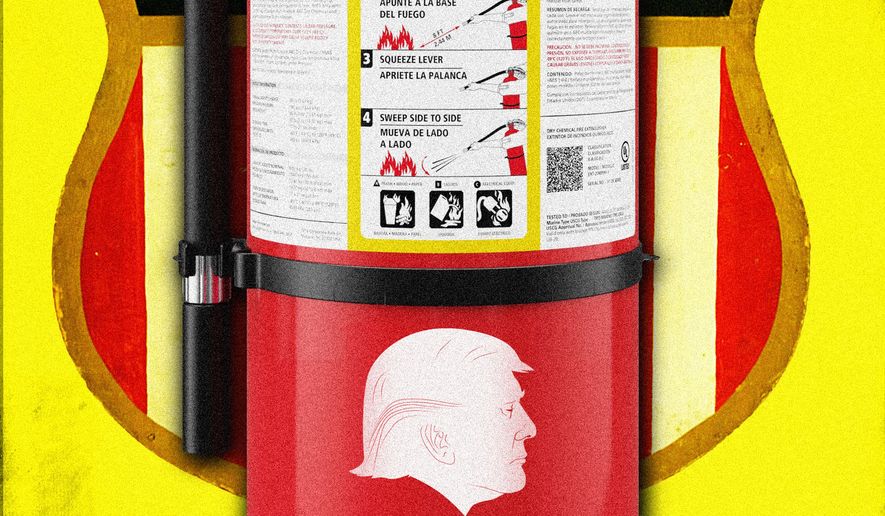
“No, it’s life,” he told reporters from halfway around the world, where he went to talk to the leaders of Planet Earth, Russia and China. “It’s life. When you’re big and powerful, when you have all the money, things like that happen.” Then, for good measure, he tossed in, “It’s fine.”
Homeland Security Secretary Markwayne Mullin had a different theory, and he brought it straight to Fox News, citing an anonymous tech-industry contact. “I believe that it’s the SI,” Mr. Mullin said, using the administration’s preferred euphemism for artificial intelligence, “super intelligence.” His source’s theory: Self-correcting code is now moving faster than the infrastructure built to contain it.
People were interested in these podcasts
In the same breath, Mr. Mullin insisted that he could say “with 98% certainty, we’re not seeing a cyberattack,” calling the incidents “all individually unrelated.”
The agencies and companies themselves tell a far less cinematic story. The FAA blamed a single router in Arkansas that flooded legacy air traffic equipment with data, disrupting radar feeds at 17 of 22 Air Route Traffic Control Centers, with no indication of a cyberattack.
Microsoft traced its 24-hour outage to a dormant software bug introduced back in July, compounded by rising network traffic — explicitly not AI, not cyber. J.P. Morgan Chase pointed to a software bug in on-premises hardware tied to a release the company pushed that very Monday.
Not everyone is buying the “boringly unrelated coincidences” explanation. Gary Marcus, the New York University professor emeritus and AI critic behind the newsletter Marcus on AI, called Mr. Mullin’s claims a turning point. He wrote, in a post headlined “America’s infrastructure is melting. And AI appears to be partly responsible,” that the secretary had “finally broken ranks” on the subject.
“I doubt we are getting full candor for these incidents and doubt any have been fully investigated,” he told Fortune. “I certainly have the same intuition as Mullin’s contact.”
Then there is Secretary of State Marco Rubio, dispatched to Manila to administer the official calm-down. “We have zero evidence whatsoever … that any of these incidents are related to each other,” he told reporters, insisting, “The Microsoft incident has nothing to do with what we saw with the FAA. The FAA has nothing to do with what we saw with the banks.”
Asked about AI’s role, Mr. Rubio hedged toward the mundane: “Sometimes, when you are going in to fix your system because you’ve identified a vulnerability, it creates a short-term disruption in the way the system works. That’s how it’s been described to me.”
Yes, that is where we are: We have leaders who need things “described” to them, like a grandma trying to figure out how to use an iPad.
And then, almost as an afterthought to the week’s chaos, hackers quietly infiltrated software used by 178 organizations across the planet — CNN, the BBC, Fox News, HSBC, Equifax, Ikea, Zoom, Salesforce, Peacock, airlines, insurers, a petition website, a Norwegian moving company, pharmacies, freezer systems, even a blood bank — by compromising a single shared vendor.
Google, not to be left out of the week’s doom chorus, declared flatly that “the era of autonomous attacks has arrived,” describing bad actors using AI to scan software patches and auto-generate exploits “without human involvement.” That certainly seems to be the most plausible explanation.
Naturally, the internet drew its own conclusions, and they involved neither Mr. Mullin’s super intelligence nor Mr. Rubio’s reassuring shrug.
Conspiracy theories erupted across social media alleging the cascading outages are a deliberate, coordinated maneuver straight out of Project 2025, The Heritage Foundation’s nearly 900-page blueprint for restructuring federal power — specifically its stated ambition, outlined on page 633, to make the FAA “operate more like a business” by stripping it from the Department of Transportation and loosening its ties to congressional funding.
“Microsoft on Thursday. FAA on Friday. Banks on Monday. Quick! Someone tell me what’s next on the list in Project 2025!” one Threads user posted.
Actor Wil Wheaton added his own flourish: “How interesting that a bunch of infrastructure disruptions and power grabs outlined in Project 2025 are all happening exactly the way they drew it up, almost like there’s a speed run before the new Congress is seated and the investigations begin.”
Not to be left out, former Rep. Marjorie Taylor Greene of Georgia has floated her own version of events, tying the blackouts to shadowy, coordinated interference, a theory that fits neatly alongside the Project 2025 chatter, even if the evidence remains, charitably, thin.
Here is the part nobody wants to hear: Democrats just won the midterms in a landslide, and if you are waiting for that victory to fix any of this, settle in for a long wait. Both parties have had their hands on this infrastructure; both have let “vibe coding” and vendor shortcuts run the show, and neither has shown the slightest urgency to regulate the autonomous systems now quietly rewriting the rules on who controls what.
The banks are back online. The planes are flying again. But the thing melting underneath all of it isn’t going to un-melt just because the other team’s in charge now. It’s fine, Mr. Trump says. Sure. It is fine.
• Joseph Curl has covered five American presidents over nearly four decades at The Washington Times. He can be reached at jcurl@washingtontimes.com.
Follow the author


Please read our comment policy before commenting.