


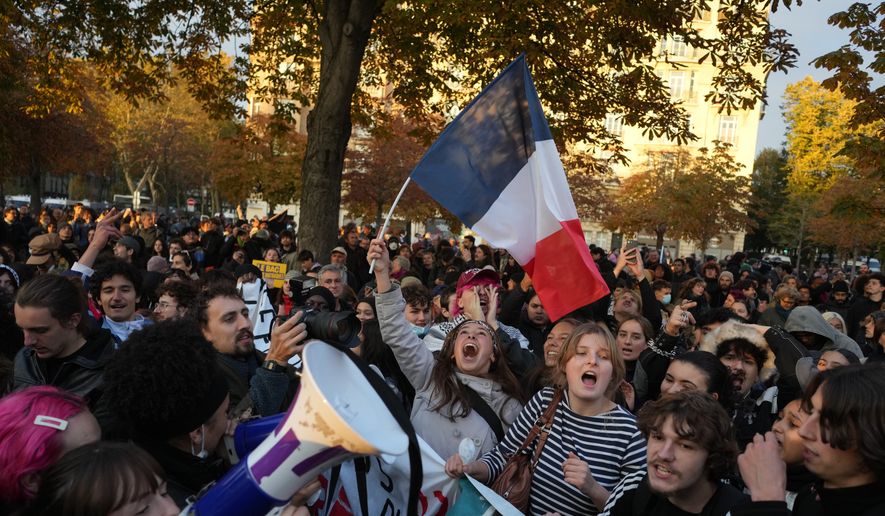

Russian military intelligence has tried to radicalize France’s student protests, urging demonstrators to reject government concessions and draw labor unions into the movement, according to hacked emails published this week by Ukrainian investigators.
The disruptive operation comes as Moscow and Tehran seek to exploit France’s growing political unrest, spreading false reports and inflammatory narratives ahead of the country’s presidential election next spring.
The correspondence, released Friday by the investigative group InformNapalm and Ukrainian hacker collectives, identifies Lt. Col. Stanislav Nemich of Russia’s military intelligence agency (GRU) as the purported author of instructions sent to an unidentified contact in France.
People were interested in these podcasts
In one Oct. 15 message, the alleged handler urged protest organizers to reject concessions during government talks with student representatives. “Do not let yourselves be fooled,” the email said, calling on movement leaders to insist that every demand be met.
Other messages called for drawing labor unions and members of the “Yellow Vest” protest movement into student demonstrations, and demanding punishment for police officers accused of injuring teenagers.
The email correspondence has not been independently authenticated, but Russia has been linked to disinformation and attempts to target France, including a massive cyberattack on President Emmanuel Macron’s first presidential campaign in 2017 and several other recent major hacks, including on a TV station and an organization involved in the Paris Olympics.
An Oct. 11 email urged the French contact, who has not yet been identified, to push for the abolition of Parcoursup, France’s university admissions system, and encourage far-left politician Jean-Luc Melenchon to endorse the demand. InformNapalm acknowledged that Mr. Melenchon had made that proposal publicly earlier the same day, before the message was sent.
The allegations come amid ongoing protests that began among high school students over education funding and conditions and have grown to include workers and groups angry over living costs. Demonstrations on Oct. 17 descended into rioting in several cities.
The Russian networks appear to be targeting European sources of aid, funding and weaponry for Ukraine.
A confidential European Union assessment obtained by Reuters last week found that a Russian-linked operation called “Operation Overload” used fabricated news videos to depict the French government as losing control. The forgeries, some impersonating Western media, falsely claimed migrants had raped demonstrators or warned that terrorist attacks were imminent.
The network also cast French aid to Ukraine as money taken from struggling households.
“Such events offer opportunities to undermine national governments, fuel fear and division, and shape public perceptions ahead of elections,” the EU document said.
In a separate analysis of roughly 2 million social media posts, the research group Alliance4Europe identified 939 synchronized messages by Russia’s Doppelganger network since September, drawing a combined 10.6 million reported views.
The accounts promoted proposals associated with Mr. Melenchon and, later, posts favoring far-right politician Marine Le Pen, both prominent figures in France’s increasingly fractured political landscape. Researchers found no evidence that either had sought or knew about the promotion.
By Nov. 6, another pro-Kremlin network, Pravda, had published 4,299 articles about the unrest across 55 websites, often republishing the same claims within minutes, Alliance4Europe found.
Russia has rejected French allegations of electoral disinformation: In August, Foreign Ministry spokeswoman Maria Zakharova dismissed them as an effort by French authorities to manipulate public opinion.
Iran amplifies the unrest
Iranian authorities have also used the unrest to accuse Paris of suppressing dissent. France summoned Tehran’s ambassador on Oct. 7 over what its Foreign Ministry called false information distributed by official Iranian accounts.
Iranian state-linked outlets have falsely claimed that France shut down the internet during the demonstrations and passed off footage from a Florida school and earlier Paris disturbances as evidence of the current crackdown, according to an Oct. 20 investigation by IranWire.
Iranian broadcasters have also portrayed police clashes as evidence of French hypocrisy on human rights, despite Tehran’s own record of violently suppressing demonstrations.
Alliance4Europe found that Iran’s French-language Press TV dedicated 28% of its output from Oct. 27 to Nov. 6 to the unrest, compared with 12% for Russian state outlet RT’s French service.
The first round of France’s presidential election is due to be held on April 18, with a possible runoff on May 2.
Mr. Macron, who is constitutionally barred from seeking a third consecutive term, said last month that he saw no evidence that foreign governments had organized the protests, but warned of “foreign manipulation of information.”

Please read our comment policy before commenting.