



OPINION:
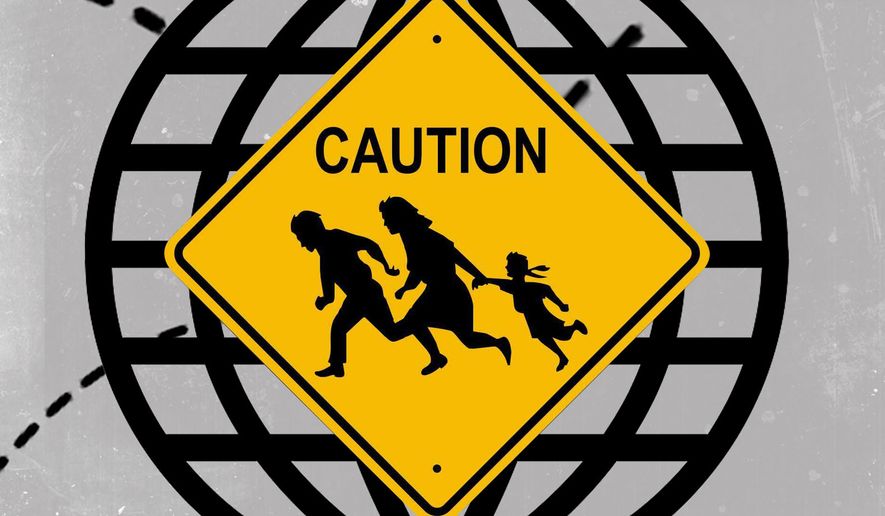
Few Americans have heard of the Pacific island nation of Palau. Yet this country of 18,000 inhabitants is one of some 35 countries that have signed bilateral agreements with the Trump administration to receive migrants ordered removed who are unable or unwilling to be sent to their home countries.
Thus far, some 25,000 illegal aliens have been deported to third countries. The vast majority were returned to Mexico, but others were sent to countries such as Eswatini in southern Africa, the Central African Republic and Jamaica.
Often, the United Nations High Commissioner for Refugees and the International Organization for Migration handle the in-country logistics.
People were interested in these podcasts
With planned payments of just over $400 million, the State Department’s Office of Remigration negotiates the agreements with countries willing to accept these aliens.
The program was born of necessity. Foreign governments sometimes refuse to issue travel documents to their citizens ordered removed from the U.S. Others delay verification indefinitely or outright refuse to recognize their nationals. Some individuals cannot be repatriated because their identities cannot be proved.
To remedy this situation, the U.S. government relies on the authority of the Immigration and Nationality Act, especially 8 U.S.C. § 1231(b)(2). The law allows for the deportation of noncitizens with final removal orders — issued by immigration judges — to countries other than their countries of citizenship or nationality.
A final order of removal issued by a federal court is not merely a ministerial act or a policy suggestion. It is the law. The law makes clear that entering the United States illegally does not automatically confer a right to remain, even if a person’s petition was denied and their country of origin makes it difficult for them to be returned.
Countries delay cooperation, refuse to issue travel documents or simply decline to take back their own nationals for political and economic reasons.
Many countries view their residents in the U.S., regardless of those residents’ legal status, as human ATMs. These people send back millions of dollars in remittances each year — millions that the countries do not want to lose. For example, remittances were 27.5% of El Salvador’s gross domestic product in 2025, according to the World Bank.
Having a policy with predictable consequences reduces the incentive to destroy documents to escape identity verification. It makes immigration proceedings meaningful because a final order of removal produces a legal outcome. Failure to carry out these removals would allow foreign governments to influence and dictate our immigration policies.
During the Biden administration’s southern border chaos, migrants discarded their passports or other identity documents before crossing the border. Human traffickers know the difficulty in deporting someone from the U.S. if their country of origin is unclear.
Human trafficking networks closely follow American immigration policy. They will exploit every weakness, vagueness and ambiguity in those policies, telling prospective migrants that crossing the border and asking for asylum can lead to permanent residence even if an asylum claim is denied.
When final removal orders are not enforced, traffickers become empowered and credible. Removing some of these migrants to third countries enhances deterrence and diminishes traffickers’ appeal.
The Trump administration’s third-country removal program is currently the subject of litigation. This litigation has focused on the notice and opportunity a person must receive to raise concerns about the proposed third country. Still, the Supreme Court has allowed the government to resume certain third-country removals and will take up the matter for full oral argument on Dec. 9.
Third-country removals even became a midterm election issue. House Minority Leader Hakeem Jeffries, New York Democrat, recently pledged that a Democratic-led Congress would defund third-country removal operations and work to return some already deported migrants to the U.S.
Immigration law is often seen as complicated, but it should not be. For years, federal immigration law, enacted by Congress, has been ignored, contorted or invented by Democratic administrations, bringing us to where we are today.
About 1.5 million people in the U.S. now have final orders of removal issued by an immigration judge. President Trump made illegal immigration a centerpiece of his 2024 election victory.
Immigration should always be safe, secure, orderly and legal. Ample paths to legal immigration exist. Yet when a person has exhausted all legal remedies and a federal judge issues a removal order, it must be respected and carried out. Justice demands it, fairness requires it and voters expect it.
• Emilio T. Gonzalez is a retired U.S. intelligence officer who has served in senior positions in the U.S. Army, on the National Security Council and within the Department of Homeland Security.

Please read our comment policy before commenting.