


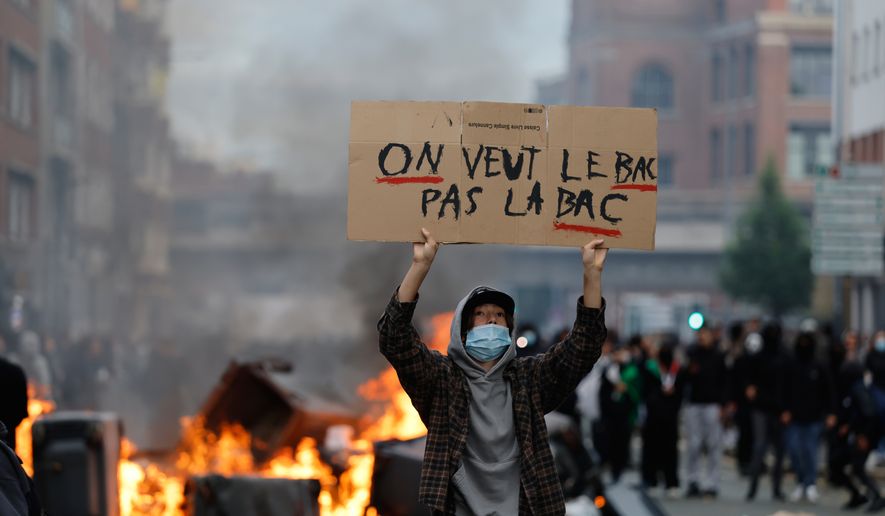

Student protests over crumbling schools and teacher shortages have spread across France and turned increasingly violent, prompting a crisis meeting Thursday called by Prime Minister Sebastien Lecornu.
Police arrested 625 people, mostly young, on Wednesday alone, Interior Minister Laurent Nunez said, as blockades that began last week in the Paris region spread nationwide. Police counted about 340 demonstrations outside high schools by mid-morning Thursday, with more than 160 schools shut. University students blocked access to about 30 campuses, according to a student union.
Mr. Nunez said 83 police and gendarmerie officers were injured Wednesday. Education Minister Edouard Geffray said that as of Thursday, 170 students and 65 education staff had been injured since the protests began. Students have accused police of heavy-handed tactics, including tear gas, and Mr. Nunez said police have opened internal investigations into brutality allegations involving three students.
People were interested in these podcasts
Accounts of one of the most serious incidents differ. At Marseille’s Victor Hugo high school, prosecutors initially said teachers had been assaulted and doused in petrol. Local authorities later said the teachers were inadvertently splashed when a student tried to throw petrol into a trash bin. At another Marseille school, hundreds of youths surrounded a fire truck, forced the crew to flee and set the vehicle alight, police said. In Nantes, a deputy principal said a fire that destroyed a school’s entrance hall was set intentionally.
After the crisis meeting, Mr. Lecornu’s office said intelligence services had concluded that the far-left France Unbowed party, known as LFI, and allied groups orchestrated the movement. The office said the situation had become “urban violence,” AFP reported. LFI coordinator Manuel Bompard urged the government not to indulge in conspiracy-mongering. Presidential hopeful Jean-Luc Melenchon said his party called for nonviolent methods and criticized the government’s response as repressive.
Paris Police Prefect Patrice Faure referred Bally Bagayoko, the LFI mayor of Saint-Denis, to prosecutors over possible incitement. Mr. Bagayoko had joined students blockading Paul-Eluard high school. Faure’s office cited his remark to reporters that violence can at some point be legitimate, though better avoided when possible, and video showing him laughing and dancing near a burning garbage can as a crowd of young people chanted his first name. The prefect’s office said that behavior could be perceived as at least symbolic validation of the damage. Reports of the referral describe his conduct near the fire, not any role in starting it.
Simone Rodan-Benzaquen, senior envoy to Europe at the Foundation for Defense of Democracies, told Fox News the students’ grievances were real at first. She said the effort to turn them into a broader confrontation with the government is what makes the unrest politically significant, calling it “a very dangerous situation for France.”
The protests have become a flashpoint in the campaign to succeed President Emmanuel Macron, with the first round of voting set for April 18 and a runoff, if needed, on May 2. Macron said Sept. 30 in Madrid that “violence never” is legitimate in a democracy. National Rally candidate Marine Le Pen described the unrest as riots organized by professionals. Student organizations have called a nationwide demonstration for Tuesday.
This article was constructed with the assistance of artificial intelligence and published by a member of The Washington Times' AI News Desk team. The contents of this report are based solely on The Washington Times' original reporting, wire services, and/or other sources cited within the report. For more information, please read our AI policy or contact Steve Fink, Director of Artificial Intelligence, at sfink@washingtontimes.com
The Washington Times AI Ethics Newsroom Committee can be reached at aispotlight@washingtontimes.com.

Please read our comment policy before commenting.