


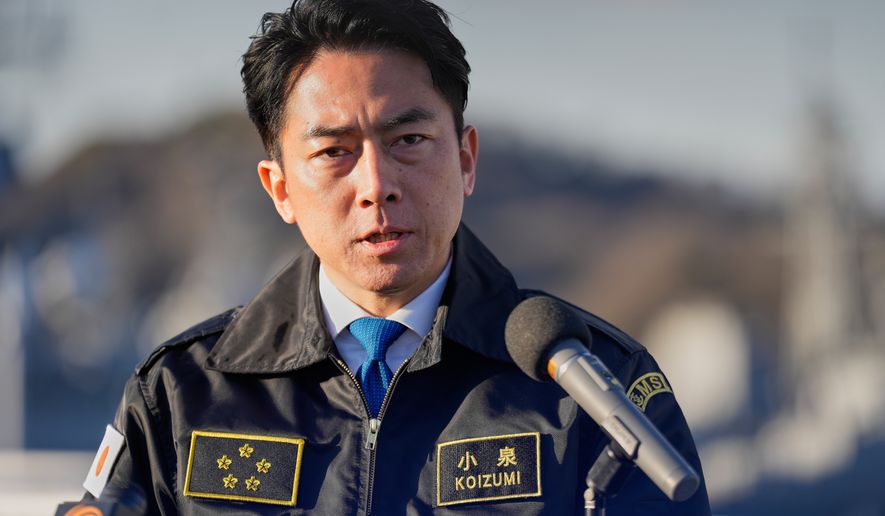

Japanese Defense Minister Shinjiro Koizumi this week again urged his government to urgently debate acquiring nuclear weapons amid growing nuclear threats from China.
The minister said during a three-hour television interview that Tokyo also should consider acquiring nuclear-powered submarines to bolster its limited but modernizing self-defense forces.
“Japan is being watched by the international community. It is watching what kind of security strategy Japan develops,” he said on the satellite news outlet BS Fuji.
People were interested in these podcasts
“Regarding the issue of nuclear weapons [and Japan’s Three Non-Nuclear Principles], and presumably the issue of nuclear-powered submarines, I think these are things that previously were difficult to discuss. My position is that we should discuss them without taboos and without excluding options,” Mr. Koizumi said.
It was the second time the defense minister called for a debate on nuclear weapons. He made similar comments in July.
The defense minister also said the debate in the one-time constitutionally pacifist nation should be held without restrictions or without making decisions in advance, and insisting the discussion of building nuclear weapons is unacceptable for Japan “is somewhat at odds with my sense of urgency.”
The widely reported comments prompted Mr. Koizumi to issue a statement a day later explaining that he did not mean Japan had decided to acquire nuclear weapons or nuclear submarines.
In the Monday broadcast interview, Mr. Koizumi noted the expanding nuclear arms threat from China and he rejected Beijing’s propaganda claim that Japanese military modernization is a “new militarism.”
Japan does not possess nuclear weapons or strategic bombers, while China has deployed substantial numbers of both, he said.
Japan boasts a highly developed nuclear power infrastructure and analysts estimate that if a decision were made to build nuclear arms, Tokyo could do so within six months to three years.
In Beijing, a Foreign Ministry spokesman condemned the defense minister’s remarks and urged Tokyo to abide by its obligations under the Nuclear Non-Proliferation Treaty.
“Japan is a non-nuclear-weapon state party to the Non-Proliferation Treaty and therefore has a bounden duty under international law to not receive, manufacture, acquire or transfer nuclear weapons. There is no room for negotiation,” Ministry spokesman Guo Jiakun told reporters.
Critics note China’s urging adherence to NPT guidelines is hypocritical based on past Chinese technology and material transfers to nuclear arms programs in Pakistan, Iran, North Korea and Libya in violation of NPT obligations.
Official Japanese statements on debating nuclear weapons are viewed by analysts as part of Tokyo’s effort to counter Chinese cognitive warfare against Japan.
Raising the prospect of the nuclear debate in strategic messaging is aimed at disrupting Beijing’s psychological dominance and challenges regional deterrence assumptions.
“Beijing has dramatically ramped up its belligerence toward Japan since Prime Minister Takaichi entered office in October 2025,” stated a report by the Jamestown Foundation.
Japan is developing countermeasures but needs better strategic messaging to blunt the aggressive cognitive warfare from Beijing, the report said.
President Trump discussed Japan’s worries about China during a phone call with Japanese Prime Minister Sanae Takaichi hours after his summit with Chinese President Xi Jinping. The discussion included security related to China, Ms. Takaichi told reporters.
Contact the author


Please read our comment policy before commenting.