


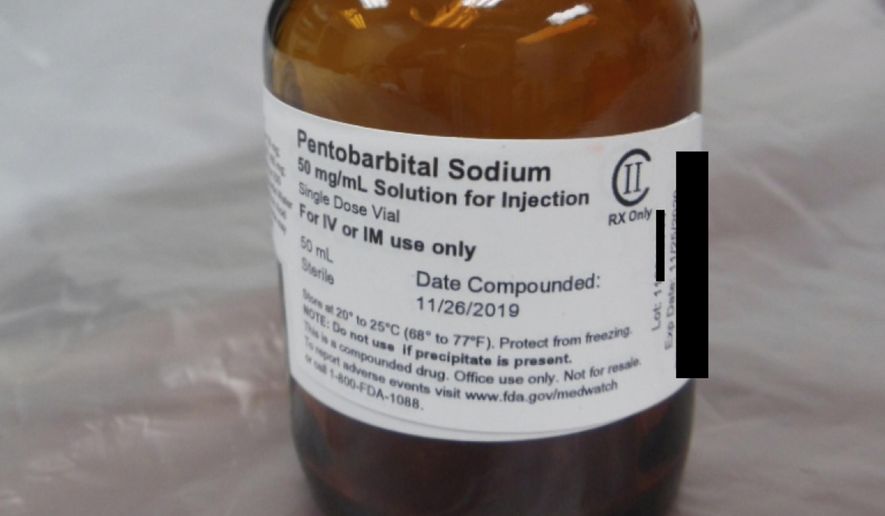

Tennessee officials could not carry out the execution of Christa Gail Pike on Wednesday after giving her two doses of pentobarbital, putting a drug long used in medicine, and increasingly in death chambers, at the center of a national debate.
Pike, 50, was taken to a hospital after she remained alive following two doses, and Gov. Bill Lee paused all remaining executions this year pending a third-party review. She would have been the first woman executed in Tennessee in more than 200 years.
What is pentobarbital?
People were interested in these podcasts
It is a barbiturate that slows activity in the brain and nervous system and is used medically to treat seizures. At high doses, it can suppress breathing and cause death.
In executions, it can be given alone or with other drugs. Tennessee switched to a single-drug pentobarbital protocol in 2024.
The drug has also been a flashpoint in federal policy. Attorney General Merrick Garland withdrew the Justice Department’s pentobarbital protocol in the final days of the Biden administration, citing scientific uncertainty over whether it causes unnecessary pain. The department has since reauthorized it. The protocol was used for 13 federal executions during the first Trump administration.
What went wrong in Tennessee
The state has not explained why Pike survived. The Department of Correction said its staff followed every step of the approved protocol and that the drug has consistently worked in past executions. Pike’s attorneys said the concerns they raised beforehand proved true, citing difficult vein access and “degraded pentobarbital”. Those are the lawyers’ claims, not established findings.
The state’s protocol calls for a second set of syringes if the inmate is not dead after the first, according to The Independent, but does not say what happens if the inmate is still alive after the second. Robin Maher, executive director of the Death Penalty Information Center, called the outcome “singular and unparalleled.”
It was the second failed attempt in Tennessee this year. In May, the state halted the execution of Tony Carruthers after the team could not establish a required backup IV line.
Lethal injection has historically had the highest rate of botched executions: 7.2%, against 3.15% across all methods from 1890 to 2010, according to scholar Austin Sarat’s data.
This article was constructed with the assistance of artificial intelligence and published by a member of The Washington Times' AI News Desk team. The contents of this report are based solely on The Washington Times' original reporting, wire services, and/or other sources cited within the report. For more information, please read our AI policy or contact Steve Fink, Director of Artificial Intelligence, at sfink@washingtontimes.com
The Washington Times AI Ethics Newsroom Committee can be reached at aispotlight@washingtontimes.com.

Please read our comment policy before commenting.