


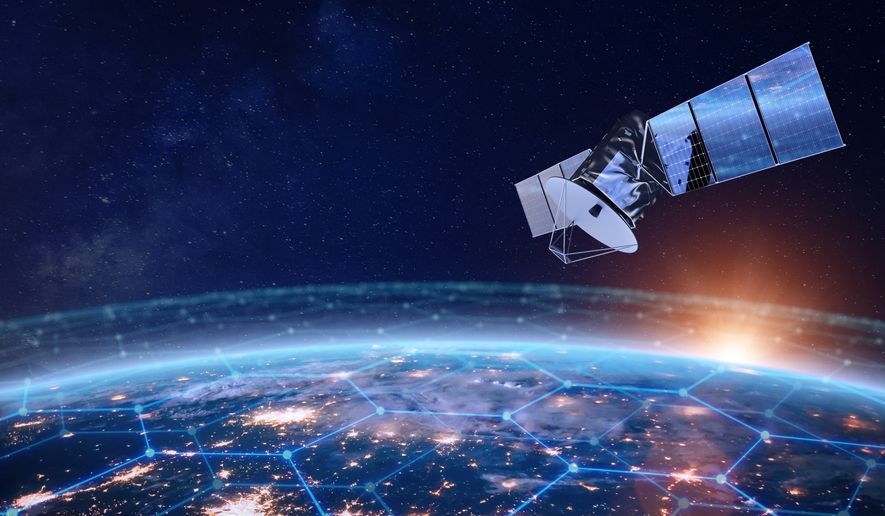

A refrigerator-size satellite carrying four Google AI chips reached orbit Oct. 1. It is the first flight test of Google’s plan to someday run artificial intelligence data centers in space.
Google is not promising a quick payoff. Travis Beals, who leads the company’s Project Suncatcher, told NPR he does not expect computing in orbit to be cheaper than computing on the ground within the next five years.
So could data centers in space actually work? Research from Google, a European consortium and independent scientists suggests orbit offers more sunlight and needs no cooling water. Cooling, networking, repairs and launch costs still stand in the way. Much of this work is preliminary, and several key papers are preprints that have not been peer reviewed.
People were interested in these podcasts
The scale of the problem shows up in one model. In an April engineering preprint, Slava G. Turyshev of NASA’s Jet Propulsion Laboratory estimated that a 1-megawatt orbital data center would need about 60,700 square feet of solar panels and about 26,900 square feet of radiators. Its solar, energy storage and radiator hardware alone would weigh about 29 metric tons, before the rest of the spacecraft is counted. The estimates are illustrative rather than demonstrated engineering requirements.
That scale captures the central problem with orbital computing. Space offers abundant solar energy, but every server, cable, radiator and replacement part must first become rocket cargo.
The concept has moved beyond company presentations. Google has tested its Tensor Processing Units for radiation exposure and designed a compact satellite cluster. A European Commission-backed consortium has studied data centers in space. Researchers also have published lifecycle, networking and economic models.
Why would anyone put a data center in space?
Orbit offers near-constant sunlight and needs no land or cooling water, two resources data centers on Earth increasingly compete for.
Data center construction is becoming a national power-planning issue. Lawrence Berkeley National Laboratory estimates in its 2024 report that data centers used about 4.4% of U.S. electricity in 2023 and could use 6.7% to 12% by 2028.
Certain low Earth orbits receive nearly continuous sunlight. Google researchers estimate that solar panels there could collect up to eight times as much energy per year as a panel at a midlatitude site on Earth.
Orbital facilities also would not occupy terrestrial building sites or consume local water for cooling. The European ASCEND feasibility study identified the absence of cooling water as a possible advantage, particularly in drought-prone areas.
How do you cool AI chips in space?
With large radiators, because a vacuum does not carry heat away the way air or water does.
Space is cold, but cold alone does not help. As NASA explains, spacecraft must move heat away from electronics and then radiate it into space.
That requirement can make radiators a major part of an orbital data center’s physical footprint. Nearly all the electricity the processors consume eventually becomes heat, so large deployable radiators would replace terrestrial cooling towers.
Google has called cooling the chips “a crucial research challenge” for Project Suncatcher. The company says it is testing a combination of heat pipes and radiators, has run them in a thermal vacuum chamber that simulates space and expects the orbital mission to show how the system performs.
Mr. Beals told NPR the radiators are among the heaviest parts of the current satellite. Heat also constrains how that prototype operates, keeping its chips running Google’s Gemma AI model in 15-minute stretches.
Radiators also must survive launch, deployment, debris strikes and repeated temperature swings without routine human maintenance.
Can satellites share data fast enough for AI?
Not yet. The laser links an orbital AI cluster would need are roughly 100 times faster than the fastest links commercial satellites use today.
Modern artificial intelligence systems depend on rapid communication among large numbers of processors. According to Google’s analysis, commercial optical links between satellites typically provide 1 to 100 gigabits per second. An orbital machine-learning cluster would need about 10 terabits per second on each link.
Google’s bench-scale test reached 1.6 terabits per second, counting both directions, over a short free-space path in a lab. That does not establish that the same throughput can be held between spacecraft moving at orbital speed.
To make the links work, Google proposes flying satellites unusually close together. Its illustrative design is an 81-satellite cluster within a radius of about 0.6 miles. The distance between some neighboring satellites would swing between roughly 330 and 660 feet as they orbit.
That arrangement would require precise formation flying, collision avoidance and continuous laser alignment. A July preprint by Kees van Berkel of Eindhoven University of Technology lists formation control and the steering of thousands of laser beams among the unsolved problems. Modeling the network itself, he concluded that using already-trained AI models in orbit may be feasible. Training the largest AI models in orbit, however, would probably cost more than doing it on the ground.
When could space data centers compete on cost?
Possibly by the mid-2030s under Google’s assumptions. An independent model, however, finds today’s launch prices far too high.
Radiation is one cost driver. It can damage electronics gradually or cause sudden errors in memory and calculations. NASA’s next-generation spaceflight processor includes radiation tolerance, error correction and fault protection because conventional hardware cannot be assumed to operate reliably in orbit.
Google reported that its Trillium processors survived a radiation dose equivalent to a five-year mission without permanent failure. Its memory chips began showing irregularities only at nearly three times that dose. The tests still detected radiation-induced errors. Google’s researchers said that error rate is likely acceptable for answering queries, but that the effect on AI training needs further study.
Terrestrial data centers can replace failed pumps, switches and processors. Google’s researchers acknowledge that such maintenance would be impractical in orbit and suggest adding redundant equipment instead. That adds mass, and launch is priced by mass.
Disposal creates another obligation. Federal Communications Commission rules adopted in 2022 require satellites ending their missions in or passing through low Earth orbit to deorbit within five years of the end of their missions, sooner if practicable.
Then comes launch. Google’s projections assume launch costs falling below $200 per kilogram by the mid-2030s. At that price, the company estimates, the cost of launching a satellite’s power capacity, spread over its lifetime, could roughly match what U.S. data centers pay for electricity. Google’s own analysis says that would take about 180 Starship launches a year and high rates of rocket reuse.
Mr. Turyshev’s economic model is less optimistic. For a design weighing about 40 kilograms per kilowatt of computing power, he found that matching ground-based infrastructure costs would leave only $250 to $1,000 per kilogram for launch and spacecraft construction combined, before communications, operations and other costs are counted. That is 3.4 to 13.5 times below the current public price of a dedicated Falcon 9 launch alone. His results depend on his model’s assumptions rather than a verified price threshold.
Environmental benefits are equally conditional. The ASCEND study found that significantly cutting carbon emissions with orbital data centers would require launch vehicles producing roughly a tenth of the emissions over their full lifecycle. Researchers at Singapore’s Nanyang Technological University reached a more optimistic conclusion. They estimated that solar-powered orbital data centers could offset their launch emissions within a few years of operation.
The more credible early use may be processing information already collected in space. The Nanyang team, writing in Nature Electronics, has proposed orbital edge computing, in which imaging satellites equipped with AI chips analyze their own data in orbit and send down only what matters. The researchers estimate that could cut data transmission by more than 100 times. Mr. Turyshev’s preprint reaches the same conclusion.
The satellite that launched Oct. 1 is a small first step. Mr. Beals called it “a very minimal test” to confirm the chips can run in space, with a goal of operating for a year. Two more satellites are slated for 2027 to test the laser connection between spacecraft. For now, the realistic goal is not replacing terrestrial data centers. It is proving that a small cluster can survive, communicate and cool itself without human repair.
This article was constructed with the assistance of artificial intelligence and published by a member of The Washington Times' AI News Desk team. The contents of this report are based solely on The Washington Times' original reporting, wire services, and/or other sources cited within the report. For more information, please read our AI policy or contact Steve Fink, Director of Artificial Intelligence, at sfink@washingtontimes.com
The Washington Times AI Ethics Newsroom Committee can be reached at aispotlight@washingtontimes.com.

Please read our comment policy before commenting.