


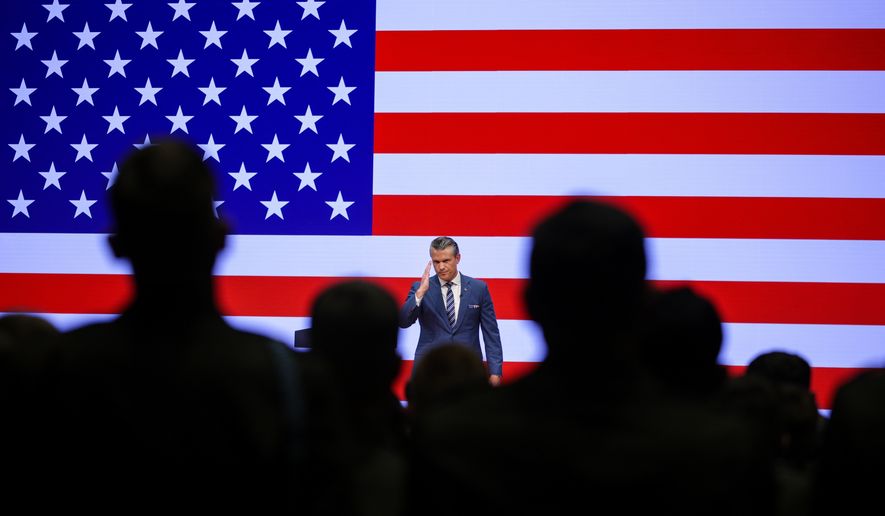

Defense Secretary Pete Hegseth on Saturday indicated that the U.S. could shift military resources from Europe to Central and South America to bolster the Pentagon’s efforts to combat drug trafficking in the hemisphere.
In remarks to reporters in Colorado Springs, Mr. Hegseth confirmed that the Pentagon is looking to expand its “presence and our footprint” in the Western Hemisphere, especially following the ouster of Venezuelan President Nicholas Maduro in January.
“Because of the bold move the president made in Venezuela,” Mr. Hegseth said. “We have a whole new suite of options economically and militarily with partnerships.”
People were interested in these podcasts
Specifically, Mr. Hegseth said the U.S. is working with Ecuador, Honduras, Guatemala and Panama to execute President Trump’s national security strategy, which not only emphasizes the importance of U.S. involvement in Central and South America but also increased “burden sharing” in Europe.
The comments come as the Pentagon enters the final stretch of its six-month review of its military posture in Europe, aimed at finding ways to shift defense responsibilities off the U.S. and toward NATO allies. The review is expected to finish in December.
The possibility of an American pullback in Europe has been greeted with alarm among the NATO members dealing with an aggressive and intensifying Russian campaign of hybrid warfare — including airspace violations by drones in Poland and Romania, an explosive-laden drone incident at Germany’s Leipzig Airport, cyberattacks and infrastructure sabotage, such as a suspected arson at a Polish Starlink station.
A U.S. move to deemphasize Europe could also signal an escalation in conventional U.S. military activity in Latin America. The Trump administration has already launched at least 70 airstrikes on small boats traveling in the Caribbean and Eastern Pacific since last September, killing at least 234 people.
U.S. officials maintain that those boats are captained by narco-terrorists, bent on distributing dangerous drugs across the region. The Trump administration has cast the operation, which has slowed in recent months since the war with Iran began, as a national security operation and has rejected assertions from critics that the strikes are a violation of international law.
The boat strikes have coincided with increased security and law enforcement cooperation between the U.S. and South American countries. Last month, the U.S. assisted Ecuadorean police in conducting several raids on alleged drug traffickers, many of whom Washington has designated as terror threats.
Mr. Hegseth and other Trump administration officials have said directly that the U.S. is at war with drug traffickers in South and Central America and will do anything to combat them. At his speech on Saturday, Mr. Hegseth cast drug cartels as the “ISIS and Al Qaeda of our hemisphere.”
Contact the author


Please read our comment policy before commenting.