



OPINION:
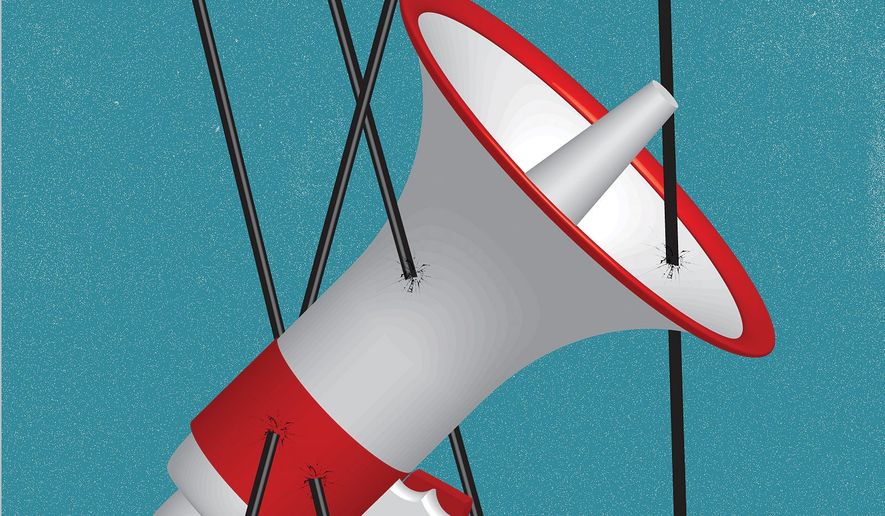
The freedom of speech and of the press is not a gift bestowed by a president, Congress or a federal agency. It is a natural right of all persons.
The First Amendment does not create that right; it prohibits the government from infringing upon it. The ability to think, speak, write, criticize, ridicule, persuade, offend, dissent and challenge those in government is among the most fundamental preconditions of the exercise of human liberty.
It is also indispensable to personal happiness. A person who cannot speak his mind, question authority, express unpopular ideas or tell the government that it is wrong is not fully free.
And free speech is essential to the survival of the republic because a government that cannot be criticized cannot be effectively held accountable.
Today, government power is being brought to bear against institutions, journalists and universities because their speech is considered objectionable by the president and his political allies.
This is hardly the first time an American administration has made that mistake.
During World War I, Congress enacted the Espionage Act of 1917 and the Sedition Act of 1918, which criminalized public criticism of the war. President Wilson used both to punish speech. The lesson is enduring: Once government convinces itself that national unity or security requires suppressing dissent, the category of supposedly dangerous speech can expand with frightening speed.
After Pearl Harbor, President Franklin D. Roosevelt established an Office of Censorship and explicitly defended wartime censorship as necessary to national security. More dramatically, he authorized military commanders to impose speech and travel restrictions on designated areas in the U.S., ultimately facilitating the forced removal and incarceration of Japanese Americans.
This was a suppression of speech and travel on an enormous scale that was ignominiously approved by the Supreme Court.
In the aftermath of 9/11, the government dramatically expanded surveillance and investigative authority through the so-called Patriot Act and the National Security Agency’s warrantless surveillance programs. The George W. Bush administration defended those measures as necessary to protect Americans while insisting that somehow civil liberties remained protected, an insistence few believed or cared about.
In all these cases, the government used the same concept as its trigger (emergency), since so-called emergencies are the times when constitutional liberties are most likely to be treated as obstacles rather than boundaries.
The government is not omnipotent. There are areas of human behavior forbidden to it. Speech is foremost among them.
Universities are supposed to be places where ideas compete, including ideas that many people find offensive, foolish, repugnant or dangerous. The constitutional answer to bad ideas in a free society is more speech, not government coercion.
Yet the Trump administration has pursued universities over a range of controversies involving protests, diversity policies and alleged dangerous speech, using investigations and the withholding or threatened withholding of federal funding as leverage.
There is a legitimate governmental interest in protecting students from actual harassment and violence. But that authority cannot constitutionally become a back door through which the federal government decides which political, academic or ideological viewpoints universities may tolerate.
The First Amendment becomes meaningless if universities are told that their free speech is contingent on pleasing the government.
The same principle applies to broadcasting. The Federal Communications Commission, an unconstitutional and authoritarian New Deal vestige, possesses substantial regulatory authority over broadcasters, which makes political retaliation particularly dangerous.
The FCC has undertaken investigations and an early review of eight ABC-owned broadcast licenses. ABC and Disney have credibly alleged that these proceedings constitute retaliation for programming and editorial decisions that the administration dislikes.
But government does not need to issue an explicit threat to chill speech. If a broadcaster reasonably fears that criticism of the president could trigger a burdensome investigation, license challenge or regulatory punishment, the constitutional problem can arise before any government official formally prohibits a single word.
That is the irony of censorship: Those who suppress criticism usually believe they are protecting something more important. Wilson invoked wartime necessity. Roosevelt invoked national security. Mr. Bush invoked terrorism.
Today’s administration invokes bias, discrimination, misinformation, ideological imbalance or institutional misconduct.
The vocabulary changes; the temptation does not.
A genuine understanding of free speech must reject the idea that constitutional liberties belong only to people who say things of which the government approves.
Free speech protects the dissenter. It protects the radical. It protects the journalist who gets under the president’s skin. It protects the professor whose political opinions infuriate half the campus. It protects the student who says something unpopular. It protects the broadcaster whose editorial judgment the government considers irresponsible. It even protects speech that is objectively hateful, foul or contemptible.
The test of government fidelity to the Constitution is not whether the government protects popular speech; the test is whether it protects all speech.
That is why the question is larger than Mr. Trump. Presidents come and go. Political majorities change. Today’s censored opinion can become tomorrow’s majority position, and today’s majority can become tomorrow’s dissident minority.
The framers understood that government cannot be trusted with the authority to determine which ideas Americans may express. Once that authority exists, every administration inherits it — and eventually someone will use it.
So the proper response is not to ask whether President Trump’s targets deserve protection. The proper question is whether any administration should possess the power to punish persons because of what they think and say. The Constitution’s answer is no.
Freedom of speech is not a luxury or a public relations principle. It is not something that disappears whenever a president becomes angry, a war begins, a university tolerates controversy or a government agency decides that the public has been exposed to too much dissent.
It is a natural right, a condition of personal freedom and human happiness. And without the ability to say whatever we want to the government, the republic eventually ceases and becomes an empire.
• To learn more about Judge Andrew Napolitano, visit https://JudgeNap.com.
Follow the author

Please read our comment policy before commenting.