


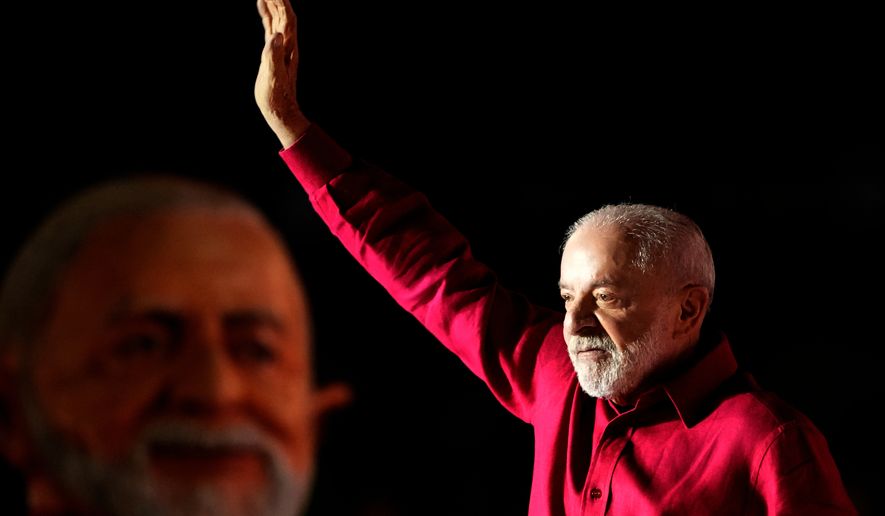

RIO DE JANEIRO — Brazilian President Luiz Inácio Lula da Silva signed a decree on Thursday increasing benefits under his flagship welfare program by 15%, weeks before the first round of the presidential elections.
The minimum monthly benefit per family of Bolsa Familia (Family Grant) will rise to $134 next month, from $117. The decree says that it adjusts payments for accumulated inflation since March 2023.
The measure will increase the purchasing power of some voters, who will decide in October whether to grant Lula a fourth, nonconsecutive term, or elect Sen. Flávio Bolsonaro, a son of former President Jair Bolsonaro, in a likely run-off vote. Polls show the two are currently running neck-and-neck.
“Bolsa Familia is central to our strategy to look after more vulnerable families, guarantee income so that people emerge from poverty and don’t suffer from food insecurity,” Finance Minister Dario Durigan said.
The additional spending would be absorbed within existing budget allocations and would not represent a new expenditure, he added.
The measure will cost $1.1 billion this year and around $4.3 billion next year, a statement from the Brazilian government’s communications secretariat said. The average benefit will increase from $132 to $151, the statement added.
Millions of families will receive the new amount from Oct. 19. The potential run-off vote is scheduled for Oct. 25.
The announcement prompted lawmaker and Sen. Bolsonaro ally Marcos Antônio Pereira Gomes, known as Zé Trovão, to ask Brazil’s electoral court to suspend the decree, alleging that it amounts to an electoral measure that violates Brazilian law, according to local press articles shared by Trovão on social media.
Some justices from Brazil’s top court also sit on the country’s electoral court. Supreme Court Justice André Mendonca, a Bolsonaro appointee who faces accusations of political bias, will oversee the case brought by Trovão, local press reported.
Some members of Brazil’s Supreme Court have recently openly accused Mendonca of selectively releasing parts of the sprawling Banco Master case, which has ensnared justices and politicians, including Lula’s main rival in this election, Sen. Bolsonaro, and Justice Alexandre de Moraes - who oversaw the case that led to former President Bolsonaro’s 27-year sentence for attempting a coup.
Critics allege Mendonca has purposely slow-walked the release of parts of the investigation that relate to Sen. Bolsonaro to coincide with the upcoming elections. Mendonca denies the accusations.
Lula introduced the cash-transfer program at the beginning of his first term in 2003. It provides financial aid to low-income families, conditional on children’s school attendance and health requirements, such as vaccinations.
Bolsa Familia was the subject of thousands of academic studies in Brazil and abroad, which reported significant reductions in poverty, inequality and infant mortality. Researchers also found greater access to basic health and said school attendance also improved.
Bolsonaro replaced the program with Auxilio Brasil (Brazil Aid) ahead of the 2022 vote, in what analysts widely saw as an effort to rebrand the popular program associated with Lula to buoy his reelection chances. Lula defeated Bolsonaro.
Last week, Lula signed a decree and a provisional measure aimed at lowering fuel prices, as the U.S.-Iran war drives up the cost of filling the tank. The cost of fuel is a particularly sensitive issue for voters.

Please read our comment policy before commenting.