



A version of this story appeared in the daily Threat Status newsletter from The Washington Times. Click here to receive Threat Status delivered directly to your inbox each weekday.
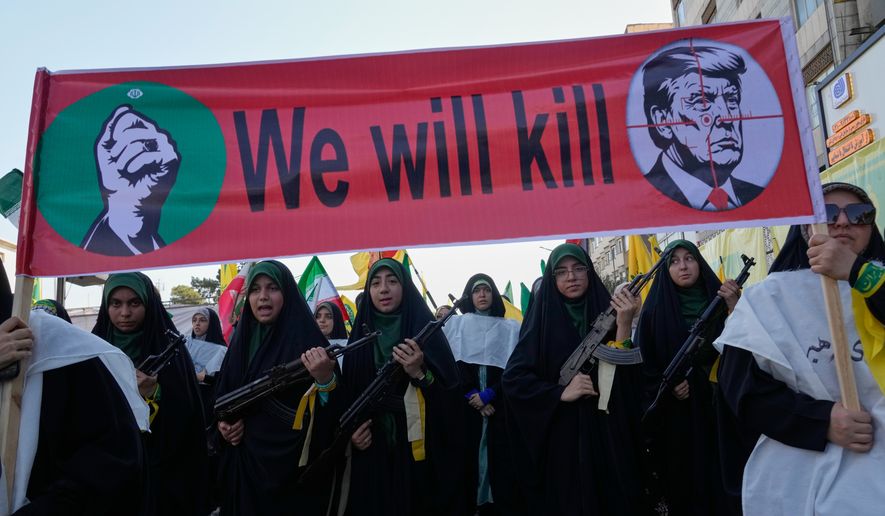
Iran possesses new weapons capable of expanding “the geography of the war” with the U.S., a top Iranian general warned Monday as President Trump weighs whether to resume strikes and deepen America’s role in a widening Middle East conflict.
The threats from Brig. Gen. Hossein Mohebbi, a key figure in Iran’s Islamic Revolutionary Guard Corps, may be little more than bluster to deter U.S. strikes against Iran or its proxies. Nevertheless, his warning that new weapons could target previously safe U.S. bases is being taken seriously across the Pentagon and Washington’s national security community.
Gen. Mohebbi made the comments just days after a major Pentagon inspector general report detailed the significant damage Iranian drones and ballistic missiles have inflicted on U.S. installations across the region.
People were interested in these podcasts
The implication is that if Mr. Trump orders new U.S. strikes against Iran or its proxies, such as the increasingly dangerous Houthis in Yemen, American military bases will face further damage, along with the potential for more U.S. casualties at a delicate political moment just six weeks before the midterm elections.
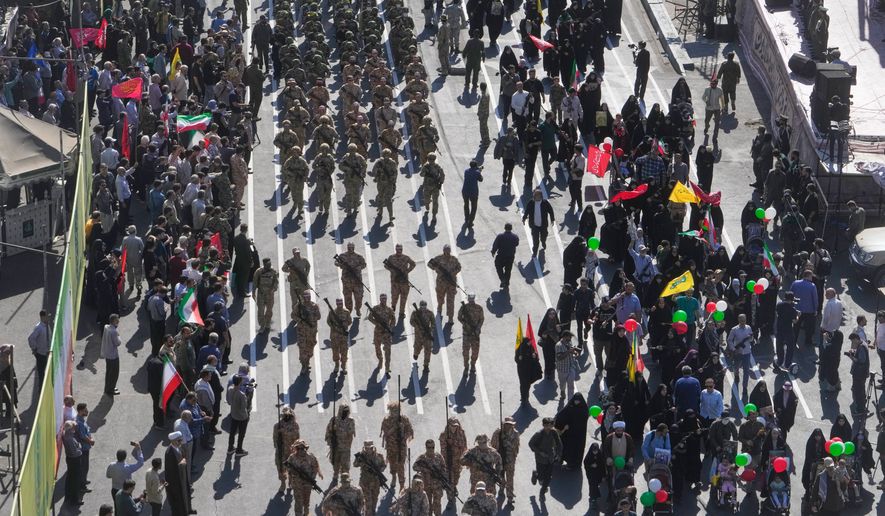
Iran’s threats will also fuel suspicions that adversary nations in the so-called Axis of Authoritarians — namely China and Russia — are helping Tehran develop weapons targeting U.S. assets. Analysts warn that assistance from Beijing and Moscow has allowed Iran’s military to strike far above its independent capacity, potentially improving its missile capabilities and real-time targeting of U.S. assets.
“Why is the United States of America having such a problem? There’s many answers to that, but one is the help that they have received and are receiving from China and Russia,” said Bradley Bowman, senior director of the Center on Military and Political Power at the Foundation for Defense of Democracies.
SEE ALSO: Trump weighs massive strike amid rebel military pressure on Gulf region oil
“China has shipped multiple shipments of chemical precursors to the Islamic Republic of Iran. … That’s sodium perchlorate, and those chemicals are used in missiles. And it is not hyperbole to say that many of the missiles that have caused American, Arab or Israeli casualties had Chinese chemicals in them. China has also transferred control of a satellite that has been likely used to target U.S. forces,” Mr. Bowman recently told The Washington Times’ “Threat Status” podcast. “In the conflict this year, Russia has provided targeting assistance to the Islamic Republic of Iran to attack American bases and intelligence facilities.”
Iran warned that if Mr. Trump orders new attacks, it will expand the scope of the war and deploy its new weapons.
“If another aggression takes place, there will certainly be significant changes in our defense and our counterattack,” Gen. Mohebbi said, according to the country’s state-run Fars News Agency.
“We will definitely change the geography of the war,” he said, according to English-language translations of his comments.
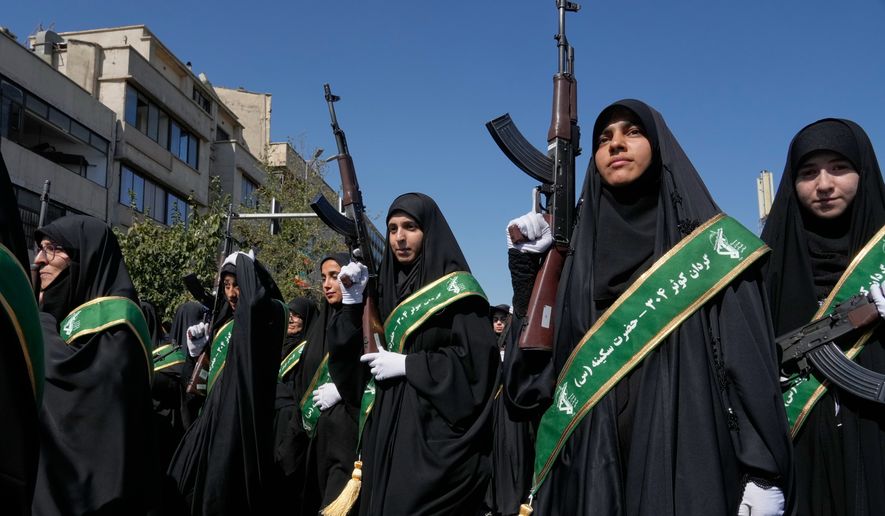
He made the strong comments as world leaders gathered in New York for the annual United Nations General Assembly meeting. The Iran war is expected to be a key topic.
All eyes will be on Mr. Trump, who over the weekend said he was deciding whether to launch a catastrophic military attack on Iran.
SEE ALSO: Iran hit hundreds of buildings, dozens of aircraft as war drains U.S. munitions, IG says
“My question is, if and when do I blow the entire nation up? They better behave,” Mr. Trump told Fox News chief foreign correspondent Trey Yingst in a phone interview Sunday morning.
The president’s threat followed his sudden return to the White House on Saturday from Camp David, cutting short a weekend getaway.
Mr. Trump said he was in “deciding mode” on Iran and “very big things are going to be happening in the not-so-distant future.”
The administration aims to increase economic pressure on Iran while weighing its military options.
Treasury Secretary Scott Bessent said Monday that the U.S. will begin imposing strict sanctions on any country that allows Iran to refuel or service its airplanes — a move U.S. officials said will cripple Iranian air travel.
“On Sept. 23, all the Iranian airlines will be shut down around the world,” Mr. Bessent told CNBC in an interview.
He said Washington would carry out the plan by cutting off countries from U.S. currency if they service or refuel Iranian airplanes.
Resuming U.S. attacks on Iran or the Houthis would represent a response to regional escalation. Saudi Arabia confirmed over the weekend that Iran-backed Houthi rebels in Yemen attempted to attack its capital with ballistic missiles.
Saudi-led coalition forces spokesperson Maj. Gen. Turki al-Maliki said Saturday that Royal Saudi Air Defense Forces “successfully intercepted and destroyed a ballistic missile” launched by the Houthis and aimed at Riyadh.
The Houthis have also captured a strategic island in the southern Red Sea, giving them greater control over the Bab el-Mandeb Strait, another critical chokepoint connecting the Red Sea to the Gulf of Aden. Global oil prices are already high because of Iran’s hold on the Strait of Hormuz, the critical channel through which Gulf oil exports flow.
Two tankers were reportedly hit Monday by unknown projectiles while sailing through the Strait of Hormuz. It was not immediately clear whether Iran was responsible for the strikes, but the incidents underscore just how disrupted the situation has become in and around the strategically vital waterway.
In Yemen, Houthi leaders warned other nations Monday against joining the Saudi offensive there, but the Iran-backed rebel group also appeared to be walking a rhetorical tightrope as it looks to avoid provoking U.S. strikes.
“We confirmed that we are not targeting the United States, or any other nation, in the strait, with the sole exception of the Saudi enemy,” Mohamed al-Bukhaiti, a member of the Houthis’ political bureau, told The Associated Press. “That remains the case.”
A Defense Department inspector general report revealed that Iranian missile and drone attacks on U.S. outposts have damaged or destroyed hundreds of buildings and dozens of combat aircraft since the conflict began in late February.
Investigators also detailed the U.S. military aircraft destroyed or heavily damaged in the conflict, including F-15E and F-35 fighters, KC-135 refueling aircraft, combat helicopters such as the AH-64 and the MH-60, along with drones such as the MQ-4C Triton and the MQ-9 Reaper. The inspector general said as many as 30 Reapers have been destroyed in the fighting.
Iran’s ability to target U.S. facilities in the Middle East has sparked new Pentagon initiatives to guard American personnel, buildings and equipment.
• Susan Ferrechio and John T. Seward contributed to this report.
Contact the author


Please read our comment policy before commenting.