


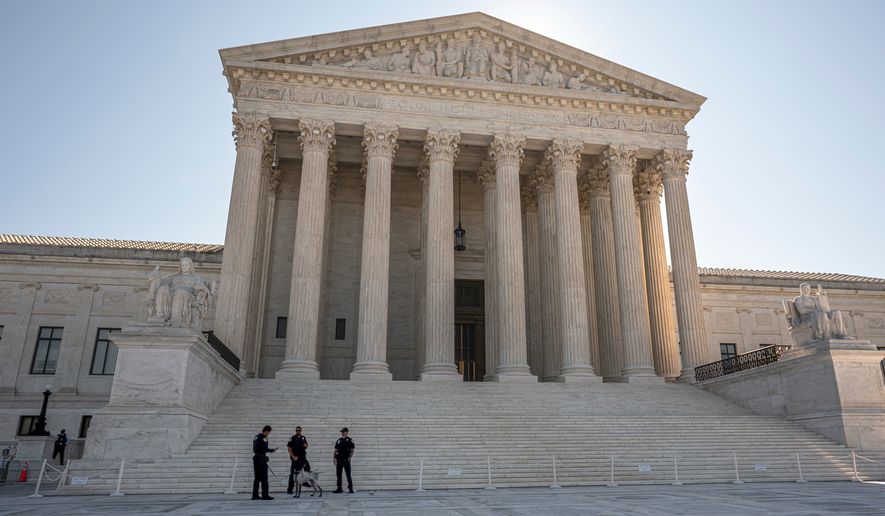

President Trump on Monday asked the Supreme Court to approve the federal prisons’ new policy of refusing to pay for hormone treatments and surgeries for prisoners who seek to undergo gender transitions while behind bars.
A lower court blocked the change and ordered the Federal Bureau of Prisons to keep offering those treatments. U.S. Solicitor General D. John Sauer told the justices that the judge was wrongly imposing his own “policy judgments” on the entire government.
“BOP’s decision to prioritize mental-health treatment, while discontinuing medically disputed and unproven sex-rejecting interventions, falls well within the bounds of reasoned decision-making,” Mr. Sauer said in a petition asking the justices to block the lower court’s injunction.
People were interested in these podcasts
The case is part of a growing number of cases asking the Supreme Court to settle thorny emerging questions about transgender rights.
The Trump administration is also battling to enforce its policy of trying to hold transgender prisoners with other prisoners of the same biological sex, rather than based on gender identity.
In the case now before the justices, the government this year issued a policy forbidding sex-altering surgery, hormone treatments and “social accommodations” for transgender prisoners. Mental health services are still allowed under the Trump policy.
The case comes to a high court that has lent a sympathetic ear to complaints about growing demands by transgender Americans.
In cases over the past 18 months, the justices said states could bar transgender athletes from public sporting events and impose restrictions on transgender treatments for juveniles.
The lower court called the updated prison policy arbitrary, saying it conflicted with the Bureau of Prisons’ past reliance on findings by the World Professional Association for Transgender Health.
But the Trump administration says WPATH’s recommendations have been “cast into serious doubt” by subsequent work and can no longer control the government’s decision-making.
Prison officials also said they had concerns over security and difficulty in administering prisons. That included the danger that those who underwent “sex-rejecting interventions” would become targets for other inmates.
The Bureau of Prisons said it has to exert “significant” time in trying to figure out housing arrangements for prisoners who are transitioning.
Providing social accommodations also created friction in the prison, officials argued.
Contact the author


Please read our comment policy before commenting.