


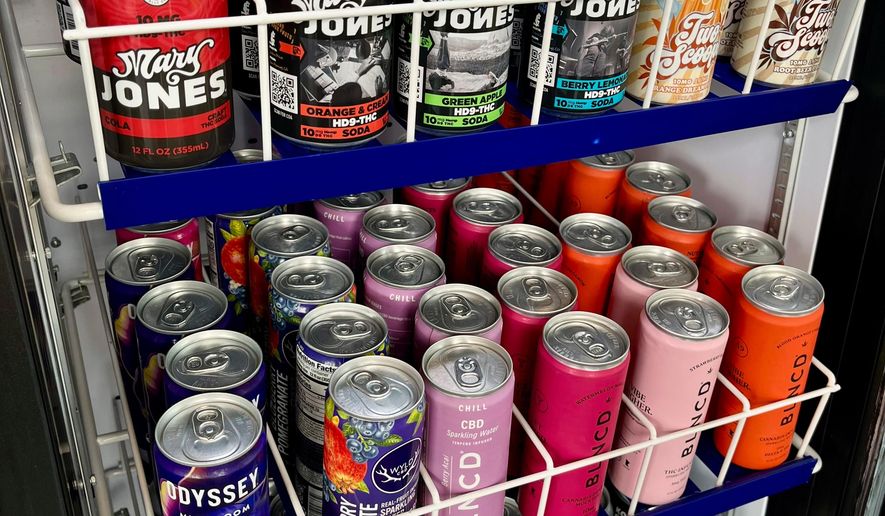

Producers of hemp-derived beverages and similar products got a little breathing room with a one-month delay of a law that threatens to shut down their industry.
It’s not a lot of time, but supporters of intoxicating hemp products plan to use the reprieve to broker a deal for less sweeping federal regulations.
“Adults should have the freedom to purchase a THC beverage if they want to,” said Democratic Sen. Tina Smith, a top supporter of the industry, in a statement. She called the federal ban “ill-advised.”
People were interested in these podcasts
The law banning intoxicating hemp products that Congress enacted in a spending package last fall was set to take effect on Nov. 12. A temporary government funding bill that Congress passed and President Trump signed into law last week delayed the effective date to Dec. 11, when the stopgap funding expires.
Mr. Trump and the White House have asked lawmakers to revise the law to exclude full-spectrum CBD products from the broader ban on hemp-derived cannabinoid products.
“We must get this done RIGHT and FAST, especially for those who saw that CBD helps them,” Mr. Trump said on social media in April. “Plus, I am told it will also help our GREAT FARMERS, who we love, and will always be there for. Please get it done, and SOON.”
The president said Congress could update the law to allow CBD products with trace amounts of the psychoactive cannabis compound THC, while maintaining a ban on other hemp-derived products that pose health risks.
The law as written bans hemp-derived products that contain more than 0.4 milligrams of THC per container.
CBD is a nonpsychoactive cannabis compound but can contain trace amounts of THC — referred to as full-spectrum CBD.
Without a rewrite of the definition, the law would ban many full-spectrum CBD products, including topical products like oils and lotions, as well as edibles and beverages that are commonly used for pain relief.
The Hemp Beverage Alliance, the trade association for the industry, is hoping the one-month delay provides enough time for Congress to create a new regulatory framework that will save its industry while achieving lawmakers’ initial aims.
They not only want to save full-spectrum CBD products but also other hemp-infused beverages with THC, such as Delta-9.
The alliance supports a framework “that protects public health, keeps products away from minors, and permanently removes the bad actors that sell untested, high-potency, copycat gummies and candies that target children,” founder and president Christopher Lackner said in a statement.
He pointed to states, such as Georgia, Kentucky, Louisiana, Minnesota and New Jersey that regulate hemp beverages as models for Congress to use.
Ms. Smith and fellow Minnesota Democratic Sen. Amy Klobuchar hold up their state as the gold standard for regulation of hemp products.
Ms. Smith supported the one-month delay and is pushing for a long-term solution, alongside other opponents of the ban, such as Kentucky GOP Sen. Rand Paul.
In April, Mr. Paul and Ms. Klobuchar introduced a bill to allow states to opt out of the federal ban if they have their own regulations, including bans on synthetic cannabinoids that do not naturally occur in the hemp plant and a minimum age for purchasing other hemp-derived products.
Notably, Kentucky’s other Republican senator, Mitch McConnell, was the lead author of the federal ban.
Mr. McConnell was not present for the debate over the one-month delay in its implementation because he has been absent from the Senate since a serious fall in June, but other Republicans pushed back.
Sen. Ted Budd, North Carolina Republican, said in a floor speech on the issue that he was appalled by the intoxicating hemp industry’s “well-oiled, slick lobbying machine — which is very well connected in this town — that has chosen to wage this surreptitious war against our efforts to protect American children.”
He said the industry packages its intoxicating THC products with bright colors and designs intended to mimic popular snack food and candy brands — “unmistakably designed to appeal to children.”
“We are talking about unregulated hemp-derived products being sold on the shelves of nearly every corner store in America,” he said. “These intoxicating substances are hiding in plain sight — and they are putting our kids at risk.”
Mr. Budd offered an amendment to the government funding stopgap to strip the provision delaying the hemp ban.
It failed, but 31 other senators backed his proposal, signaling a notable roadblock to developing potential compromise regulations.
“I will not back down. I will not waver. And I will not stop until this life-threatening loophole is closed permanently,” Mr. Budd said.
Contact the author


Please read our comment policy before commenting.