



OPINION:
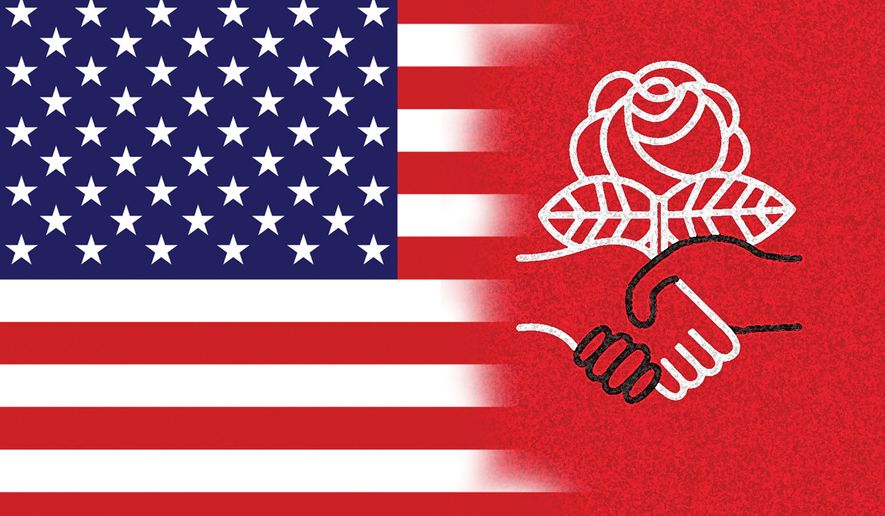
Many Black and brown voters are increasingly questioning whether democratic socialism offers the best path forward for their families and communities.
Yet recent elections have demonstrated that self-described democratic socialists are gaining influence within the Democratic Party.
As a Black theologian, economist and professor, I believe democratic socialism is being marketed as a solution to economic problems despite limited historical evidence that it produces better outcomes.
For much of my career, I have helped students understand the relationship between economics and human welfare. In time, I developed a framework called Tutt’s 4 C’s: Christianity, capitalism, constitution and contracts (the rule of law) — the principles that made America.
On the first day of class, I make a statement that often surprises students: “I will prove that the greatest economic system the world has ever seen is capitalism.”
Before opening a textbook, however, I ask students to listen to three songs: Loretta Lynn’s “Coal Miner’s Daughter,” Johnny Cash’s performance of Merle Travis’ “Sixteen Tons” and Grandmaster Flash and the Furious Five’s “The Message.”
We study the lyrics as economic texts.
Students identify themes of poverty, labor, debt, opportunity and economic struggle. I then remind them that all three artists began with very little. Through talent, hard work, entrepreneurship and economic freedom, they transformed their circumstances. They literally sang their way into prosperity.
Teaching in North Carolina, not far from Dollywood, we also discuss Dolly Parton. Born into poverty, she became one of America’s most successful entertainers, entrepreneurs and philanthropists.
The semester then turns to history. Students are introduced to Thomas Hobbes and John Locke. We examine Karl Marx and Friedrich Engels’ critique of capitalism and advocacy of socialism and communism. I require students to read these thinkers to understand America’s foundational ideas.
We study 1776, when America declared independence and Adam Smith published “The Wealth of Nations.” Together, those events helped shape the modern world.
Yet, I remind students, America’s Founders were not perfect men. They were flawed human beings who nevertheless advanced a revolutionary idea: that individual liberty comes from God and that the government exists to protect those rights rather than grant them.
I remind students that America proclaimed liberty and tolerated human bondage. Yet it was ultimately the Judeo-Christian belief that every human being is created in the image of God that fueled the abolitionist movement.
America corrected one of its greatest sins not by abandoning Christianity, but by applying Judeo-Christian principles more faithfully. We wrestle with slavery, discrimination, monopolies, exploitation and wealth inequality. Then I ask a larger question: What has happened to the world over the past 250 years?
The answer is remarkable. World Bank data reports that global poverty fell from 38% in 1990 to roughly 8.5% in 2024. Since 1776, life expectancy has increased, literacy has expanded, infant mortality has declined and billions of people have moved into higher standards of living.
These gains did not occur by accident. They coincided with the spread of economic institutions that protect private property, encourage entrepreneurship, reward innovation and operate within constitutional systems of law.
Capitalism has never been perfect, but historical evidence suggests that no alternative economic system has produced comparable improvements in human well-being on a global scale.
Given the data, one of the most important assignments in my classes comes at the end of the semester. Students are often required to write a final essay analyzing one of the most overlooked sermons in modern American history: the Rev. Martin Luther King Jr.’s sermon, “Can a Christian Be a Communist?”
Many Americans know King as the leader of the Civil Rights Movement. Far fewer know that he delivered a forceful theological critique of communism.
King preached it while serving a predominantly Black congregation. He was under considerable pressure from people who viewed socialism or communism as potential solutions to racial and economic inequality. Yet he refused to compromise his theological convictions. He did not believe the solution would be found in Marxist ideology. He believed communism threatened religious liberty.
Although democratic socialism differs from classical communism, they share a belief that the government should play a significantly larger role in economic life, and its advocates seek a larger governmental role in our lives.
Today, I am concerned that democratic socialism is a modern-day threat to America. Our future will depend not on expanding government power but rather on preserving the freedom, opportunity and responsibility that have historically lifted millions from poverty.
After 40 years of teaching, my conclusion is that human welfare is best advanced through Tutt’s 4 C’s: Christianity, capitalism, constitution and contracts. The data supports my conclusion.
• Dwayne L. Tutt, Th.D., is an economist, theologian, higher education administrator and fourth-generation Christian minister who has taught economics and statistics for nearly 40 years.

Please read our comment policy before commenting.