



OPINION:
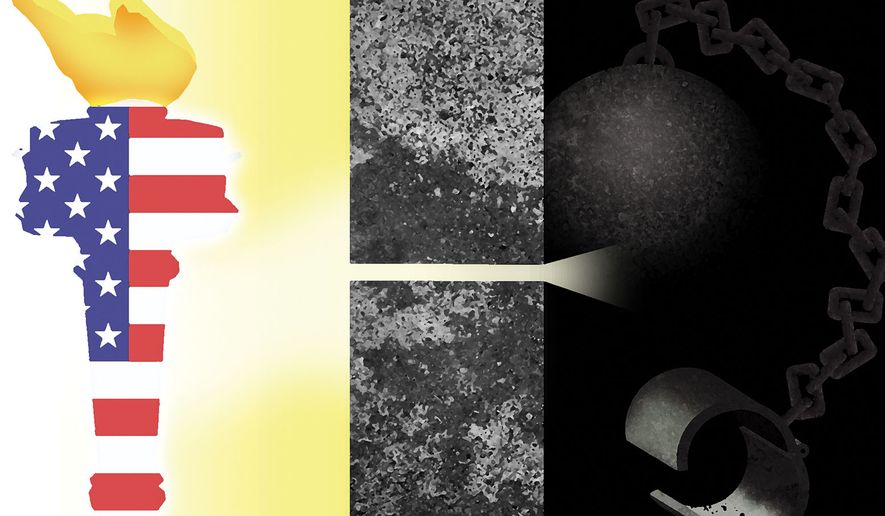
Freedom has weight. I learned that before I understood constitutions or civil liberties, when I discovered what happens if the state, not the individual, decides the boundaries of a life.
I grew up in Dresden, East Germany, behind the Iron Curtain. Authoritarianism was no chapter in a textbook; it shaped what people said openly, the choices they made and the futures they could imagine. The Stasi’s extensive surveillance meant that the possibility of being overheard changed how people spoke, trusted and lived.
That is authoritarianism’s most enduring legacy. Its power reaches beyond laws, prisons and borders into ordinary life, teaching people to ask what is safe before saying what is true.
People were interested in these podcasts
My desire to choose my own future led to an escape attempt and, in turn, to imprisonment. My grandmother’s determination was critical to securing my release, and in 1975 I crossed Checkpoint Charlie into West Berlin.
I still regard that crossing as a dividing line in my life. Yet I learned quickly that release from political control is not the same as having a life waiting for you. Freedom gave me possibility, not certainty.
My journey led through France, Switzerland and Britain, and then finally to the United States. I came not expecting America to guarantee success, but because it offered the opportunity to pursue it.
Immigration is often debated in terms of borders, systems and numbers. Those debates are necessary, but behind every “immigrant” is a human story. Mine was that of a young man who had known restricted choices and wanted to be responsible for his own future.
America gave me that chance. Over more than three decades, I built a career in the manufacturing, aerospace, defense and naval support industries, serving as chief operating officer. The distance between Dresden and an American boardroom was greater than geography.
Democracy does not promise an easy life, and mine has not been one. After decades of achievement, I faced serious personal and financial adversity, including the loss of my COO position. Freedom does not prevent disappointment or injustice. It preserves the right to respond: to speak, to work, to rebuild and to begin again.
That lesson anchors my memoir, “The Weight of Freedom.” I wrote it so that life behind the Iron Curtain would not become mere historical vocabulary. I also wrote it to tell people that leaving an authoritarian system does not instantly erase what it taught you.
So I worry when democratic freedom is treated as self-sustaining. I am not comparing the U.S. to East Germany; the circumstances differ fundamentally and careless comparisons diminish both history and honest debate.
Still, history can teach without accusing. It teaches that institutions matter: the freedom to speak, the right to disagree, limits on government power. Democracy can be noisy and imperfect, but its disagreements are evidence of a freedom authoritarian systems cannot tolerate.
For Americans born into these freedoms, they can feel permanent. To someone who once lived without them, they never feel ordinary.
Gratitude for America does not require pretending it is flawless. A free people must be able to criticize the country they love and challenge those who hold power. The privilege is that disagreement belongs to us, not the state.
Freedom has weight because it carries responsibility. It asks us to remember what history cost, to protect institutions even when they disappoint us and to defend the rights of people with whom we disagree.
I once crossed a border because I wanted to be free. America taught me the harder truth: Freedom is not the moment a gate opens. It is what we choose to build, defend and honor after we walk through it.
• Peter R. Hitschler is the author of “The Weight of Freedom: Dresden to Destiny via Checkpoint Charlie to the Boardroom Table.”

Please read our comment policy before commenting.