



SEOUL, South Korea — Fascinated by the very latest Armageddon-class weaponry? A brand new museum in North Korea might just be for you.
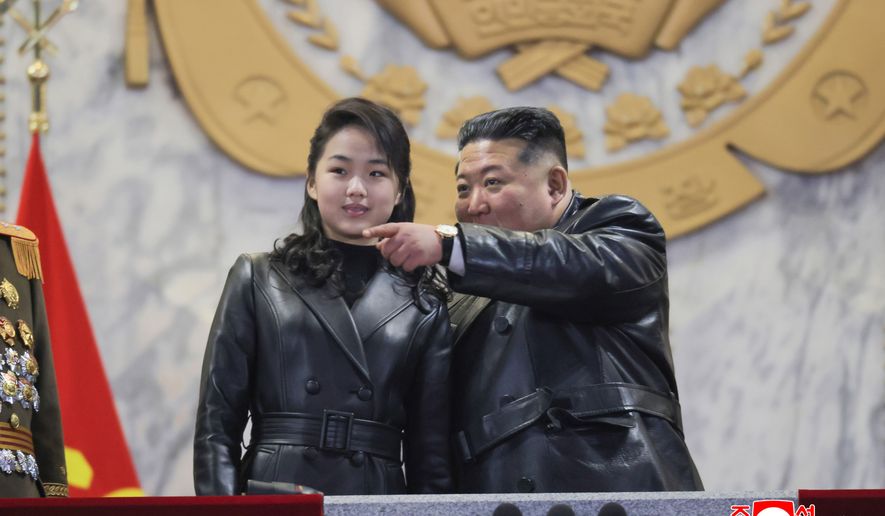
A ribbon-cutting ceremony attended by all of North Korea’s A-listers — leader Kim Jong-un and his teenage daughter — was held Sunday at an undisclosed location for the National Defense Revolution Museum, a cavernous-looking display hall built to commemorate the 81st founding anniversary of the Workers’ Party of Korea.
Even for a nation that offers such offbeat tourist spectacles as a moored American spy ship and a mummified eternal president, the National Defense Revolution Museum looks novel. Official state media photos released Tuesday show Mr. Kim, his adviser daughter and the ever-present cadre of uniformed military figures walking past displays of up-to-the-minute ballistic missiles and hypersonic warheads.
People were interested in these podcasts
But getting into the hall won’t be easy.
Westerners and other tourists who somehow manage to gain access to one of the world’s most isolated nations will almost certainly be denied entry unless they are North Korean citizens, a specialist tour guide with wide experience in North Korea told The Washington Times.
VIPs attending included daughter Kim Ju-ae, believed to be between 12 and 14 years old. She is seen by many, including South Korea’s National Intelligence Service, as her dad’s likely successor.
Mr. Kim called the museum “the greatest national treasure house” that, moreover, “shows how the dignity and security of ‘[North Korea] and the happiness of its people are defended, and how the peace of this land is achieved.”
The museum exhibits some of North Korea’s most up-to-date military technologies.
Images released showed Mr. Kim and his group admiring a huge, Hwasong-20 intercontinental ballistic missile — the latest of North Korea’s ICBMs — on its equally huge transporter erector launcher (TEL).
Both the ICBM and the TEL were painted in matte, olive-green livery. The TEL allows the weapon to move around the country, to hide from spy satellites in tunnels and under bridges. Its solid-fuel system enables it to be more swiftly fueled and launched from its TEL than liquid-fuel weapons.
Other weapons shown included a hypersonic short-range ballistic missile, submarine-launched ballistic missiles, multiple-launch rocket systems, tanks and small arms.
The location, apparently underground, was not disclosed. However, specialist Seoul-based media NK News, which analyzed related satellite imagery, guessed that the museum is located in the long-suspected “Hagap” underground nuclear site.
If Hagap is the location, then the new museum lies close to the industrial city of Huichon, some 86 miles northeast of Pyongyang in central North Korea.
However, non-natives are unlikely to gain access at any time in the near future, according to Australian tour guide Rowan Beard.
“North Korea is basically ‘no go’ except for Russians,” said Mr. Beard, the Abu Dhabi-based cofounder of Young Pioneer Tours, a travel agency that specializes in off-beat locations and events. “I don’t see anyone returning until 2028.”
North Korea — never the easiest state to visit — slammed shut its borders in 2020 as the global COVID-19 pandemic spread. It has only reopened them for a tiny handful of foreign tourists taking part in such events as the Pyongyang Marathon and a handful of trade fairs.
The only tourists in-country, reportedly, are Russians.
In 2024, Moscow and Pyongyang signed a mutual defense pact. North Korea is the only nation that has openly sold weapons to Russia and deployed troops to fight alongside the Russian Army in its war on Ukraine.
Mr. Beard said that even if North Korea reopens to Western tourism, the National Defense Revolution Museum will likely be off-limits.
“Before COVID, they opened up a military hardware museum which is similar, but that was only for Korean people,” he said. “I think this one will be the same …I doubt even Russians will be able to go.”
The aim of such museums is “for Koreans to see how they defend themselves,” he said. “It’s part of their education process.”
Even so, he hoped it might open up in the future. “It’s interesting, it’s military hardware that is constantly in the media, and would be interesting for foreign visitors to see up close, and learn a bit more about.”
Mr. Beard specializes in taking clients to hard-to-reach destinations and events in 190 countries and territories, including Taliban-ruled Afghanistan, war-torn Sudan and Russia’s Baikonur Cosmodrome in Kazakhstan, where visitors can witness a rocket launch from Soviet Cosmonaut Yuri Gagarin’s launch pad, and visit a Soviet copy of the U.S. space shuttle, which only ever made one flight.
He also offers access to hard-to-enter international events such as Jordan’s Special Operations Forces Exhibition and Conference, or SOFEX. The interest factor there is that Iranian and Russian arms manufacturers ply their wares alongside their U.S. and European counterparts.
Young Pioneer Tours has extensive experience in North Korea.
Key attractions Mr. Beard cites include Pyongyang’s Mansudae Grand Statues of the country’s first two ruling Kims. “It’s like the Eiffel Tower,” he said. “It’s like, ‘Hey Mom, now you know where I am!’”
At the Kim Il-sung Mausoleum, the preserved corpse of the state founder and “eternal president” lies under glass. “No photographs are allowed, so there are no YouTube videos of it,” Mr. Beard said. “It’s a place that you have to experience yourself.”
He disputes widespread claims that visitors are forbidden any unscripted contact with locals.
He recalled that in Pyongyang’s impressive subway system, schoolchildren sometimes try out their English on tourists, and young locals offer elderly visitors their seats.
Likewise, at the monumental Victorious Fatherland Liberation War Museum — the national museum to the 1950-53 Korean War, which started with a North Korean invasion and ended in a stalemate — the guides, serving army officers, engage in conversation.
“You step through the [North] Korean version of the story,” Mr. Beard said. “A lot of the time, it’s a first for foreigners to hear this.”
Another site that “hits Americans in the face” is the American spy ship, the USS Pueblo, seized, with her crew, on the high seas at the height of the Asian Cold War in 1968. Today, she is moored as a trophy in Pyongyang’s Taedong River.
“People don’t talk about it now, but in the ’60s, it was big time,” Mr. Beard said.
Americans are not currently permitted to enter North Korea by North Korean authorities, but have also been prevented from entering by their own State Department since 2017.
That ban followed the fate of U.S. college student Otto Warmbier, who was imprisoned by North Korea in 2016 for allegedly defacing a propaganda poster.
For reasons which still remain unclear, he entered a coma in captivity, was flown home as a medical evacuee, and died without regaining consciousness in 2017.
Mr. Warmbier, 22, was a Young Pioneer client.
“It is one of these tragic things that happen, and is a reminder to all who go to countries that are off the beaten path that do not have great relations with the country you come from, that you need to be a good guest and respect local laws,” Mr. Beard said, saying that all his clients are “given appropriate information on how to behave.”
Mr. Warmbier’s death was devastating for his family. However, the widespread news reports of their loss had an unintended impact on tourism to North Korea.
“After the incident, tourism actually boomed as people had not been aware that you could go in,” Mr. Beard said, citing data from a United Nations study on tourism in North Korea. “The following year, it went double.”
Contact the author


Please read our comment policy before commenting.