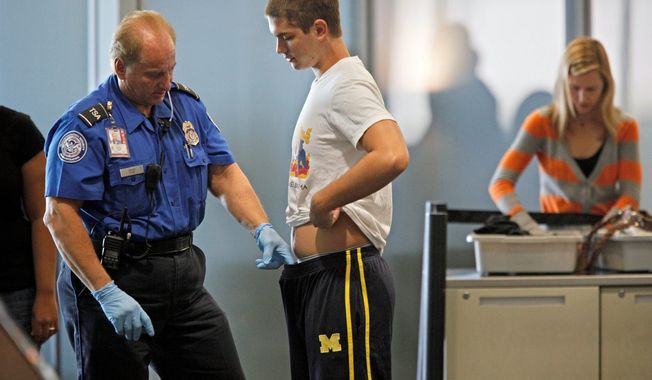
'Your papers, please' must never be heard in America
Independent voices from the TWT Communities
Niall Ferguson, a Harvard history professor and author, is apologizing for saying economist John Maynard Keynes didn't care about the future because he was gay and had no children.

That Treasury Department official Harry Dexter White was a Soviet agent — perhaps the most important one in the Red-riddled Roosevelt administration — has been well-documented in defector reports and intercepted intelligence cables. Now startling new evidence has emerged on an attempt by White to tilt international economic policy in favor of the Soviet Union during the postwar Bretton Woods Conference in New Hampshire.

Which country will serve as the trigger for the next financial crisis? Given the continuing rise in debt-to-gross domestic product (GDP) ratios in many countries, it is apparent that a new financial crisis will occur. Most of the speculation has been about when, rather than where.

Great rocks have tumbled from the sky since there was an Earth for them to tumble on, but the asteroid falling in Russia's Ural Mountains was the largest caught live on film. Dramatic footage shows pieces of a 10,000-ton cosmic object streaking through the atmosphere, glowing brighter than the sun.

Democrats are united in their fiscal message. Throughout the "cliff" negotiations and again with the pending debt-ceiling debate, their argument has rested on a single, flimsy premise: Cutting government spending would push the economy into recession.
President Obama, on behalf of every American citizen, could you please stop blaming everyone but yourself for your failed policies? Your predecessor isn't responsible for the protracted economic downturn for the past three years -- you are.

Sen. Claire McCaskill, Missouri Democrat, once told Fox News that President Obama's $833 billion stimulus was "wildly successful." As the Election Day draws near, it's important to have a clear view of the impact of the president's major legislative achievement second only to Obamacare.

The clash of economic ideas perhaps has never been this bitter. The possible breakup of the eurozone may bring Europe into uncharted waters, but the debate over the future of the Continent is shaped by ideas that are at least a century old: restraint in public finance versus economic stimulus.

In early 2009, two of President Obama's economic advisers predicted that a stimulus package could keep American unemployment below 8 percent. Needless to say, that hasn't panned out. There's now a bipartisan consensus that the administration's stimulus efforts didn't work.

As a job-creating entrepreneur out here in the hinterlands, I am amazed at the Keynesian priests in Washington calling for more stimulus fueled by debt.

Repeal of Obamacare ought to be a priority not only on constitutional grounds, but also as a move essential to pulling our economy out of its malaise. The head of the Congressional Budget Office (CBO) let slip the reason why in testimony Thursday before the House Budget Committee.
"When the facts change, I change my mind. What do you do, sir?" So said John Maynard Keynes when a dearly held belief of his was confronted by new facts. He changed his mind and was not ashamed. I am an extreme empiricist. Show me the facts, and I shall make up my mind. Show me the new facts, and I shall change my mind.

Ultimately, when VIPs go home and the November election dust settles, the Obama administration could face stark, bilateral decisions on international fiscal and monetary policies as the economy continues to sputter.

The surprise winner of Tuesday's U.S. Republican Senate primary drew cheers and applause from the evangelical Christians who made up most of the audience at the annual Values Voters Summit Friday.

Is the recession's great irony that government spending killed Keynesianism? With economists, bankers and investors perplexed over the economy's continued funk, we cannot be blamed for looking in odd places for answers. Could it possibly be that continuously increasing spending over eight decades has left little ability for government spending to affect the economy?
He said he deeply apologized.
Harvard professor sorry for saying Keynes' economic philosophy molded by gay love life →
In 1937, Keynes said that "the idea of the future being different from the present is so repugnant to our conventional modes of thought and behavior that we, most of us, offer a great resistance to acting on it in practice."