


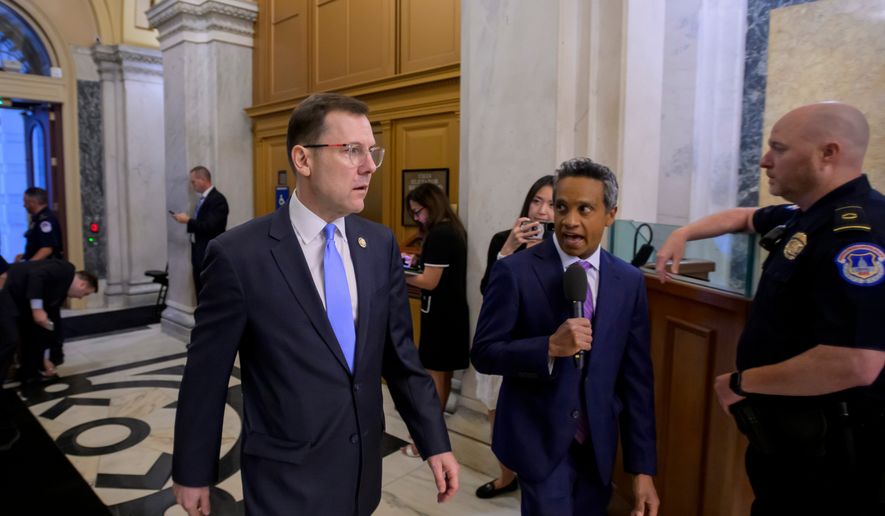

Rep. Thomas H. Kean Jr., who returned to Capitol Hill this week after a four-month absence due to depression, has introduced a bill to strengthen enforcement of federal mental health parity laws.
Mr. Kean said he has long championed mental health issues, but now sees them in a new light.
“During my time in the New Jersey Legislature, I worked to advance mental health parity. I believed in the cause then,” Mr. Kean, a Republican, said in a statement. “I understand it in a far more personal way now. I am proud to help lead this fight in Congress.”
People were interested in these podcasts
His bill, the Mental Health Parity Enforcement and Funding Act, would give the Department of Labor a penalty mechanism and funding to enforce existing health plan requirements for treating mental health.
Under the bill, the Department of Labor could impose civil monetary penalties — currently authorized for genetic-information violations — to also cover violations of mental health and substance use disorder parity requirements.
It expands who can be penalized: not just the plan sponsor, but also the service provider or plan administrator of a group health plan. The new penalty provisions start with plan years beginning one year after enactment, allowing for a transition period.
The Employee Retirement Income Security Act of 1974 generally limits the Labor Department’s enforcement powers. The bill carves out an exception so the secretary of labor can specifically enforce mental health parity requirements through these new civil penalties, closing a gap where parity violations previously had weaker federal enforcement teeth.
Mr. Kean’s bill also appropriates $30 million per year for fiscal years 2027 through 2031 to the Employee Benefits Security Administration to carry out enforcement of both this and an existing act.
There is already a nearly identical bill in Congress, the Parity Enforcement Act of 2025, introduced by Rep. Donald Norcross, New Jersey Democrat, to “provide for civil monetary penalties for violations of mental health parity requirements.”
Mr. Kean’s bill is dated a day before he returned to the House floor and publicly revealed his depression diagnosis and treatment that led to his absence from Congress.
He previously attributed stepping away from the public to a health condition but did not disclose details before his return.
“Several months ago, due to health concerns, I entered the hospital for some testing. I did not believe this would result in a long-term stay,” he said on the House floor Tuesday. “I was given the diagnosis of depression.”
Mr. Kean said he was grateful he got the treatment he needed.
“I began to understand not only my diagnosis, but how long depression had been affecting my life,” he said.
Mr. Kean has a fairly consistent record on mental health issues, mostly focused on kids and youth, as well as strengthening existing programs rather than creating brand-new mandates.
Originally introduced in the 118th Congress and reintroduced in the 119th Congress, the Youth Mental Health Research Act would establish a Youth Mental Health Research Initiative within the National Institutes of Health to encourage collaborative research on improving youth mental health.
Contact the author


Please read our comment policy before commenting.