



OPINION:
It is like something out of a James Bond movie, or maybe “The Naked Gun”: Nvidia CEO Jensen Huang resigned Thursday after allegedly having an affair with a Chinese businesswoman and Megaspeed executive suspected of spying for Beijing.
Compounding the problem is that a network involving the woman, Alice Huang, reportedly facilitated the shipment of 240,000 restricted Nvidia chips into China, valued at $7.5 billion.
The Chinese Foreign Ministry angrily denied the alleged espionage, but that rings hollow in light of China’s long history of spying on American companies and stealing their intellectual property.
People were interested in these podcasts
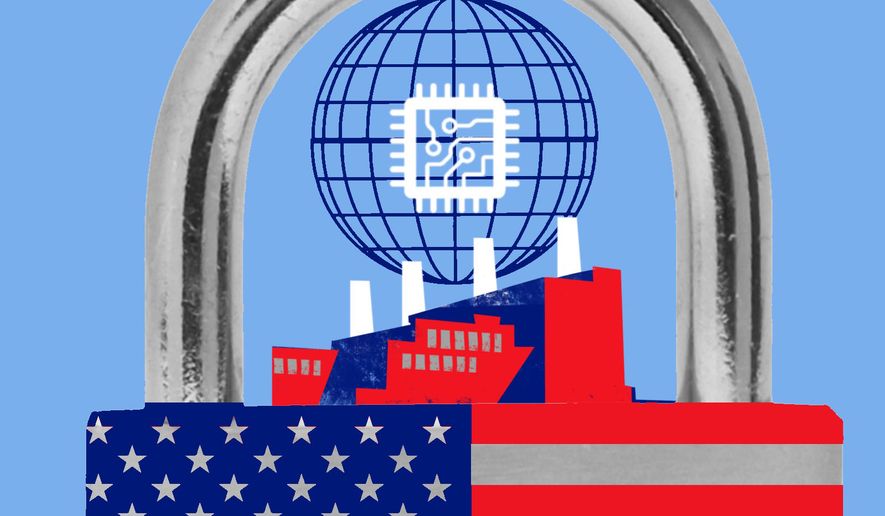
China is trying to lock down global chip supply chains through industrial policy and intellectual property theft. The U.S. must push back against these aggressive ambitions. This means America and its partner nations need more companies competing to develop advanced chips.
These tiny components power smartphones, artificial intelligence, military weapons systems and critical infrastructure. The countries that lead in developing chips will have an enormous economic and national security advantage for decades to come.
Right now, the United States makes only about 12% of the world’s semiconductors, down from 37% in 1990. This is despite the fact that Americans consume about a quarter of the world’s semiconductors and U.S. companies dominate global sales.
The manufacturing numbers are moving in the right direction. Thanks to the CHIPS and Science Act and investments by both the Biden and Trump administrations, semiconductor production in the United States has been growing. Still, China is ramping up its semiconductor industry to compete with U.S. growth.
Huawei, for example, recently unveiled its first “100% domestically made” desktop computer, which uses chips designed and manufactured in China.
Just how successful China’s onshoring of semiconductors will prove is an open question. Some worry that export controls could accidentally spur a domestic chip boom inside China. More skeptical observers point out that China still has a long way to go and that Chinese startups have had trouble securing funding amid AI bubble concerns.
Whatever the case, it is clear that America and its allies must win the day. Whoever controls these chips controls the future of global technology.
America needs to double down on what made us such a tech powerhouse in the first place. Our approach is the opposite of China’s: We allow competition to flourish and innovation to proliferate. What we need now is a robust, competitive semiconductor sector.
Fortunately, the CHIPS and Science Act and the efforts of the Biden and Trump administrations are bearing fruit. Some companies that traditionally focused on licensing chip designs are now designing and selling their own processors, bringing new competition to a market long dominated by a handful of players.
Others are investing billions of dollars in new manufacturing facilities, developing more powerful AI chips and expanding production in the U.S. and allied nations.
More competitors, innovation and options for producing advanced chips are exactly what America and its allies need to stay ahead of China. Plenty of hurdles remain in the way — and it is not just capital.
For example, to make semiconductors, the U.S. needs certain specialized chemicals, yet one estimate finds that 60% of these materials lack sufficient domestic capacity to support increased semiconductor production.
The construction and permitting costs that plague the American economy are also formidable obstacles. These hurdles make it less cost-effective to build chip-fabrication plants, or “fabs,” in the U.S.
If America is going to secure its chip supply chain against the Chinese threat, it needs a comprehensive approach. That means making the materials, clearing out the red tape and educating the talent necessary to shore up this vital industry.
Solutions to these problems are already under consideration. Congress is debating a major permitting reform bill that would help make it easier to build new fabs.
Washington also ought to encourage chipmakers to continue funding job training for semiconductor manufacturing at colleges.
Yet the federal government must acknowledge that change cannot be dictated from the top. America’s technological advantage comes from its innovative and relatively free markets. Once the conditions are set, Washington should get out of the way and let a dynamic chip industry grow.
Unlike China, the U.S. does not need pillow espionage to innovate. Beijing can never steal the spirit of free enterprise that made America the world’s technological leader. Washington’s job now is to clear the way and let the chips fall where they may — so long as they fall on our side.
• Bart Marcois is a retired career diplomat. He was the principal deputy assistant secretary of energy for international affairs and has extensive private sector experience in commercial intelligence and international business development. He produces daily political and diplomatic analysis at youtube.com/AMinuteWithBart.

Please read our comment policy before commenting.