



OPINION:
Until relatively recently, North Korea wanted normal diplomatic relations with the U.S.
That ended in 2009, when North Korea quit the six-party talks, refusing to permit nuclear inspectors to visit undeclared suspected nuclear sites.
Since then and during a U.S. policy of “strategic patience” with North Korea, Pyongyang has significantly strengthened its alliances with China and Russia.
People were interested in these podcasts
On Saturday, North Korean leader Kim Jong-un visited Dandong, China, to inaugurate the newly opened New Yalu River Bridge connecting China and North Korea. Mr. Kim was accompanied by Wang Huning, China’s fourth-highest-ranked official, who conveyed greetings from President Xi Jinping. At a June summit in Pyongyang, Mr. Xi announced plans to expand cooperation with North Korea in trade, agriculture, construction and technology, and Mr. Kim called China a strategic priority.
Mr. Kim called China a strategic priority for North Korea.
Russian President Vladimir Putin visited North Korea in June 2024 and signed the Treaty on Comprehensive Strategic Partnership with Mr. Kim. Article 4 of the treaty states that both countries agreed to provide immediate military and other assistance with all means in their possession if either country is subjected to an armed invasion or put in a state of war.
According to Western intelligence estimates, North Korea has sent 16,000 to 22,000 troops to Russia to support its war with Ukraine — the Ukrainian military intelligence places the figure closer to 25,000 — in addition to artillery shells, ballistic missiles, drones and other weaponry.
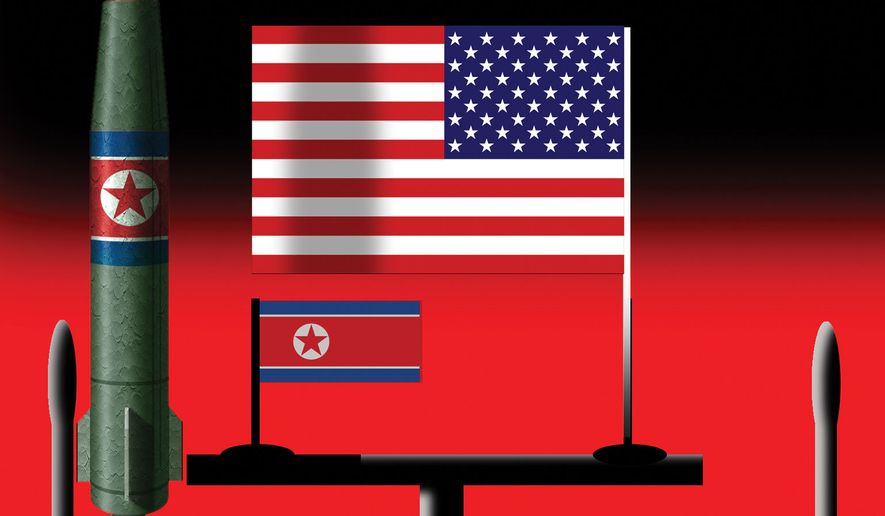
North Korea now views the U.S. and South Korea as its primary enemies. Pyongyang claims that its nuclear and missile programs are deterrents to a U.S. threat of nuclear annihilation.
As South Korean president, Yoon Suk Yeol advocated a hard-line defense strategy that incorporated a preemptive “decapitation” and massive retaliation against North Korea’s leadership and nuclear infrastructure if Pyongyang showed signs of using a nuclear weapon.
How did this transformation — from seeking normalized relations with the U.S. to viewing Washington and Seoul as Pyongyang’s primary enemies — happen?
There was never ambiguity: North Korea wanted nuclear weapons. It told us this clearly in the first meetings of the six-party talks, claiming that its nuclear weapons were a deterrent never to be used against the U.S.
North Korean negotiators routinely said they wanted to be friends with the U.S. and have normal bilateral relations. They argued that the U.S. should treat North Korea like it treated Pakistan, a nuclear weapons state initially sanctioned by the U.S. and the international community for acquiring nuclear weapons, but now accepted as a nuclear weapons state.
North Korea was told that it would never happen. We explained why: Nuclear weapons proliferation would follow, with many countries in the region and beyond seeking nuclear weapons. North Korea never accepted this view.
In 2002, the intelligence community said North Korea had a secret, highly enriched uranium program for nuclear weapons. North Korea said that was not true. Despite North Korea’s denials, the country continued to pursue its highly enriched uranium program while activating its plutonium program for nuclear weapons, giving it two paths to nuclear weapons.
North Korea reportedly has 60 to 100 nuclear weapons and a sophisticated ballistic missile program to deliver them. Its most recent intercontinental ballistic missile, the Hwasong-20, which was publicly displayed in October 2025, is estimated to have an operational range of more than 9,000 miles, enabling it to reach all of the U.S.
On Oct. 14, North Korea test-fired two submarine-launched strategic cruise missiles in the East Sea/Sea of Japan, one from a vertical launch system and the other from a torpedo tube. According to North Korean state media, both launches were successful.
Russia and China, both participants in the six-party talks with North Korea, argued for complete and verifiable denuclearization of North Korea. Yet they apparently now accept North Korea as a nuclear weapons state. Russia has publicly called North Korea’s nuclear program justified, while China has refrained from discussing North Korean denuclearization.
Many now argue that it is too late to get North Korea to denuclearize. They say Pyongyang is firmly aligned with Moscow and Beijing and sees the U.S. and South Korea as enemies despite our — and Seoul’s — efforts to resume a dialogue.
Accepting that defeatist view would be a mistake. North Korea sought a normal relationship with the U.S., one that would provide it with international legitimacy and access to international financial institutions for economic development.
As we witnessed in the 2019 Hanoi summit between President Trump and Mr. Kim, North Korea will not acknowledge having a highly enriched uranium program for nuclear weapons, but we must still try to reengage with it.
Our ultimate goal should continue to be North Korean denuclearization, but that should not be an impediment to a dialogue with North Korea. Our first goal in talks should be to freeze the country’s nuclear and missile programs in return for sanctions relief and a path to normal relations with the U.S.
Reengaging with North Korea is in our interest.
• The author is a former associate director of national intelligence and the former special envoy for six-party talks with North Korea. All statements of fact, opinion or analysis expressed are those of the author and do not reflect the official positions or views of the U.S. government.
Follow the author


Please read our comment policy before commenting.