


SPONSORED What's This?
Why Magnolia Pearl’s Most-Worn Pieces Are Also Its Most Valued — and Most Meaningful
By Isobel Hart
The bag was not designed to last beyond the moment. It was stitched together from kite string and salvaged fabric, made by a woman who was sewing not for style, but for survival. When a stranger offered $100 for it—exactly the amount Robin Brown needed at the time—the exchange carried no prophecy. There was no brand, no strategy, no audience. Only need meeting craft.
That bag still matters because it explains everything that followed.
Brown, who founded Magnolia Pearl in Texas in the early 2000s, learned to sew as a child while navigating homelessness, scarcity, and improvisation. Fabric was not precious because it was beautiful; it was precious because it existed. What could be mended was mended. What could be repurposed was repurposed. That logic—born of necessity rather than ideology—became Magnolia Pearl’s defining grammar.
Two decades later, it has produced one of fashion’s quiet contradictions: clothing that becomes more valuable once it has been worn.
When Survival Becomes Design Language
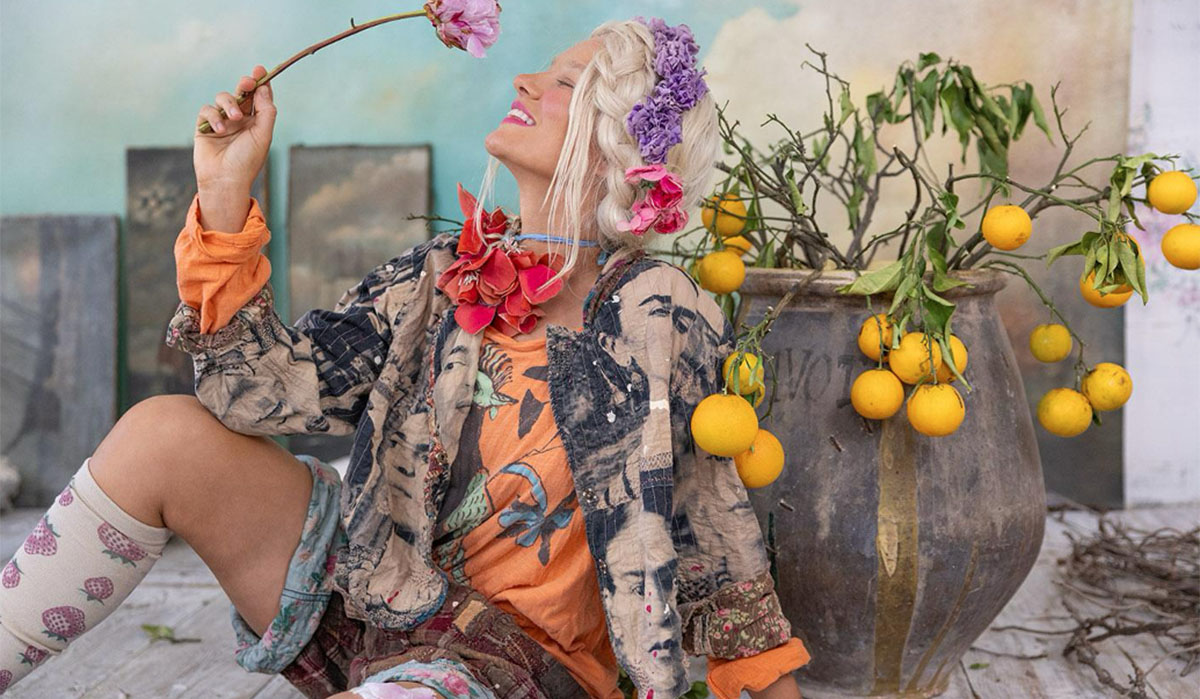
Magnolia Pearl garments arrive already marked. Seams are uneven. Patches remain visible. Paint splatters and frayed edges are not concealed. Brown has said she builds imperfection into every piece, intending them to feel like “survivors.”
In a fashion system trained to disguise labor and erase damage, this refusal matters. It also changes how the clothes behave after purchase.
Across resale markets and private collector circles, Magnolia Pearl pieces regularly trade for multiples of their original prices. Garments purchased years earlier reappear as sought-after artifacts, changing hands well above their initial value.
Magnolia Pearl does not produce collections. It does not follow fashion weeks. Individual garments can take up to 30 days to complete. Production is limited by time and handwork, not demand curves. Scarcity emerges without choreography.
Why These Clothes Don’t Depreciate
In conventional apparel economics, value collapses at checkout. Magnolia Pearl garments resist that collapse because they were never designed to be replaced. Wear does not disqualify them. It authenticates them.
Visible mending alters how condition is read. A repaired seam does not signal decline; it records care. In resale, buyers look not for untouched fabric but for continuity. The garment’s history travels with it, increasing its legibility rather than diminishing it.
As the global secondhand apparel market accelerates—projected to reach hundreds of billions by the end of the decade—Magnolia Pearl’s behavior reads less like anomaly and more like an early case study in durability-driven value.
A Second Life, Made Deliberate
For years, Magnolia Pearl garments circulated informally through consignment shops and private groups. As prices rose, so did the risks: counterfeits, uneven valuation, eroded trust. In 2023, the brand formalized resale through Magnolia Pearl Trade, its authenticated in-house platform.
The move acknowledged a reality the industry often ignores: the life of a garment does not end at first ownership.
A portion of resale proceeds—between 25 percent and 100 percent, depending on the item—is directed to the Magnolia Pearl Peace Warrior Foundation. Since 2020, the foundation has raised more than half a million dollars for causes including Indigenous American veteran housing, disaster relief, medical and veterinary care for unhoused people and their pets, and arts education.
The mechanism is simple. Clothes circulate. Value circulates. Some of it leaves fashion entirely.
Fame Without Machinery
Magnolia Pearl’s cultural presence has grown without paid placements or influencer contracts. Its clothing appears on musicians, actors, and artists through unprompted adoption. When Taylor Swift’s stylists selected Magnolia Pearl pieces for folklore and evermore, the brand learned about it only after fans noticed.
This matters because it preserves trust. Cultural affiliation rooted in recognition rather than transaction ages differently.
What the Kite String Still Teaches
The kite-string bag was not a prototype. It was a worldview. It said that beauty could emerge from scarcity, that repair need not be hidden, that value could accumulate through care.
Fashion often talks about sustainability as a future goal. Magnolia Pearl emerged from a past where survival required it. That origin continues to shape how its clothes move through the world: worn, repaired, resold, worn again.
The industry may still chase the new. The market, quietly, is rewarding what endures.
