Bill Gertz is a national security correspondent for The Washington Times. He has been with The Times since 1985. He is the author of eight books, four of them national best-sellers. His latest book, "Deceiving the Sky: Inside Communist China's Drive for Global Supremacy," reveals details about the growing threat posed by the People's Republic of China. He is also the author of the ebook "How China's Communist Party Made the World Sick." Mr. Gertz also writes Inside the Ring, a weekly column that chronicles the U.S. national security bureaucracy. Mr. Gertz has been a guest lecturer at the FBI National Academy in Quantico, Va.; the Central Intelligence Agency in Virginia; the National Defense University at Fort McNair in Washington; and the Brookings Institution in Washington. He has participated in the National Security Studies Program at the Johns Hopkins University School of Advanced International Studies and Syracuse University Maxwell School of Citizenship and Public Affairs. He studied English literature at Washington College in Chestertown, Md., and journalism at George Washington University. He is married and has two daughters. He can be reached at bgertz@washingtontimes.com.
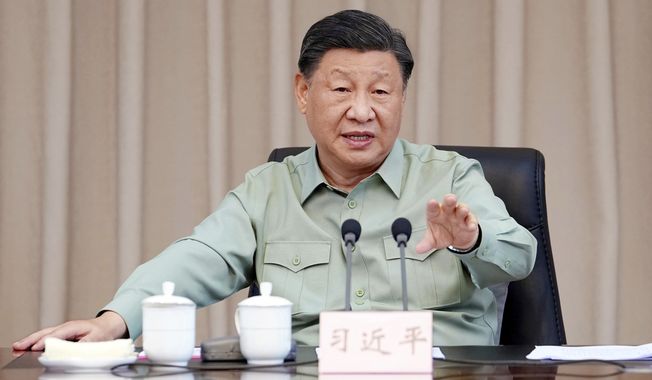
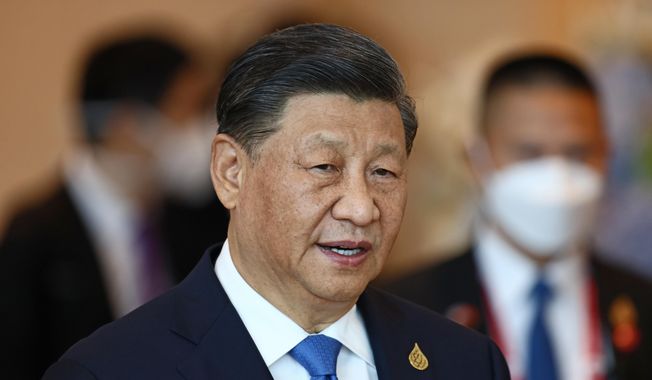
Chinese President Xi Jinping urged top security officials of the ruling Communist Party this week to modernize the country's national security system and warned them to be ready for "worst-case" scenarios amid growing tensions with the United States.
Adm. John Aquilino, commander of the U.S. Indo-Pacific command, recently warned Chinese President Xi Jinping that any attempt to take Taiwan by force would result in massive losses of "blood and treasure" for China.
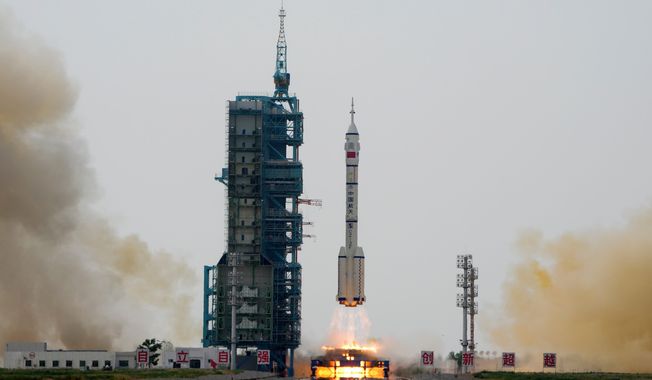
The State Department unveiled a new space diplomacy strategy on Tuesday in a bid to counter efforts by China and Russia to militarize space and challenge U.S. power.
The U.S. government on Tuesday imposed sanctions on 17 entities from China and Mexico for their alleged role in producing illicit fentanyl that has killed hundreds of thousands of Americans through drug overdoses.
China's rapid large-scale buildup of nuclear missiles, submarines, bombers, including an orbiting nuclear strike weapon, is increasing the danger of nuclear war, according to a study.
U.S. military forces are facing new dangers of non-kinetic warfare weapons in future conflicts including "neuro-strike" weapons designed to disrupt brain functions of key leaders, according to a military expert.
China's government has rejected President Biden's assertion that a thaw in tense U.S.-China relations is coming soon, with Beijing demanding an end to sanctions on Chinese officials and companies, a Foreign Ministry spokesman said.
China's military can't take a joke. The Communist government in Beijing took action against a stand-up comic who made fun of the People's Liberation Army during a recent comedy routine, according to reports from Asia.
The U.S.-Canadian air defense command is downplaying two recent Russian military encounters near Alaska as nonthreatening -- despite one intrusion that included nuclear-capable bombers.
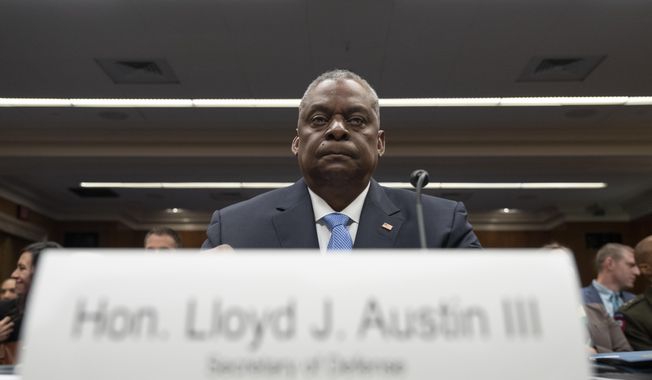
Defense Secretary Lloyd Austin this week told Congress how the Pentagon plans to spend hundreds of billions of dollars this year for new weapons and military preparations to deter what he said is the growing danger of war with China.
China's government is expanding the use of covert influence operations targeting the United States and is expected to exploit the White House-congressional clash over the debt limit crisis as part of growing anti-U.S. activities, according to the director of national intelligence.
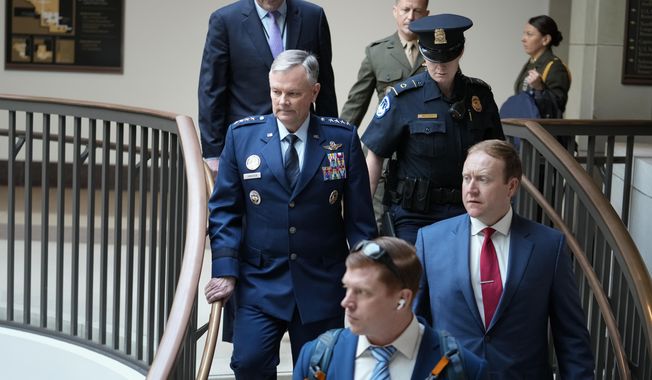
The general in charge of the Northern Command told Congress this week that the United States is falling behind both China and Russia in developing and fielding ultra-high-speed hypersonic missiles. Air Force Gen. Glen D. VanHerck warned that the U.S. military needs to speed up the outdated process currently used in building weapons.
Taiwan's democracy is confronting both military and "gray zone" information warfare threats from China and is adopting asymmetric weapons to defend itself, the country's unofficial ambassador to the United States said in an interview.
Threats from China and the potential of a war over Taiwan pose real dangers for the U.S., two top intelligence officials said during an annual briefing to Congress on Thursday.
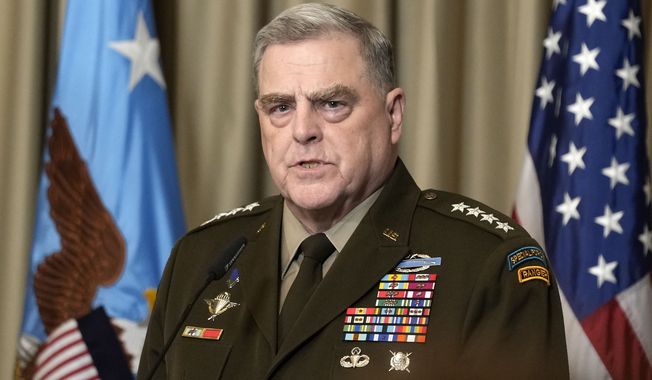
Army Gen. Mark A. Milley, chairman of the Joint Chiefs of Staff, said the U.S. military needs to become stronger to deter a war with China, while preventing Beijing from forging a closer alliance with Russia.
U.S. forces will defend Philippines coast guard vessels used to resupply an unusual sea base in the disputed South China Sea under a U.S.-Philippines defense treaty, the State Department said.
A U.S. Navy Ohio-class nuclear submarine arrived at the U.S. island of Guam recently and could be the first such submarine to sail to South Korea since the 1980s, under an agreement announced by Seoul and Washington on Wednesday.
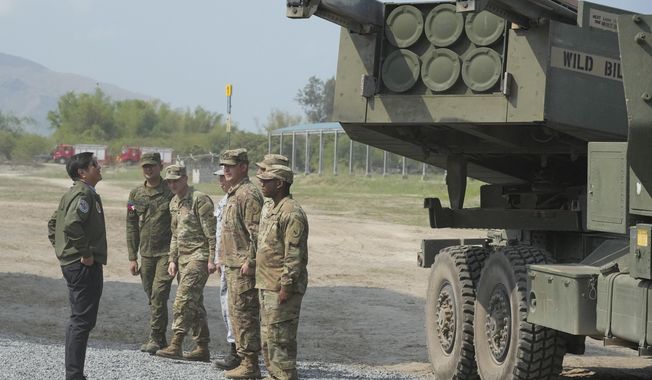
The U.S. military engaged in large-scale exercises this week with defense treaty ally Philippines near the disputed South China Sea that China claims as its maritime territory, sparking an angry reaction from Beijing.
The chairman of the House Homeland Security Committee wants the FBI and Department of Homeland Security to provide more information on suspected Chinese government police stations and other malign activities by Beijing in the United States.