



OPINION:
Ask any American family what the hardest part of the past few years has been, and the answer is usually the cost of groceries.
Food prices are up. Farm input costs are up. The squeeze keeps tightening in a way that does not seem to track with any single explanation Americans have been offered.
When it comes to fertilizer, a key input that contributes to rising food costs, there are no simple answers. Global supply chains and complex geopolitics have created a perfect storm that threatens American food security.
People were interested in these podcasts
I spent much of my time in Congress on the Financial Services Committee, studying how markets function and how global forces shape prices here at home. If you look past the headlines and trace the fundamentals of the fertilizer market, the picture that emerges is not a domestic one. It is a supply chain that begins with a tragically overlooked raw material and ends with Beijing holding far more leverage than most Americans realize.
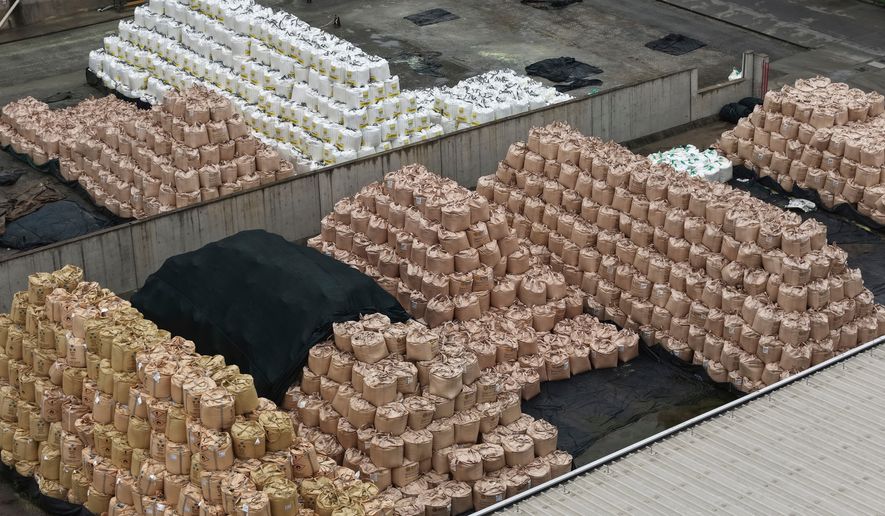
The raw material is sulfur. It is the key input in phosphate fertilizer, which American farmers apply to nearly every acre of row crop in the country. According to the U.S. Geological Survey, domestic production covers roughly 70% of the sulfur used in the United States, with imports from Canada and Mexico comfortably filling the rest.
On paper, North America as a region is entirely self-sufficient in one of agriculture’s most critical inputs. On paper, then, prices for American farmers and ultimately for American families should be stable.
So why aren’t they?
Unfortunately, we ship roughly 1.6 million to 1.8 million metric tons of our sulfur production overseas each year, according to USGS data.
Trade data from the Observatory of Economic Complexity makes clear where global pressure builds: state-owned conglomerates funded directly by the Chinese Communist Party bid heavily on raw sulfur, while the Chinese government imposes strict export controls on its own finished fertilizer and sulfuric acid.
In other words, Beijing absorbs raw materials on global markets while refusing to let finished products back out.
The result is a global supply crunch that lands squarely on American farmers and, eventually, on American families at the checkout line. Recent disruptions near the Strait of Hormuz, which risks cutting off more than a third of global sulfur trade, have only tightened the squeeze.
Even as China is buying up our sulfur, the Chinese government has imposed export controls on its own finished fertilizer and sulfuric acid. As far as Americans are concerned, China is a black hole for these needed materials.
The economic logic is unforgiving. American refiners produce sulfur as a byproduct of oil and gas processing. When Chinese state buyers, backed by government subsidies, bid up the price abroad, our own refiners have every reason to ship the material overseas rather than sell it at home.
American companies, even under ideal circumstances, cannot compete with the weight of one of the world’s largest state apparatuses stacked against them.
If an American company behaved the way China’s state-owned fertilizer sector does, the Justice Department would be at the door tomorrow. When a foreign government does it, Washington too often shrugs.
Other foreign state-backed producers have also benefited from years of favorable access to the U.S. market. The central story runs through sulfur and runs through Beijing.
The fix does not require a trade war. It requires reciprocity and focus.
First, policymakers should ensure that American farmers can buy the sulfur and fertilizer produced in North America at preferential market prices. Domestic buyers ought to have the right of first refusal at prices that reflect America’s self-sufficiency in this space.
Second, Washington should prohibit Chinese state-owned entities from purchasing American sulfur for as long as Beijing maintains its export bans on finished fertilizer. If China will not sell on the global market, it should not have preferential access to the raw materials that feed its state industries.
Third, we must stop looking for the wrong villain. The affordability pressure on American families is real and deserves a serious diagnosis rather than a convenient one. The evidence points to a deliberate strategy run out of Beijing to use raw materials and food prices as instruments of leverage.
American families should not pay more at the grocery store so that China can pay less at the port. If Congress is serious about affordability, it needs to start with sulfur and set its sights on the country that has quietly made it a weapon.
• Randy Hultgren is president and CEO of the Illinois Bankers Association and a former representative for Illinois’ 14th Congressional District.

Please read our comment policy before commenting.