



OPINION:
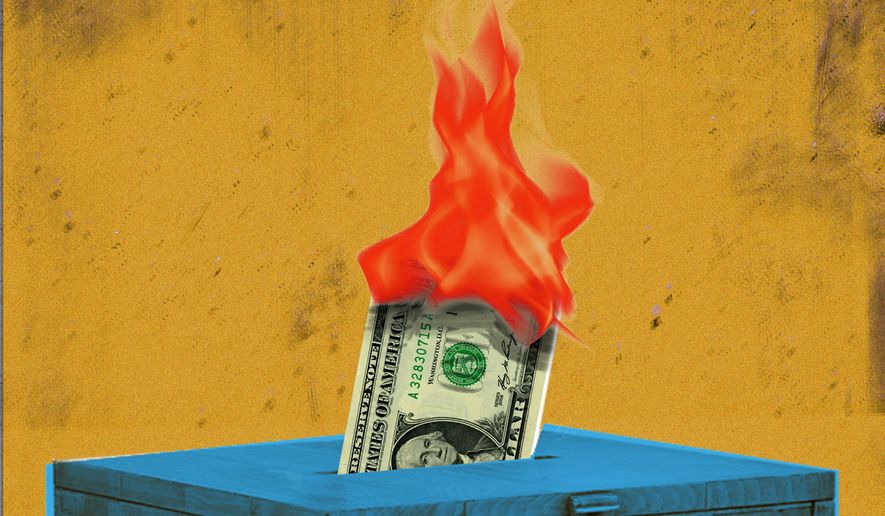
Republican-aligned spending on the 2026 Senate midterms reached unprecedented heights, continuing a decades-long trend of skyrocketing campaign expenditures.
Total federal spending for the cycle hit $11.9 billion, according to OpenSecrets, while AdImpact tracked $11.6 billion in political advertising alone. These sums dwarf previous cycles, reflecting the ever-increasing role of money in American politics. Conservative outside groups, such as super PACs and 501(c)(4) organizations, outspent their liberal counterparts by more than $350 million overall.
This spending was concentrated primarily in battleground states, where every marginal vote was pursued with massive financial outlays.
People were interested in these podcasts
Despite these investments, the electoral returns did not match the scale of spending, raising serious questions about the efficiency and strategic focus of Republican campaign operations.
Media and advertising are by far the largest components of reported spending, often eclipsing all other categories combined. Fundraising and media consultants take an outsized share, with some firms specializing in direct mail, digital ads and television buys.
The media buying houses, which act as intermediaries between campaigns and broadcasters, routinely take 10% to 15% or more in commissions on placements, creating a strong incentive to maximize volume regardless of effectiveness. This system can lead to a misalignment of goals. Consultants and vendors profit most when spending is highest, not necessarily when campaigns succeed.
Meanwhile, strategy, policy development and research represent much smaller portions of most campaign budgets. A disproportionate share of the resources, therefore, flows to these intermediaries, whose fees are driven by gross expenditure rather than the quality or durability of voter relationships or the substance of candidate policy positions.
In effect, much of the campaign ecosystem is structured to reward spending itself rather than electoral success or voter engagement.
Studies show that campaign contact and advertising have little persuasive effect in general elections. A 2018 meta-analysis by Joshua Kalla and David Broockman of the University of California, Berkeley, reviewed 49 field experiments and found the average impact on candidate choice to be essentially zero: about 1 in 800 voters.
Later research echoes this. Ads may boost turnout or name recognition at the margins but rarely change minds. Most campaign advertising is simply background noise, enriching consultants with little real return for candidates.
The 2026 midterms illustrate this pattern in the highest-spend Republican Senate races:
• Texas (Ken Paxton): AdImpact tracked $407.5 million in general election ads with Republicans ahead by $141 million. Outside groups spent $251.7 million behind Mr. Paxton, including $182.1 million from the Senate Leadership Fund-aligned Texas PAC and $37.6 million from MAGA Inc. Result: Mr. Paxton lost.
• Ohio (Jon Husted): Outside groups backing Mr. Husted outspent Sherrod Brown’s allies $252.4 million to $157 million, led by the Senate Leadership Fund ($95.6 million) and crypto PACs. Result: Mr. Husted lost.
• Michigan (Mike Rogers): Outside groups helping Mr. Rogers outspent those helping Mr. El-Sayed, $172.1 million to $94.7 million. Result: Mr. Rogers lost.
• Iowa (Ashley Hinson): Outside spending was near even, $95.9 million for Ms. Hinson versus $103.7 million for Mr. Turek. Result: Ms. Hinson lost.
• Maine (Susan M. Collins): Ads backing Ms. Collins outspent those backing Troy Jackson, $126.1 million to $89.7 million. Result: Ms. Collins lost.
Republicans spent more than $700 million here — and lost every single race.
Advertising builds name recognition and motivates supporters, but the current model focuses too much on paid exposure at the expense of electoral results.
Money spent on media buys is money not spent on policy development, local research or community engagement. Local messengers who understand their communities are far more persuasive than a barrage of ads. Impressions and reach say little about lasting voter support.
Campaign funds can be better spent on policy research, grassroots organizing and building community relationships. By learning what local communities care about and investing in their institutions and messengers, campaigns can create lasting networks of support.
Reducing ad spending redirects resources to activities that win votes and build loyalty, rather than enriching consultants.
Republican campaigns must decide whether to win elections or keep fueling the campaign industry. Repeating the 2026 formula in 2028 will lead to the same costly failures. The only path to durable support is greater investment in policy, research and local relationships.
The data proves that the current model does not work, and 2028 demands a new approach.
• Peter McIlvenna is a British Christian broadcaster, founder of Hearts of Oak, an American Freedom Alliance fellow and chief of staff to Lord Pearson of Rannoch.

Please read our comment policy before commenting.