



OPINION:
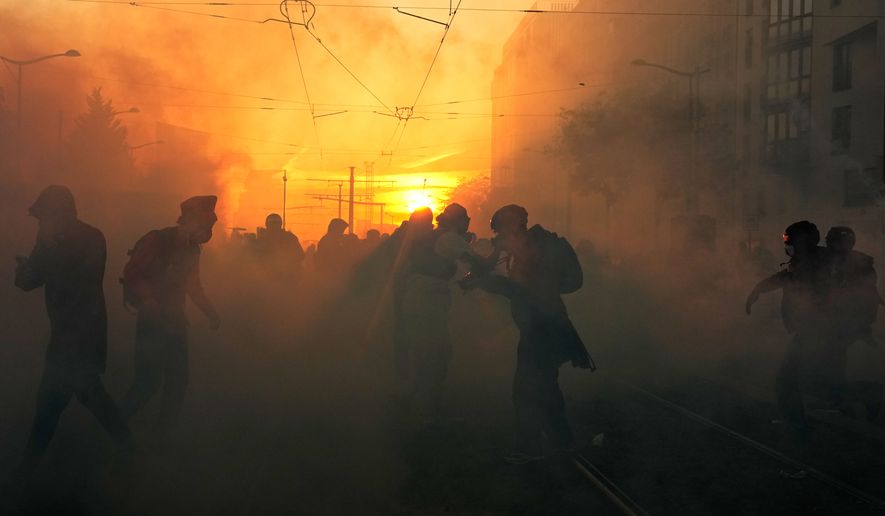
France is burning, but Americans should not be smug. We could be next.
In September, high school students walked into the streets to protest crumbling schools and understaffed classrooms. That set off broader national protests about the high cost of living and young people’s poor job prospects — and rioting and looting.
Those laments plague many Western economies and are inspiring voters to seek radical, populist solutions. Such forces gave us President Trump and punishing tariffs, which fueled inflation, squashed real wages and ultimately became terribly unpopular, souring voters on mainstream Republicans.
People were interested in these podcasts
Now, many Americans want a radical turn left. Witness the recent strength of democratic socialists.
Mr. Trump has remarked, “France is right now burning down because it opens its borders to people who hate it.”
In some measure, he is right. France has admitted numerous people who neither share French values nor aspire to genuinely assimilate into French culture.
Yet France’s frustrations and outbursts of violence have broader foundations: too much government, and too much bad government, born of the indulgence of popular demands and political gridlock. Sound familiar?
Government spending accounts for about 56% of gross domestic product, taxes for 51%, and the deficit for about 5%. Along with famously cumbersome business and labor market regulations, these smother private investment. Real GDP growth hovers at about 1%.
The average annual wage has fallen behind in Britain, Germany and South Korea. South Korea is where automakers knock out SUVs competitive in the American market — something French manufacturers cannot do.
The U.S. national debt is 111% of GDP. Interest payments exceed nominal GDP growth and will soon fly out of control.
Unlike the United States and Japan, France owes in a currency its central bank cannot print: the euro. Unless government spending is radically cut or the European Central Bank stokes inflation throughout Europe by printing euros to buy French bonds, France will likely default.
Interest rates on government bonds have soared as investors nervously speculate that France could be insolvent.
With the government spending so much, how could the schools be in such sorry shape?
France’s retirement age is about 63, compared with 66 or 67 in Britain, Germany, Italy and the United States. Pensions now absorb 14.1% of GDP. Consequently, schools get shortchanged.
Capital spending for schools — buildings, computers and such — is half the level of Japan and a quarter of the level of the United States.
More than 32% of the education budget goes to finance pensions.
Most other countries would record those outlays as pension spending, but Paris appears to be engaged in an elaborate scheme to disguise outlays for retirement benefits.
Some 11% of the government spending on pensions is recorded as something else. By diverting scarce public funds to meet these ballooning pension liabilities, Paris is failing in its primary duty to fund basic public safety. Governments are supposed to provide the basics — rule of law to secure property and persons — but not in France.
The national and local governments fund the operation and security of museums.
In October 2025, thieves stole eight pieces of the French crown jewels from the Louvre during normal operating hours on a Sunday morning. Across France, museums are ripe targets for criminals. In the past 15 years, about 20 major robberies have been recorded annually.
If Paris cannot secure the crown jewels, how can it keep the streets safe from looters?
Performance at the nation’s schools is declining.
U.S. scores on the Organization for Economic Co-operation and Development Program for International Student Assessment, which focuses on science, math and reading comprehension, fell from 500 in 2009 to 490 in 2025, while those for France dropped from 490 to 456.
When he took office in 2017, French President Emmanuel Macron sought to fix the economy by softening labor market and business regulation and raising the retirement age to 64. Those measures were met with Yellow Vests demonstrations, and raising the retirement age has been delayed.
Mr. Macron may well be succeeded by Jean-Luc Melenchon from the radical-left French Unbowed party or Marine Le Pen from the radical-right National Rally. Both have irresponsibly proposed lowering the retirement age to as low as 60.
The center of French politics is collapsing, just as the democratic socialists are pulling the ascendant Democratic Party toward solutions as ruinous as Mr. Trump’s tariffs.
The U.S. federal deficit is already greater than 6% of GDP and could soon outpace the growth rate of nominal GDP. That could propel the nation’s finances into a death spiral.
The cost of democratic socialists’ “Medicare for All” would surely do the trick, but since Washington can print dollars, it could opt for inflation instead.
That would devastate real incomes and could send angry Americans into the streets.
Remember the 2020 attacks on police stations in Seattle and Portland, Oregon, and general urban dysfunction? America, like France, is at risk of a dissolving political center and radical politicians who would wreck the nation.
• Peter Morici is an economist and emeritus business professor at the University of Maryland, and a national columnist.
Follow the author


Please read our comment policy before commenting.