



OPINION:
History yields people whose influence extends far beyond their earthly lives. They become teachers to generations they never met, spiritual companions to people whose names they never knew and reminders that faith is not merely a set of propositions to be accepted but a way of life to be embraced.
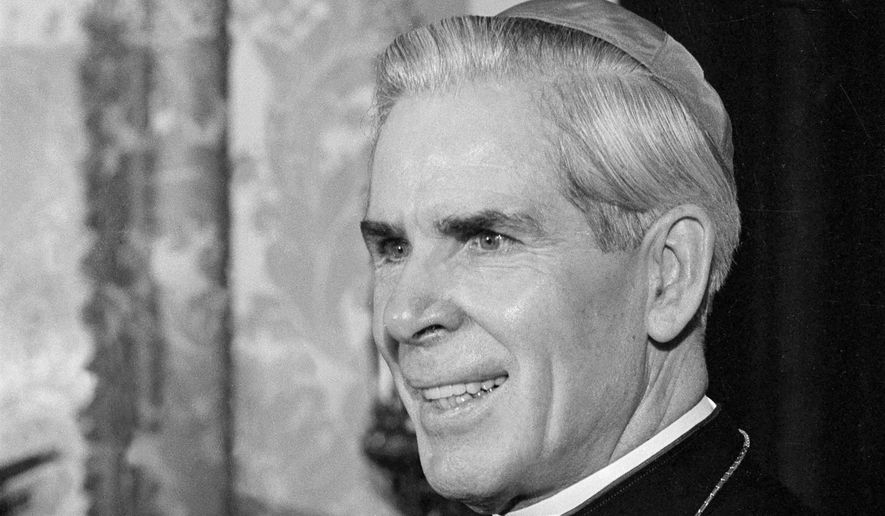
For me, one of those extraordinary figures is Archbishop Fulton J. Sheen.
Sheen possessed a rare gift: He could bring the richness, beauty and intellectual depth of traditional Catholicism into the homes of ordinary Americans. Through his television program “Life Is Worth Living,” for which he won an Emmy Award as most outstanding television personality, he introduced millions of viewers to traditional Roman Catholicism.
He did not dilute the faith to make it acceptable to the times. He presented it with clarity, conviction, humor, warmth and a deep love for Jesus Christ.
For those of us who cherish the traditional Catholic faith, Sheen remains a particularly compelling figure. His Catholicism was rooted in the Eucharist, the priesthood, the sacramental life, spiritual disciplines that had nourished the faithful for centuries, evangelization, and public recognition of the unique role of the Blessed Virgin Mary in human salvation.
The Catholic faith that Sheen proclaimed fostered the traditional pre-Vatican II practices that shaped centuries of Catholics. The Latin Mass, with its reverence, mystery and transcendent orientation, expressed a vision of worship in which the human person was drawn beyond the distractions of the world and into a unique space, reserved for Christ’s re-sacrifice of himself.
Sheen also understood the importance of the seemingly ordinary disciplines of Catholic life: meatless Fridays, weekly confession, personal prayer, the daily recitation of the Rosary and personal self-denial. These practices were not empty rules or burdens imposed for their own sake. Properly understood, they were instruments of spiritual formation.
Sheen’s genius was to explain truths and regimens in ways that ordinary people could understand. He could speak about theology without making it lifeless, about sin without making it condemnatory and about holiness without presenting it as something reserved for monks and nuns.
He understood that every person, regardless of education, wealth or social position, was created for communion with God.
Here is how Fulton Sheen touched my life. Shortly after I graduated from law school, a friend gave me a Miraculous Medal.
I wrote to Archbishop Sheen and asked him to bless it for me.
He wrote back quickly. In his letter, he asked me to meet him at 12:30 p.m. during Holy Week at Marble Collegiate Church in Manhattan, where he was preaching.
I arrived in time to hear his traditional Catholic sermon. Then, I stood in a line of people waiting to meet him. When I reached the head of the line, he floored me. He looked directly into my eyes and said: “You must be Andrew. Show me the medal!”
I was shaking as I loosened my necktie, unbuttoned the top two buttons of my shirt, removed the medal and handed it to him. He held the medal in one hand. With the other, he touched my eyes, my ears and my lips. He blessed and kissed the medal, then placed it over my head and around my neck.
Then he embraced my entire head in his hands.
This was a profoundly personal encounter. Here was a holy churchman, a public figure known to millions, yet in those moments his attention was directed entirely toward God and the sacramental significance of the medal and the wishes of a supplicant stranger. I asked him why we were in a Protestant church.
He said, in substance: “These folks need to know that in Catholic churches all over the world, Jesus Christ is physically present under the appearance of bread and wine, and he wants to be present in their hearts.”
That answer revealed something essential about Sheen’s ministry. His love for Catholicism did not lead him to withdraw from the world. It impelled him to bring the Catholic message to people who might never enter a Catholic church.
He understood that evangelization required meeting people where they were, speaking to their questions and inviting them toward the fullness of the truth.
What is the purpose of life? What is the meaning of suffering? How should we confront sin? What does it mean to love God? Where can we find truth, forgiveness and lasting hope? Why is there war and genocide? No question escaped him. Sheen’s answers always led back to Christ through Mary.
The traditional Catholic practices Sheen cherished offered a practical response to spiritual poverty. The Latin Mass directed the soul toward the mystery of transubstantiation. Confession restored the relationship between the sinner and God. The Rosary brought the mysteries of Christ and Mary into daily life. Fasting and self-denial weakened the grip of selfishness and cupidity. Personal prayer opened hearts to divine grace.
These practices did not promise an easy life. They called for discipline, humility and perseverance. Yet Sheen understood that holiness is not produced by convenience. It requires the daily decision to place God above self.
This week, the Catholic Church is beatifying Archbishop Fulton J. Sheen. Beatification is a formal declaration that a person may be publicly honored as Blessed according to the church’s norms. It is a significant step toward canonization.
For those who have long admired Sheen, his beatification is an opportunity not merely to celebrate his accomplishments, but to reflect upon his holiness.
For me, Archbishop Sheen will always be more than a figure in the history of American Catholicism. He is the man who did not know me, looked into my eyes and mysteriously said my name and drew me to his heart. That encounter remains in my heart as an unmerited gift from a future saint. Blessed Fulton J. Sheen, pray for us.
• To learn more about Judge Andrew Napolitano, visit https://JudgeNap.com.
Follow the author

Please read our comment policy before commenting.