Skip to content
Advertisement
Author profile
Ben Wolfgang

Ben Wolfgang

bwolfgang@washingtontimes.com

Ben Wolfgang is a national security correspondent at The Washington Times, a senior member of its Threat Status team, and the host and producer of the award-winning Threat Status Podcast. Ben covers national security, foreign policy, military affairs, the defense industry and the rapidly evolving landscape of military technology.
A Pennsylvania native, he joined The Washington Times in 2011 after serving as a political reporter at The Republican-Herald in Pottsville, Pa. Over the course of his career, Ben has covered the White House, Congress, and four presidential campaigns.
His reporting has earned recognition from some of journalism's most respected organizations, including the Virginia Press Association and the Society of Professional Journalists' Washington, D.C. Chapter, among other honors.
Ben has interviewed heads of state, chairmen of the Joint Chiefs of Staff, senior military commanders, cabinet secretaries, senior government officials, and the CEOs of many of the nation's largest and most influential defense companies.
Ben is a frequent guest on broadcast media, with appearances on C-SPAN, the Sirius XM POTUS channel, and other outlets.
He can be reached at bwolfgang@washingtontimes.com.

Articles by Ben Wolfgang

This Dec. 29, 2019, aerial file photo taken from a helicopter shows Ain al-Asad air base in the western Anbar desert, Iraq. (AP Photo/Nasser Nasser, File)

Rockets hit airbase in Iraq hosting U.S. troops

A burst of at least 10 rockets targeting the Ain al-Asad airbase early Wednesday resulted in no direct U.S. troop casualties, but the Pentagon later revealed that an American contractor working with the base had suffered a "cardiac episode" and died while taking cover from the attack.

March 3, 2021
This Dec. 10, 2018, file photo, provided by the U.S. Missile Defense Agency (MDA), shows the launch of the U.S. military's land-based Aegis missile defense testing system, that later intercepted an intermediate-range ballistic missile, from the Pacific Missile Range Facility on the island of Kauai in Hawaii.  (Mark Wright/Missile Defense Agency via AP)  **FILE**

Pentagon lays out big tab to keep up with China

The U.S. military must invest heavily in high-tech radar, space-based weapons detection systems, long-range artillery and a host of other 21st-century capabilities to keep at bay an increasingly aggressive China, the Pentagon told congressional leaders this week in a sweeping new funding proposal.

March 2, 2021
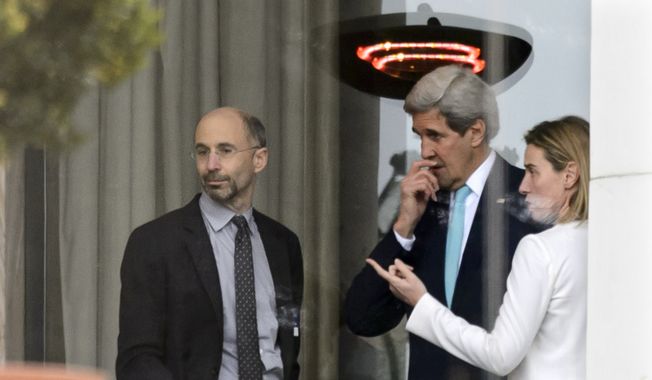
In this file photo from April 1, 2015, High Representative of the European Union for Foreign Affairs and Security Policy Federica Mogherini, right, speaks with then-U.S. Secretary of State John Kerry, center, and U.S. Robert Malley, left, Senior Director for Iran, Iraq, and the Gulf States, National Security Council during a break outside the hotel at the Beau Rivage Palace Hotel as the Iran nuclear talks continue, in Lausanne, Switzerland, Wednesday, April 1, 2015. Malley currently serves as the Biden administration's special envoy to Iran and is working to salvage the Obama-era Iran deal that President Trump canceled. (AP Photo/Keystone,Laurent Gillieron)  ** FILE **

Michael McCaul, Mark Green question Iran-John Kerry backchannel talks

Top Republicans in Congress called on the State Department Tuesday to immediately explain why key Obama-era diplomats now serving in the Biden administration held backchannel talks with Iran during the Trump years, saying it's crucial that the public learn more about Democrats' closed-door shadow diplomacy with Tehran.

February 23, 2021
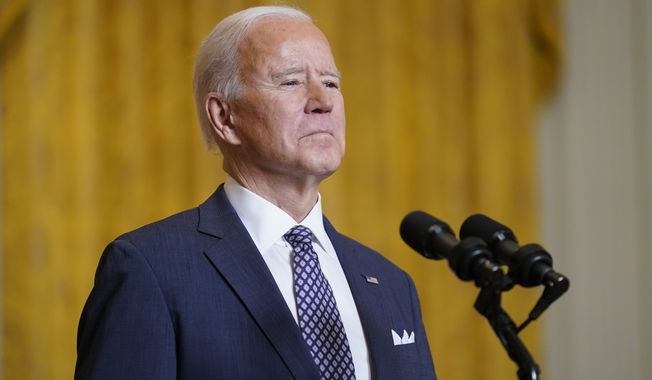
President Joe Biden speaks during a virtual event with the Munich Security Conference in the East Room of the White House, Friday, Feb. 19, 2021, in Washington. (AP Photo/Patrick Semansky)

Joe Biden Iran outreach backfires, pressure builds

The Biden administration came under pressure from all sides Monday in its push to restart nuclear talks with Iran, as leaders in Tehran threatened to dramatically ramp up uranium enrichment programs while officials in China and Israel laid out their own wildly different blueprints for how Washington should handle the tense diplomatic standoff.

February 22, 2021
In this Feb. 1, 2020, file photo Democratic presidential candidate former Vice President Joe Biden smiles as former Secretary of State John Kerry, left, takes the podium to speak at a campaign stop at the South Slope Community Center in North Liberty, Iowa. (AP Photo/Andrew Harnik, File)

John Kerry held backchannel talks with Iran, Javad Zarif

President Trump in 2019 sought to open a back channel of communication with top Iranian officials and saw the U.N. General Assembly meeting in September as a potential opportunity to defuse escalating tension with Tehran, but the effort failed.

February 21, 2021
President Joe Biden arrives for a virtual event with the Munich Security Conference in the East Room of the White House, Friday, Feb. 19, 2021, in Washington. (AP Photo/Patrick Semansky)

Biden: ‘I welcome’ competition with China; U.S. and Europe will win

The U.S. and its European partners abroad can compete with China in the 21st century and come out victorious, and Washington should "welcome" that high-stakes geopolitical and economic fight, President Biden said Friday in a sweeping foreign policy speech in which he sought to close the book on the Trump era and recast America's role in the world.

February 19, 2021
NATO Secretary General Jens Stoltenberg speaks during a media conference, after a meeting of NATO defense ministers in video format, at NATO headquarters in Brussels on Thursday, Feb. 18, 2021. (AP Photo/Virginia Mayo, Pool)

NATO ministers’ summit punts on Afghan troop decision

The U.S. and its NATO allies are deadlocked about their military future in Afghanistan, with a key May 1 withdrawal deadline fast approaching and no clear signals from either Washington or Brussels on the path forward.

February 18, 2021
In this Feb. 4, 2021, photo, Secretary of State Antony Blinken speaks at the State Department in Washington. The Biden administration on Feb. 18 rescinded former president Donald Trump’s restoration of U.N. sanctions on Iran, an announcement that could help Washington move toward rejoining the 2015 nuclear agreement aimed at reining in the Islamic Republic’s nuclear program. (AP Photo/Evan Vucci)

Joe Biden open to Iran talks, re-entering nuclear deal

Top Biden administration officials said Thursday that the U.S. would accept an invitation from the European Union to join multilateral talks with Iran, extending an olive branch that could pave the way for Washington to re-enter a landmark global nuclear deal with Tehran or craft another to take its place.

February 18, 2021
President Joe Biden listens as Secretary of Defense Lloyd Austin speaks at the Pentagon, Wednesday, Feb. 10, 2021, in Washington. (AP Photo/Alex Brandon, Pool)

Biden stands up ‘China Task Force’ at the Pentagon

President Biden on Wednesday issued an urgent call for a governmentwide effort to reevaluate and confront the threat posed by China, making his first trip to the Pentagon as president to announce a high-level task force that could overhaul American military policy toward its chief 21st-century rival.

February 10, 2021