


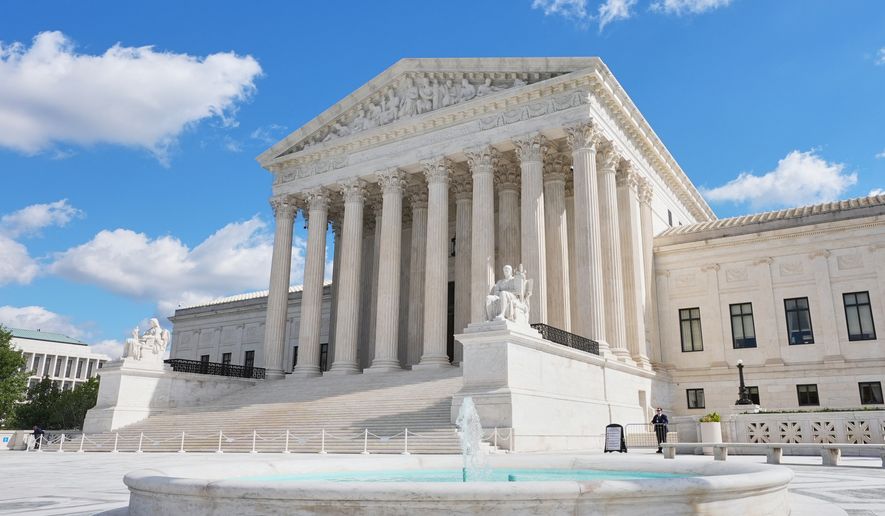

The Justice Department warned the Supreme Court on Tuesday that the entire system of federal administrative fines could topple if the justices rule that the Labor Department can’t unilaterally assess fines on employers who abuse the farm worker guest program.
For decades, the government has had the power to slap fines on businesses that violate the terms of their agreement for bringing in foreign workers.
A federal circuit court ruled that fines are the type of punishment that must be decided by regular courts, rather than unilaterally imposed by the executive branch.
People were interested in these podcasts
Now the justices have been asked to referee.
The DOJ said that if the court rules against the government, it could unwind the system of fines on violators for programs ranging from Medicare to student loans.
“That’s kind of a nuclear option,” said Principal Deputy Solicitor General Sarah Harris, telling the justices during oral argument that “tons of civil programs” would be imperiled.
The case involves the H-2A visa and Sun Valley Orchards, a New Jersey fruit and vegetable farm that brought in nearly 100 foreign agricultural workers in 2015 and promised free housing, access to groceries and cooking facilities, and a guaranteed number of hours of work.
The Labor Department said it broke those promises, and the federal agency assessed a fine of nearly $600,000 for back wages and penalties.
Sun Valley went to court, arguing the department lacked authority to assess the fines on its own and should have brought the farm to court, where an independent judge would hear the case from the start and issue a final ruling.
All sides agreed that challenges involving so-called private rights must be heard in the regular courts.
But those involving public rights, where the government is conferring a benefit, have often been allowed to be adjudicated by an executive branch agency.
Ms. Harris said the power to bring in guest workers is such a public right.
Robert Johnson, the lawyer arguing the case for the farm, said that may be true for the initial decision to admit the workers, but once they are here, the case turns into a contract matter.
That means the Labor Department can kick Sun Valley out of the H-2A visa program and deport the workers, but punitive fines require court involvement.
Chief Justice John G. Roberts Jr. seemed sympathetic to that idea, saying the conditions the Labor Department imposes on farms seem “more like a condition of employment than a condition of entry” into the country.
“The H-2A workers here have been in the country for some time,” he said.
Justice Elena Kagan countered that the entire point of the H-2A program was to protect domestic workers from being undercut by foreign workers, and the violations aren’t merely contract matters but rather “visa fraud.”
“This is essentially the government saying you have violated admissions pledges you’ve made to us,” she said.
Justice Brett M. Kavanaugh pointed out that the farm can already go to court to challenge the Labor Department’s decision, though judges give deference to the agency’s findings.
Ms. Harris said that was true, but said the question is where the process starts.
“It’s the enforcement effect,” she said. “Can the federal government have enforcement of federal laws within the agency context or is it entirely at the mercy of the tail end of the court process?”
The case is Department of Labor v. Sun Valley Orchards.
A ruling is expected before the court’s term ends next summer.
Contact the author


Please read our comment policy before commenting.