


SPONSORED What's This?
From Legend Capital to Columbia: Hong Shangguan on AI, Global Capital, and Investing Beyond Consensus
In venture capital, consensus is often comforting. For Hong Shangguan, it is often where the greatest risks begin.
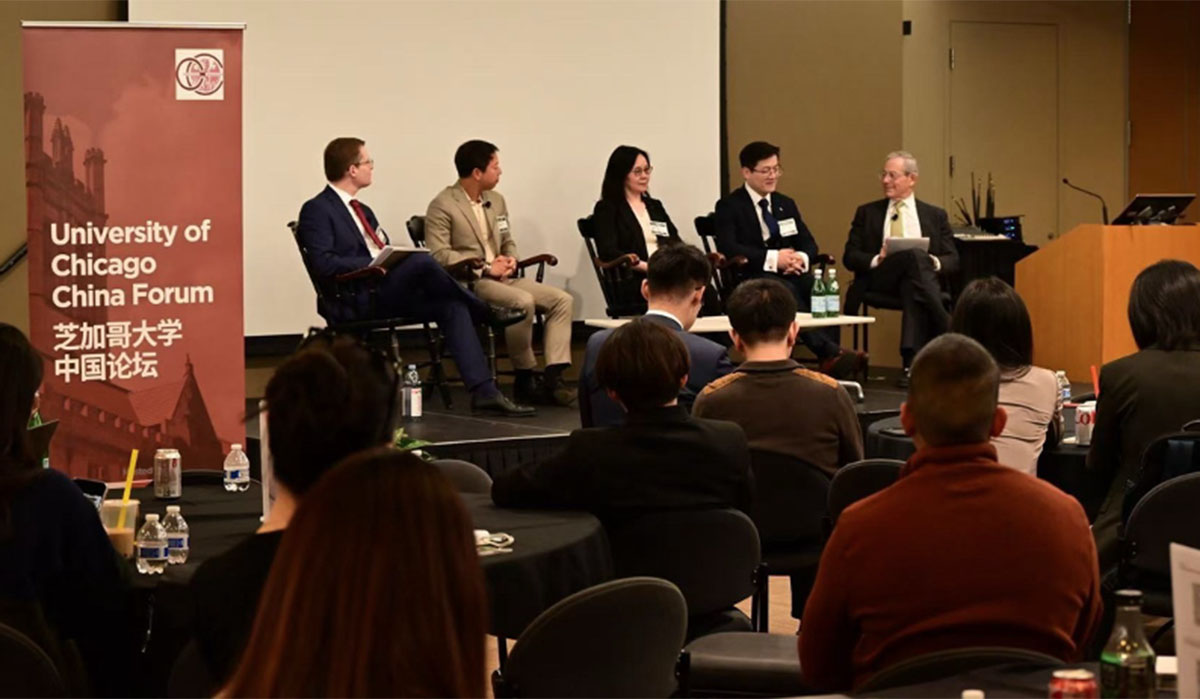
After nearly two decades investing across China’s technology, consumer, media, and cross-border markets, Shangguan has developed a perspective shaped not merely by financial models, but by observing how businesses, industries, and global systems evolve under pressure.
A former Partner at Legend Capital, one of China’s leading venture capital firms, Shangguan has spent much of her career evaluating emerging technologies, consumer behavior shifts, platform economies, and strategic transactions. Her investment experience includes category-defining companies such as Bilibili, Luckin Coffee, and Bloks, while earlier in her career, she held senior executive roles in a publicly listed Chinese media company and participated in large-scale M&A transactions.
Today, as a Visiting Scholar at Columbia University, she finds herself in a different but equally revealing environment: America’s leading academic and entrepreneurial ecosystems, where ideas about artificial intelligence, global competition, and the future of capital are being tested in real time.
What she sees reinforces one conviction: the next era of innovation will not be won by those with the loudest narratives or even the fastest technologies alone, but by those who understand how complex systems move together.
A Career Built on Pattern Recognition
Many investors describe their work through numbers—valuation multiples, market sizes, return scenarios.
Shangguan sees it differently.
“People often think investing is about spreadsheets, models, and financial forecasts,” she says. “But the most difficult business judgments are rarely purely financial. They are about understanding systems—people, incentives, regulation, execution, timing, and market psychology.”
That worldview was shaped early.
Before entering venture capital, Shangguan worked inside China’s media industry during a period of rapid digital transformation, later participating in major M&A transactions where strategic alignment often proved more decisive than headline numbers.
She learned that business success rarely depends on one variable alone.
Management incentives, capital structure, operational execution, regulatory realities, competitive positioning, and external market sentiment often determine outcomes together.
That systems-oriented approach would later define her investment style.
At Legend Capital, where she spent years investing across technology, consumer, and platform businesses, she developed a reputation for identifying category shifts before they became obvious.
Her work included investments in Bilibili, which evolved into one of China’s most influential youth digital communities, and Luckin Coffee, which redefined coffee consumption through a combination of digital operations, supply chain efficiency, and aggressive market execution.
“Consensus can be dangerous,” Shangguan says. “The most valuable opportunities often emerge before the market agrees they are obvious.”
Columbia: A Window Into Global Business Reconfiguration
Now at Columbia University, Shangguan has found a new vantage point.
In recent months, she has participated in a series of high-level academic and entrepreneurial conversations, including the Columbia China Summit and venture showcase events affiliated with Columbia Business School.
At Columbia China Summit, she joined discussions around globalization, business transformation, and cross-border commercial strategy alongside faculty, executives, investors, and founders.
One recurring question stood out:
How are Chinese companies’ globalization strategies changing?
Shangguan sees a structural shift.
“In earlier generations, Chinese companies often competed through manufacturing scale or cost advantage,” she explains. “Today, what increasingly travels across borders is not just products, but organizational efficiency, platform capability, supply chain coordination, and operational systems.”
That transition reflects a deeper transformation in how globalization works.
For Shangguan, today’s international competition is less about exporting goods and more about exporting capability.
Columbia’s environment, she says, is particularly revealing because it sits at the intersection of business, technology, policy, and international dialogue.
“Universities like Columbia are not just academic institutions,” she says. “They are places where early signals about future industries often become visible before they fully appear in the broader market.”
What American AI Founders Are Getting Right
As an investor judge at technology venture showcase events at Columbia Business School, Shangguan has evaluated startups spanning AI, health technology, battery systems, enterprise software, and workflow automation.
What stands out is not simply technical sophistication.
It is narrative clarity.
At the Wharton Entrepreneurship Summit, where she also participated in startup evaluation, she observed a similar pattern.
Many of the most compelling AI ventures were not foundational model companies, but application-layer businesses solving specific operational problems.
These included AI-enabled education platforms, consumer AI fitness tools, workflow automation systems, and infrastructure tools designed to improve long-term AI memory and productivity.
“What American founders often do exceptionally well is not necessarily just building technology,” Shangguan says. “They are very strong at articulating what the future could look like.”
That ability, she argues, is not merely communication skill.
It is capital strategy.
“Entrepreneurs are not only solving problems. They are persuading investors, teams, and partners that those problems are worth solving.”
At the same time, she sees caution signs.
AI enthusiasm has accelerated fundraising timelines, sometimes ahead of durable business validation.
“The question is not whether AI is powerful,” she says. “The question is whether the product creates sustainable value inside real workflows.”
AI Is Not Just Another Software Story
For Shangguan, one of the biggest misconceptions in the current market is treating AI as a conventional software cycle.
That view was reinforced during recent discussions affiliated with the University of Chicago Booth School of Business, where conversations spanned macroeconomics, capital markets, robotics, energy systems, and technology transformation.
“Many investors are still trying to understand AI through the framework of past software investing,” she says. “But this cycle is fundamentally different.”
Why?
Because AI touches multiple layers simultaneously:
* compute infrastructure
* semiconductor architecture
* data feedback loops
* enterprise workflow redesign
* deployment systems
* energy requirements
* robotics and embodied intelligence
This makes AI less of a traditional software category and more of a structural technology platform.
“It’s not simply about identifying the fastest-growing software company,” Shangguan says. “It’s about identifying capabilities that can enter production systems and meaningfully improve how industries operate.”
That perspective helps explain why capital is increasingly flowing not just toward AI applications, but toward infrastructure, industrial automation, robotics, and enterprise workflow transformation.
Globalization Beyond Simplistic Decoupling
Geopolitics has become an unavoidable variable in global investing.
Regulatory constraints, data governance, supply chain resilience, national security considerations, and capital movement restrictions increasingly shape investment decisions.
For Shangguan, this means capital allocation is no longer purely economic.
It is strategic.
But she rejects simplistic narratives around U.S.-China “decoupling.”
“That framing is often too simplistic,” she says. “In some politically sensitive sectors, separation is clearly happening. But in many others, what we are really seeing is commercial reorganization.”
That distinction matters.
Because companies are not necessarily abandoning globalization.
They are redesigning it.
New supply chains, new partnerships, new operational structures, and new market entry strategies are emerging.
The world is becoming more fragmented in some areas—but more creatively interconnected in others.
The Most Underrated Capability
As technology, geopolitics, and capital increasingly collide, Shangguan believes one capability remains deeply underestimated:
cross-system judgment.
The ability to understand not just technology, but how technology interacts with regulation, organizational behavior, market psychology, capital timing, and global strategic change.
That may ultimately define tomorrow’s winners.
“The best technology alone is not always enough,” she says. “What matters is understanding how multiple systems evolve together.”
For an investor who has spent years navigating category shifts, strategic transactions, and cross-border uncertainty, that perspective feels less like theory—and more like lived experience.
And in the age of AI, it may be more relevant than ever.
