


SPONSORED What's This?
Personal Power is the New Common Sense: Why Americans are Moving Off-Grid
Skip the permits, red tape, and thousands in contractor fees. Jackery’s plug-and-play solar generators are quickly setting a new standard in power self-reliance.
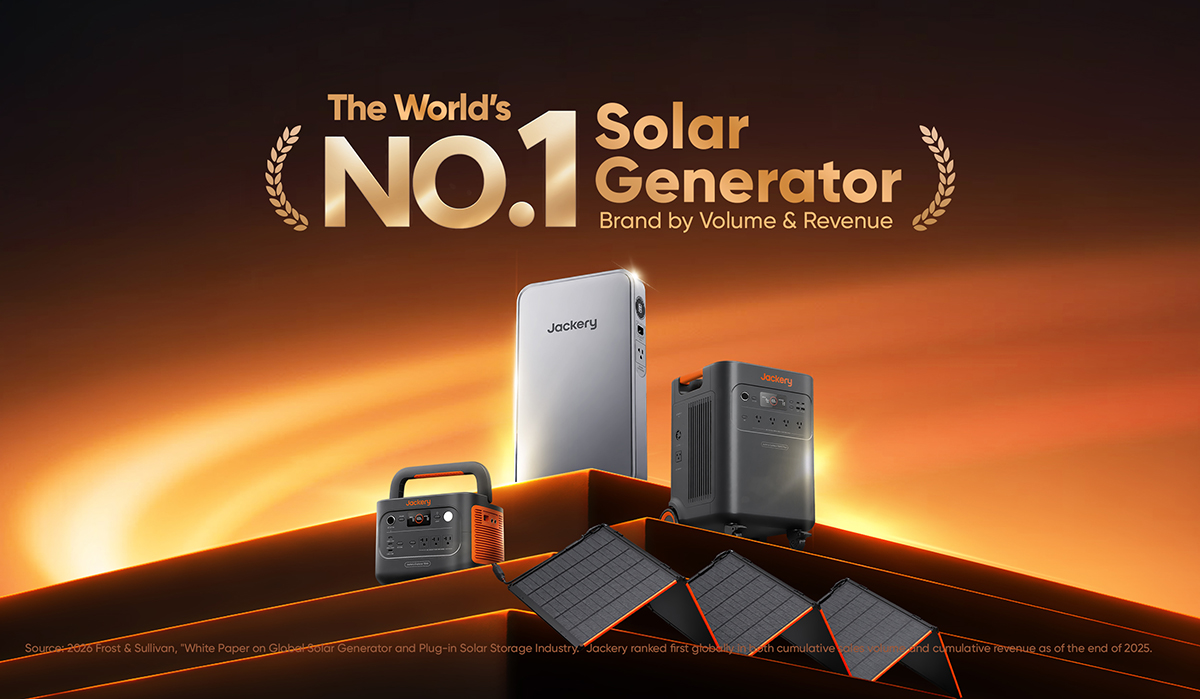
Across the country, a quiet transition is taking place in how American households view personal energy. Devices that were once considered recreational conveniences are rapidly being integrated into homes as vital, independent infrastructure.
According to global research and consulting firm Frost & Sullivan, Jackery has maintained its position as the World’s No. 1 Solar Generator Brand by cumulative sales volume through 2025. But beyond the corporate metrics, the company’s recent residential expansion points to a fundamental shift in homeowner behavior. In the first week of November, Jackery’s sales jumped 1,204% compared to November 2025, with retailers racing to get stock back on the shelves. Millions of Americans who initially purchased portable battery stations for remote job sites and off-grid camping are now pulling those systems into their living rooms and basements as always-available backup power.
If the Government Won't Rely on the Grid, Why Should Homeowners?
That shift toward household self-reliance mirrors a broader reassessment of national infrastructure. As recent energy coverage in The Washington Times has highlighted, the vulnerabilities of the aging U.S. power grid are well-documented, marked by premature closures of reliable baseload power plants and multi-year bureaucratic delays in building new transmission lines.
Washington is actively acknowledging this reality. Under the newly launched FORTRESS America initiative, defense planners are aggressively moving to decouple major domestic military bases from civilian utilities, requiring them to generate their own power and operate independently for up to 90 days. Concurrently, civil agencies across 17 allied nations are actively advising citizens to maintain a baseline of three to seven days of essential supplies on hand.
The takeaway for practical taxpayers is clear: if national defense planners and global governments no longer trust centralized grids and fragile supply chains to function during a severe crisis, homeowners must also establish their own operational independence.
Escaping the Gasoline Trap at 7,800 Feet
For 82-year-old former finance executive Weldon Morton, that independence became a necessity. High in the mountains of northern New Mexico, his cabin sits at 7,800 feet above sea level. When winter temperatures plunge, maintaining reliable heating and refrigeration isn’t about comfort — it’s a matter of basic survival.
Historically, rural and suburban homeowners have relied on combustion generators. But those legacy machines carry steep physical and logistical burdens: they’re loud, they emit toxic carbon monoxide exhaust, and they depend entirely on gasoline that degrades in storage and isn’t easy to source when neighborhood pumps lose power. After years of hauling heavy fuel cans and wrestling with noisy combustion engines in freezing weather, Morton overhauled his approach.
He turned to Jackery solar generator systems, gradually building a comprehensive off-grid setup he refers to as his “Jackery life system.” Starting cautiously with mid-range units, he expanded his reserves to include heavy-duty platforms like the Jackery Explorer 2000 Pro.
Paired with high-input SolarSaga panels, which Morton notes frequently pull in over 200 watts even on cloudy winter afternoons, the system keeps his refrigerators cold and his appliances running smoothly without a drop of fuel. As Morton puts it: “I’m in control of my system instead of the system controlling me.”
Bypassing Bureaucracy and Red Tape
Upgrading the nation’s bulk power infrastructure will require years of capital investment and endless administrative oversight. According to the latest Queued Up tracking report by the Lawrence Berkeley National Laboratory (LBNL), new power projects now face a median wait of five years just to clear the grid interconnection queue, and fewer than 20% of proposed projects actually get built. In the meantime, homeowners are securing their own properties while completely bypassing local bureaucracy.
Permanently hardwired standby generators routinely cost homeowners $5,000 to $10,000. Worse, they trap residents with weeks of municipal permitting, contractor scheduling delays, HOA approvals and utility interconnection red tape.
By pairing high-efficiency solar capture with battery storage, modular setups bypass those hurdles entirely. Because systems like Jackery's HomePower and Explorer series are self-contained and require no hardwiring, they demand zero permits. Engineered around lithium iron phosphate (LiFePO4) battery chemistry for exceptional thermal stability and a lifespan exceeding a decade of regular use, Jackery solar generators and power stations operate safely inside a kitchen or bedroom with zero emissions.
For heavier domestic loads, platforms like the Jackery Explorer 5000 Plus deliver true split-phase 120-volt and 240-volt output. This produces the substantial wattage required to run demanding equipment like well pumps and central blowers that standard backup units simply can’t handle, sustaining a continuous generation-and-storage loop directly on site.
Personal Energy as Common Sense
While Jackery is known for a versatile lineup centered on streamlined, user-friendly operation, it isn’t the only manufacturer seeing a surge in demand as winter weather sets in. Broadly speaking, the widespread adoption of home battery storage is an encouraging development that underscores the American ethos of independence and constant readiness.
By centering energy self-reliance on equipment that operates completely independent of public utilities and gas stations, pragmatic Americans are insulating themselves from grid volatility. They’re proving that true resilience doesn’t come from waiting for the government to fix the grid, but from securing their own power, on their own terms.
