Ben Wolfgang is a national security correspondent at The Washington Times, a senior member of its Threat Status team, and the host and producer of the award-winning Threat Status Podcast. Ben covers national security, foreign policy, military affairs, the defense industry and the rapidly evolving landscape of military technology. A Pennsylvania native, he joined The Washington Times in 2011 after serving as a political reporter at The Republican-Herald in Pottsville, Pa. Over the course of his career, Ben has covered the White House, Congress, and four presidential campaigns. His reporting has earned recognition from some of journalism's most respected organizations, including the Virginia Press Association and the Society of Professional Journalists' Washington, D.C. Chapter, among other honors. Ben has interviewed heads of state, chairmen of the Joint Chiefs of Staff, senior military commanders, cabinet secretaries, senior government officials, and the CEOs of many of the nation's largest and most influential defense companies. Ben is a frequent guest on broadcast media, with appearances on C-SPAN, the Sirius XM POTUS channel, and other outlets. He can be reached at bwolfgang@washingtontimes.com.
Most U.S. troops need to get more sleep. That's the big-picture takeaway from a sweeping Government Accountability Office study that found a sizable majority of service members get six or fewer hours of sleep each night -- less than the minimum of seven hours recommended by the Defense Department.
At least 115 people were killed and many more wounded in an attack on a Moscow concert hall Friday, Russian officials said, marking one of the deadliest assaults in recent history in Russia and coming just two weeks after U.S. officials warned of a looming terrorist attack on the Russian capital.
The rapidly growing threat posed by the Islamic State-Khorasan Province, the jihadi terrorist group's Afghanistan affiliate better known as ISIS-K, has linked the U.S. with some of its most bitter enemies, including Russia, Iran and even Afghanistan's ruling Taliban regime, in the high-stakes world of counterterrorism.
"Major warning signs" in the national security sector could hold back America's ability to innovate at a crucial moment in the intensifying global competition with adversaries such as Russia and China, according to a report made public Tuesday.
A nonpartisan watchdog group sent a letter to top Pentagon officials this week requesting all information that led to Defense Secretary Lloyd Austin's public claim that more than 25,000 Palestinians had been killed in the Gaza Strip since Oct. 7 -- a figure based on data supplied by the Hamas militant group.
Shadowy pro-Ukraine "Russian liberation forces" said they took control of a Russian town just over the Ukrainian border Tuesday as part of a seemingly well-coordinated assault by anti-Kremlin groups designed to bring the war to Russian soil.
Hungarian Foreign Minister Peter Szijjarto argues in an exclusive interview that his country remains the only NATO nation to avoid sending weapons to Ukraine because such a step, he believes, would only prolong a war with Russia that it is increasingly evident neither side can win.
There is no evidence to support claims that shadowy elements inside the U.S. government have made contact with alien life forms, have reverse-engineered extraterrestrial spaceships, or have systematically kept that information hidden from the American public for decades, according to a remarkable new Pentagon report issued Friday.
North Korean leader Kim Jong-un's appetite to make a major diplomatic deal with the U.S. seems all but dead. But Kim-watchers say it could suddenly spring back to life in January 2025 if former President Donald Trump returns to the White House.
Tensions between the White House and Israeli Prime Minister Benjamin Netanyahu's government neared the boiling point Monday as Biden administration officials ramped up their public pressure on Jerusalem over the "intolerable" humanitarian conditions in the Gaza Strip while simultaneously embracing one of Mr. Netanyahu's most popular political rivals.
Ukrainian troops are running perilously low on ammunition. Russian forces are gaining ground in the Donbas. And in America, the political fight over the utility of continued financial aid for Ukraine has reached a fever pitch.
Elon Musk's Starlink satellites played a pivotal role in slowing Russia's invasion of Ukraine and helped save Kyiv from complete collapse in the early days of the 2022 invasion. But those same satellites may have accelerated the Kremlin's determination to level the playing field and neutralize that advantage.
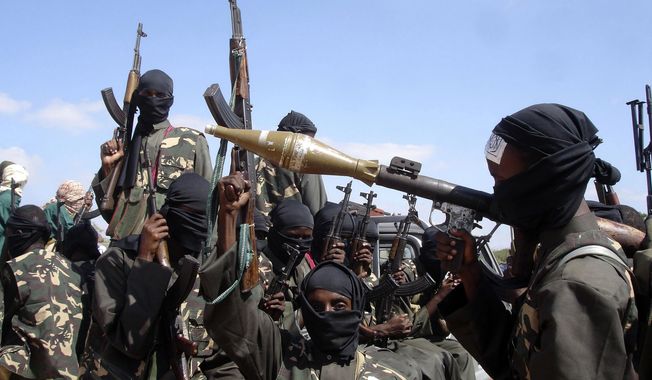
To fully understand the slate of bad options facing the U.S. in Somalia, consider this: National security analysts say that the Somali government troops are "several degrees of magnitude worse" than the hapless Afghan army that surrendered to the Taliban in a matter of weeks in 2021 after the Biden administration announced the U.S. combat troop withdrawal.
The White House confirmed Thursday that Russia is developing a space-based military capability that poses a national security threat, but insisted there is no immediate danger to the U.S.
U.S. forces on Jan. 28 seized a ship originating in Iran, loaded with missiles and drones, and destined for Yemen's Houthi rebels, the Pentagon revealed Thursday as it blamed the regime in Tehran for aiding the Houthis in their continued targeting of commercial ships in the region.