Ben Wolfgang is a national security correspondent at The Washington Times, a senior member of its Threat Status team, and the host and producer of the award-winning Threat Status Podcast. Ben covers national security, foreign policy, military affairs, the defense industry and the rapidly evolving landscape of military technology. A Pennsylvania native, he joined The Washington Times in 2011 after serving as a political reporter at The Republican-Herald in Pottsville, Pa. Over the course of his career, Ben has covered the White House, Congress, and four presidential campaigns. His reporting has earned recognition from some of journalism's most respected organizations, including the Virginia Press Association and the Society of Professional Journalists' Washington, D.C. Chapter, among other honors. Ben has interviewed heads of state, chairmen of the Joint Chiefs of Staff, senior military commanders, cabinet secretaries, senior government officials, and the CEOs of many of the nation's largest and most influential defense companies. Ben is a frequent guest on broadcast media, with appearances on C-SPAN, the Sirius XM POTUS channel, and other outlets. He can be reached at bwolfgang@washingtontimes.com.
President Trump's brain trust of retired military officers has disappeared just as tensions with Iran, Venezuela and North Korea heat up -- and critics say the White House is in danger of rushing to the brink of war under a mostly civilian and increasingly hawkish leadership team.
President Trump's decision last year to withdraw from the multinational Iran nuclear deal is the root cause of heightened military tensions with Iran, Russian President Vladimir Putin suggested Wednesday as he urged leaders in Tehran to continue abiding by the agreement.
His predecessor, retired Marine Gen. and war hero James N. Mattis, was confirmed by an overwhelming 99-1 vote in the Senate. But Patrick M. Shanahan, who was Mr. Mattis's No. 2 at the Pentagon, will face a much tougher road to become President Trump's defense secretary.
Telecommunications giant Huawei offered Tuesday to sign "no-spy" agreements with governments around the world in an effort to tamp down growing fears that the company's 5G technology could be used in a systematic Chinese espionage operation.
The United States has seized a North Korean cargo ship used to illegally ship coal and heavy machinery in violation of international sanctions, the Justice Department said Thursday, as tensions between the two nations continue to escalate.
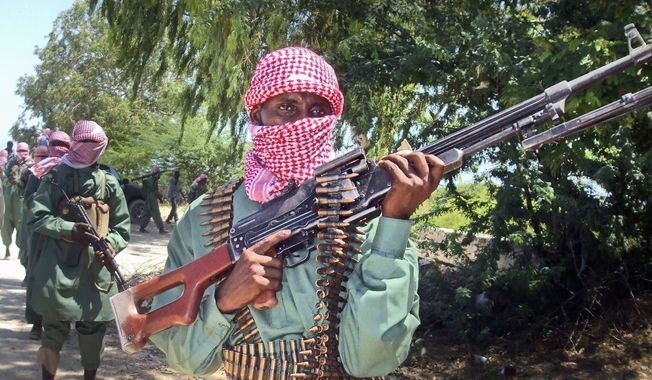
Words such as "eradicate" and "eliminate" are largely absent from the discussion surrounding al-Shabab, the al Qaeda affiliate estimated to control roughly 20% of Somalia and boasting at least 5,000 trained fighters.
Iran delivered an ultimatum to the U.S. and its allies on Wednesday: Rework a comprehensive nuclear deal within the next 60 days, or Tehran will quickly ramp up its uranium enrichment operations to near weapons-grade levels.
The pardon of former soldier Michael Behenna this week could spur a series of similar actions, according to advocates who say President Trump is reviewing other cases and could soon issue more pardons to members of the military convicted of murder and other major crimes.
Secretary of State Mike Pompeo made a brief, unannounced trip to Baghdad on Tuesday and huddled with Iraqi officials amid reports of growing threats from neighboring Iran.
A "credible threat" of Iranian attacks on American interests in the Middle East led President Trump to suddenly bump up the deployment of a U.S. aircraft carrier and bomber task force to the region, top administration officials said Monday in an escalation that critics fear could lead to a military clash with Iran.
Iranian President Hassan Rouhani will deliver a major speech Wednesday and is expected to lay out "counteractions" against the U.S. -- including the "resumption of some nuclear activities" as a direct response to President Trump's decision last year to exit the Iranian nuclear agreement.
Despite setbacks last week, top Trump administration officials on Sunday said they're sure socialist Venezuelan President Nicolas Maduro ultimately will be driven from power and the country will have its "democracy restored."
The Trump administration on Sunday downplayed North Korea's weapons tests, vowing to press on with its diplomatic outreach even as lawmakers -- including some of President Trump's closest Republican allies -- warned that the weekend missile launches strained the fragile relationship between Washington and Pyongyang.
Sexual assaults in the military increased dramatically over the past two years, new Defense Department data show, sparking outrage from lawmakers on both sides of the aisle who charged Thursday that the Pentagon is failing the nation's women and men in uniform.
Violence erupted in the streets of Caracas on Tuesday as U.S.-backed Venezuelan opposition leader Juan Guaido unexpectedly launched what he called the "final phase" of his campaign to drive socialist President Nicolas Maduro from power, urging supporters and members of the military to mount an all-out rebellion and take control of the government.
Thousands of miles from the chaos that erupted in Caracas, Venezuela, on Tuesday, White House National Security Adviser John R. Bolton directed a string of unusually sharp threats at socialist President Nicolas Maduro and found himself embroiled in a Twitter war of his own with one of Mr. Maduro's top deputies.
Amid a popular uprising and violence in the streets, Venezuelan President Nicolas Maduro was planning to flee for Cuba but was convinced by Russia to stay and fight for his survival, Secretary of State Mike Pompeo said Tuesday.
With its price tag rising each day as the inmate population grows older and sicker, the sudden firing of the top commander at Guantanamo Bay adds fresh fuel to the debate over the prison's future and highlights a political, logistical and legal minefield that neither the Obama nor the Trump administration has managed to navigate.
The first major battle for President Trump's prized Space Force is being waged here on Earth, as three states compete for a key component of the military's 21st-century space initiative.