Ben Wolfgang is a national security correspondent at The Washington Times, a senior member of its Threat Status team, and the host and producer of the award-winning Threat Status Podcast. Ben covers national security, foreign policy, military affairs, the defense industry and the rapidly evolving landscape of military technology. A Pennsylvania native, he joined The Washington Times in 2011 after serving as a political reporter at The Republican-Herald in Pottsville, Pa. Over the course of his career, Ben has covered the White House, Congress, and four presidential campaigns. His reporting has earned recognition from some of journalism's most respected organizations, including the Virginia Press Association and the Society of Professional Journalists' Washington, D.C. Chapter, among other honors. Ben has interviewed heads of state, chairmen of the Joint Chiefs of Staff, senior military commanders, cabinet secretaries, senior government officials, and the CEOs of many of the nation's largest and most influential defense companies. Ben is a frequent guest on broadcast media, with appearances on C-SPAN, the Sirius XM POTUS channel, and other outlets. He can be reached at bwolfgang@washingtontimes.com.
At the height of the global pandemic, the Pentagon in August 2021 decreed that all U.S. troops must get the COVID-19 vaccine, then launched a logistical push to get the shot to every service member stationed anywhere in the world.
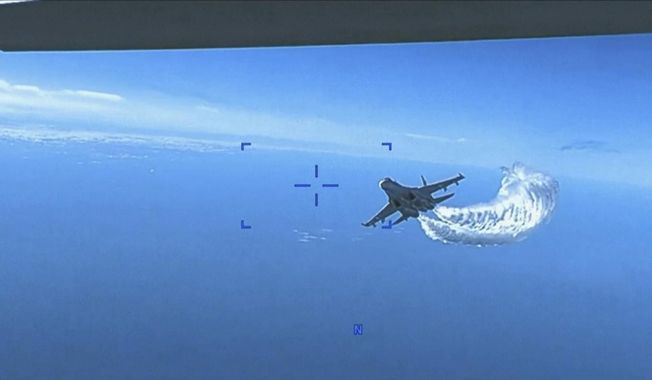
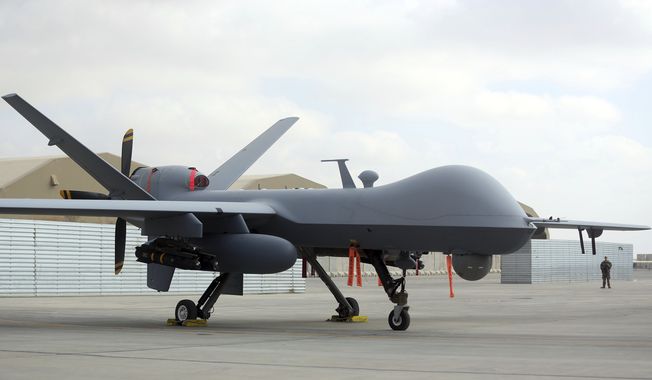
Russian crews are scouring the Black Sea for remnants of the American MQ-9 Reaper that crashed there earlier this week, Pentagon officials said, while the U.S. military made public on Thursday raw video footage that seems to show a Russian fighter jet dumping fuel on the drone and clipping its propeller just before it went down.
The Pentagon early Thursday released a declassified video that officials say shows the Tuesday collision between a Russian Su-27 fighter jet and a U.S. MQ-9 Reaper drone over the Black Sea.
The U.S. and Russian militaries scrambled Wednesday to locate the wreckage of the American MQ-9 Reaper drone that crashed into the Black Sea after being hit by a tailing Russian fighter jet a day earlier.
A Russian fighter jet collided with a U.S. military surveillance drone over the Black Sea on Tuesday, forcing U.S. operators to bring down the unmanned craft in international waters and prompting Pentagon officials to blast the Russian pilots' behavior as "unsafe and unprofessional."
The Biden administration said it would guarantee all deposits at the now-shuttered Silicon Valley Bank but insisted the move was not a taxpayer-funded bailout, while regulators closed a second institution, New York City's Signature Bank, amid fears of an unfolding economic crisis.
Finnish President Sauli Niinisto said Sunday he is optimistic his country will eventually join NATO, but he conceded that Turkey has a "different opinion" over a key security-related dispute between the two sides that is holding up the process.
Russian President Vladimir Putin is insulating wealthy urban families from the carnage in Ukraine, Western intelligence analysts said Sunday, with the Kremlin instead sending poor Russians and ethnic minorities to the front lines of an increasingly bloody war.
The world may be on an irreversible march toward clean energy, but the past year has brought with it a sobering reminder that 21st-century economies cannot function for the foreseeable future without oil, natural gas and other fossil fuels, said Egyptian Minister of Petroleum and Mineral Resources Tarek El Molla.
U.S. troops at the Kabul airport on Aug. 26, 2021, believed they identified the Islamic State suicide bomber who ultimately killed 13 Americans and nearly 200 Afghans at the height of America's frantic military exit.
Iran's commitments to allow tighter oversight at its nuclear facilities represent a key step forward, United Nations officials said Monday as they sought to tamp down growing fears about Tehran's nuclear program after reports that the Islamic republic can now produce enough weapons-grade uranium for a nuclear bomb in as little as 12 days.
Russia seemed to lack an effective battle plan in the early weeks of the Ukraine war last year as a succession of military commanders struggled to adjust to changing circumstances on the ground.
The carnage, political dysfunction and rising tide of Islamic terrorism gripping Syria have created a toxic powder keg unlike anything else on the planet -- and that was before last month's massive earthquake killed thousands and reduced even more of the divided and volatile country to rubble.
The unthinkable -- a multi-year shooting war with tanks, trenches, drones and vast waves of refugees -- is playing out in the heart of Europe, amid mounting fears the raging war in Ukraine will pit Russia and its allies against the U.S. and Western-aligned democracies around the world for decades to come.
The year-old Russian invasion of Ukraine has shaken the foundations of a post-Cold War order that has held sway for three decades, sparking new global unease over the prospect of nuclear war, rocking long-established diplomatic and political norms, and aligning the world's top autocracies in unsettling new ways.
Prominent right-wing Russian nationalists have seen their influence and public profiles rise over the past year to a point where they appear poised to shape the country's future.
Four U.S. troops were wounded and a senior Islamic State leader was killed during a Thursday night helicopter raid in northeastern Syria, the Pentagon said Friday, marking the American military's latest counterterrorism operation in the war-torn country.
The Biden administration on Monday seemingly ruled out an alien invasion as the explanation for three shoot-downs of unidentified objects over North America this weekend.