Ben Wolfgang is a national security correspondent at The Washington Times, a senior member of its Threat Status team, and the host and producer of the award-winning Threat Status Podcast. Ben covers national security, foreign policy, military affairs, the defense industry and the rapidly evolving landscape of military technology. A Pennsylvania native, he joined The Washington Times in 2011 after serving as a political reporter at The Republican-Herald in Pottsville, Pa. Over the course of his career, Ben has covered the White House, Congress, and four presidential campaigns. His reporting has earned recognition from some of journalism's most respected organizations, including the Virginia Press Association and the Society of Professional Journalists' Washington, D.C. Chapter, among other honors. Ben has interviewed heads of state, chairmen of the Joint Chiefs of Staff, senior military commanders, cabinet secretaries, senior government officials, and the CEOs of many of the nation's largest and most influential defense companies. Ben is a frequent guest on broadcast media, with appearances on C-SPAN, the Sirius XM POTUS channel, and other outlets. He can be reached at bwolfgang@washingtontimes.com.
The Afghan air force on Monday pounded the Taliban with repeated airstrikes in an effort to keep insurgent fighters from capturing key cities in southern and western Afghanistan, officials said, as the battle for the country's future moves from the rural countryside toward major population centers.
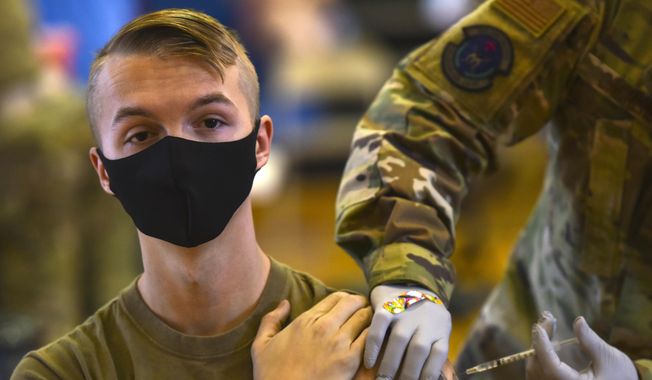
The Pentagon hopes to move "expeditiously" toward mandatory COVID-19 vaccinations for all U.S. service members, Defense Secretary Lloyd Austin said Friday, pledging to consult with military doctors and to quickly develop a path forward.
It's become far too easy for repressive regimes around the world to abuse Interpol and use international law enforcement to target dissidents and political opponents, a bipartisan group of lawmakers said Friday as they rolled out legislation to limit how governments can enlist the group.
Russian commandos on Friday kicked off a series of military drills along the Uzbekistan-Afghanistan border, fueling questions about a regional power vacuum left by the unfolding U.S. and allied military withdrawal from Afghanistan that Russia and other players will seek to fill.
The U.S. will end its combat mission in Iraq by the end of the year, President Biden announced Monday, with American forces shifting to an advisory and training role but potentially opening the door, critics say, for Iran to gain even more influence in the region.
The future of the U.S. war in Iraq will come into focus Monday when President Biden meets with Iraqi Prime Minister Mustafa al-Kadhimi at the White House, with the two leaders expected to finalize a withdrawal plan that could fundamentally reshape America's military role in the Middle East.
Iraqi Prime Minister Mustafa al-Kadhimi said his country no longer needs U.S. combat troops on its soil and it is time for America to transition to a support role in Iraq.
The Pentagon has invested two decades of time and untold manpower to train Afghan security forces, while American taxpayers have spent tens of billions of dollars providing direct financial assistance and military equipment for the effort.
The Pentagon was dragged deeper into the political fray Wednesday as the military's top uniformed officer faced repeated questions about his view on "White rage" and whether he crafted private plans to stop President Trump from staging a coup to stay in power.
Maj. Gen. Stephen Maranian was reinstated Wednesday as commandant of the U.S. Army War College after a months-long investigation into claims of abusive sexual contact found "no probable cause" that he committed the offense.
The Pentagon's chief watchdog has launched a major review of security procedures involving the so-called "nuclear football," the briefcase that contains launch codes for starting a nuclear war.
The U.S. and Russia on Monday traded shots over the development and deployment of hypersonic missiles, with each nation accusing the other of using the cutting-edge weapons in a "destabilizing" way that could lead to conflict.
The Biden administration said Monday it has transferred a detainee from the Guantanamo Bay detention center back to his native country of Morocco, cutting the total number of prisoners at the controversial site in Cuba to 39 with more moves on the horizon.
Afghanistan may be the first domino to fall in a much broader restructuring of America's military footprint across the broader Middle East and Central Asia.
With the Pentagon's $10 billion virtual "war cloud" now dead, military officials and key lawmakers are left with a troubling question: Can a company as powerful as Amazon effectively dictate how the federal government does business in the 21st century?
President Biden faced renewed pressure to rethink his diplomatic outreach to Tehran after the Justice Department late Tuesday charged four Iranian intelligence officials with plotting to kidnap a U.S. journalist in New York City.
President Biden is under renewed pressure to rethink diplomatic negotiations with Tehran after the Justice Department late Tuesday charged four Iranian intelligence officials with plotting to kidnap a U.S. journalist in New York City.
President Biden on Thursday fired back at a reporter who asked whether he trusts the Taliban, the insurgent group that's quickly overrunning large parts of Afghanistan as U.S. troops exit.
President Biden on Thursday offered a strong defense of his decision to withdraw all U.S. military forces from Afghanistan and said the "status quo" of a continued, indefinite American presence in the country after 20 years of war simply isn't a viable option.
The Biden administration is scrambling this week to defend its rapid withdrawal from Afghanistan amid a string of Taliban victories that have left the nation's fragile central government apparently barreling toward collapse.