Ben Wolfgang is a national security correspondent at The Washington Times, a senior member of its Threat Status team, and the host and producer of the award-winning Threat Status Podcast. Ben covers national security, foreign policy, military affairs, the defense industry and the rapidly evolving landscape of military technology. A Pennsylvania native, he joined The Washington Times in 2011 after serving as a political reporter at The Republican-Herald in Pottsville, Pa. Over the course of his career, Ben has covered the White House, Congress, and four presidential campaigns. His reporting has earned recognition from some of journalism's most respected organizations, including the Virginia Press Association and the Society of Professional Journalists' Washington, D.C. Chapter, among other honors. Ben has interviewed heads of state, chairmen of the Joint Chiefs of Staff, senior military commanders, cabinet secretaries, senior government officials, and the CEOs of many of the nation's largest and most influential defense companies. Ben is a frequent guest on broadcast media, with appearances on C-SPAN, the Sirius XM POTUS channel, and other outlets. He can be reached at bwolfgang@washingtontimes.com.
Israeli gunfire "likely" killed Palestinian-American journalist Shireen Abu Akleh during an Israeli Defense Forces (IDF) raid in the West Bank city of Jenin last month, U.S. officials said Monday following an extensive analysis of the bullet that struck the prominent reporter.
Russian forces over the weekend captured the key city of Lysychansk in Ukraine's eastern Donbas region, marking a major strategic win for Moscow while bringing virtually all of the disputed Luhansk province under Kremlin control.
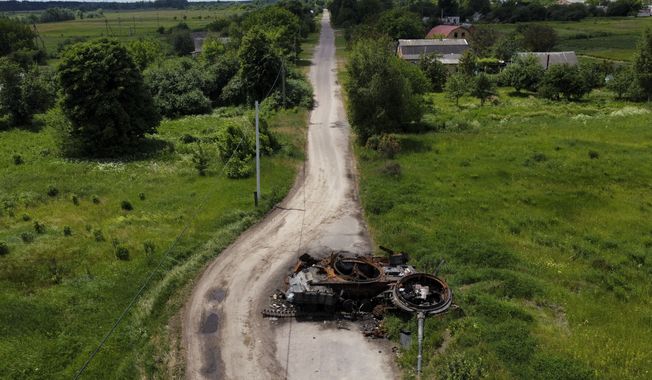
The early weeks of the war in Ukraine were dominated by social media posts showing Russian tanks decimated by small, cheap drones that helped level the playing field and largely negated Moscow's massive advantage in personnel and equipment.
The future of America's long-term troop presence in Europe came into focus Wednesday as President Biden announced new plans to permanently place fresh U.S. personnel in Poland, air defense batteries in Italy and Germany, and a host of other steps as NATO reinforces its front line as relations deteriorate badly with Russia in the wake of Moscow's invasion of Ukraine.
Turkey on Tuesday dropped its opposition to Sweden and Finland joining NATO, seemingly clearing the way for the two nations to enter the trans-Atlantic alliance and delivering a major boost to Western solidarity amid the Russia-Ukraine war.
The number of American troops in Europe has risen sharply in the four months since Russia invaded Ukraine, jumping from about 65,000 in mid-February to 100,000 today.
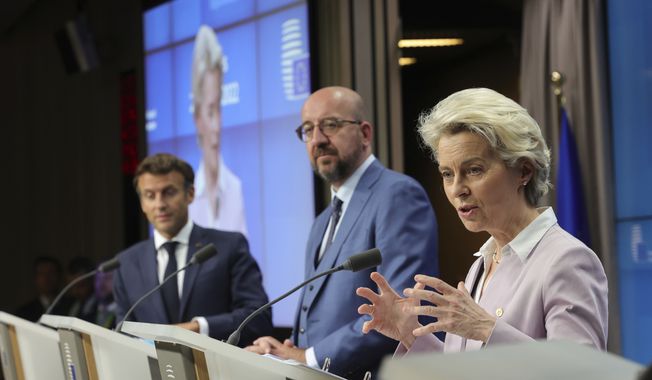
The European Union on Thursday formally made Ukraine a candidate for membership in the 27-nation alliance, delivering what could be a major morale boost for Ukrainian troops while dealing a significant blow to Russian President Vladimir Putin's drive to pull Kyiv away from the West.
Cracks are deepening across Europe over how to handle the Russia-Ukraine endgame, according to new data released Wednesday, as a growing number of Europeans favor immediate peace over the continuation of a hard-line anti-Russia stance that's defined Western policy since the start of the war nearly four months ago.
From predicting equipment failures on an F-16 before they happen to sorting through a mountain of data to correct overhead video in real time for a U.S. special forces team, the rapidly expanding role of artificial intelligence in today's military is often much less exciting than its critics suggest, but more important than most realize.
The U.S. is to blame for rising tensions in the Pacific, and America's Indo-Pacific strategy to further divide the region is "doomed to failure," a leading Chinese military official said Sunday.
The U.S. is to blame for rising tensions in the Pacific, and America's Indo-Pacific strategy will only further divide the region and ultimately is "doomed to failure," a Chinese military official said Sunday.
Russia is massing more troops and could soon dispatch fresh battalions for its major ground offensive in Ukraine's eastern Donbas region, foreign intelligence officials said Sunday, while Russian rocket attacks on the opposite side of the country reportedly injured more than 20 Ukrainians.
The fight in Ukraine has become "a war of attrition" and Western aid for Kyiv against Russia is more vital than even, NATO Secretary-General Jens Stoltenberg said Thursday, offering a grim assessment of the bloody conflict as it nears the 100-day mark but also expressing deep solidarity with the embattled government in Kyiv.
With Friday marking the 100th day of the invasion, it has become clear Russian President Vladimir Putin has scaled back his once-lofty ambitions of immediately decapitating the Ukrainian government and bringing most, if not all, of the country under Moscow's thumb.
The increasingly futuristic nature of war calls for a new generation of tools for the American military -- including heat-sensing cameras that can detect enemy machine gun nests miles away, cutting-edge inflatable boats that can be dropped from helicopters, and handheld underwater controllers capable of operating drones overhead.
North Carolina's storied Fort Bragg Army base should be renamed "Fort Liberty," a congressional commission recommended Tuesday in a major step forward for the Pentagon's controversial two-year push to purge from the U.S. military any links to the Confederacy and its most high-profile generals.